
Main image: AI illustration.
Seven days of unlimited JR trains sounds like a bargain until the arithmetic lands. In 2026 the pass costs ¥50,000 on the official site, and most first trips never spend that much on trains.
This guide prices five real itineraries, compares the regional passes, and walks through buying. Every figure comes from JR fare tables or the official pass site, checked in November 2026.
JR Pass 2026 in Short
- Seven days of Ordinary travel costs ¥50,000 on the official site and ¥53,000 through an overseas agent (JR Group, 2026).
- Half price applies at ages 6 to 11, and under-6s ride free without a seat (JR Group, 2026).
- Supplements apply to Nozomi and Mizuho trains: ¥4,960 each way between Tokyo and Kyoto (JR Central, 2026).
- Tokyo–Kyoto returns cost ¥28,340 in singles, so the pass loses ¥19,060 on that route alone (JR Central, 2026).
- Regional passes beat the national pass on most single-region trips, starting at ¥12,000 for five days in Kansai (JR West, 2026).
What the Pass Covers
One pass covers JR trains across all of Japan for 7, 14, or 21 consecutive days. Shinkansen rides sit inside that cover, with one big exception below.
Local JR trains, the Tokyo Monorail to Haneda, and the JR ferry to Miyajima all ride free on the pass (JR Group, 2026). Some JR buses join them, though routes vary by region.
Private railways stay outside the pass, and so do subways, the Keisei Skyliner, and the Keikyu line (JR Group, 2026). Skyliner riders reaching Ueno still pay that fare in full.
The 2026 Prices, in Full
| Pass | Official site | Overseas agent |
|---|---|---|
| 7-day Ordinary | ¥50,000 | ¥53,000 |
| 14-day Ordinary | ¥80,000 | ¥84,000 |
| 21-day Ordinary | ¥100,000 | ¥105,000 |
| 7-day Green | ¥70,000 | ¥74,000 |
| 14-day Green | ¥110,000 | ¥116,000 |
| 21-day Green | ¥140,000 | ¥147,000 |
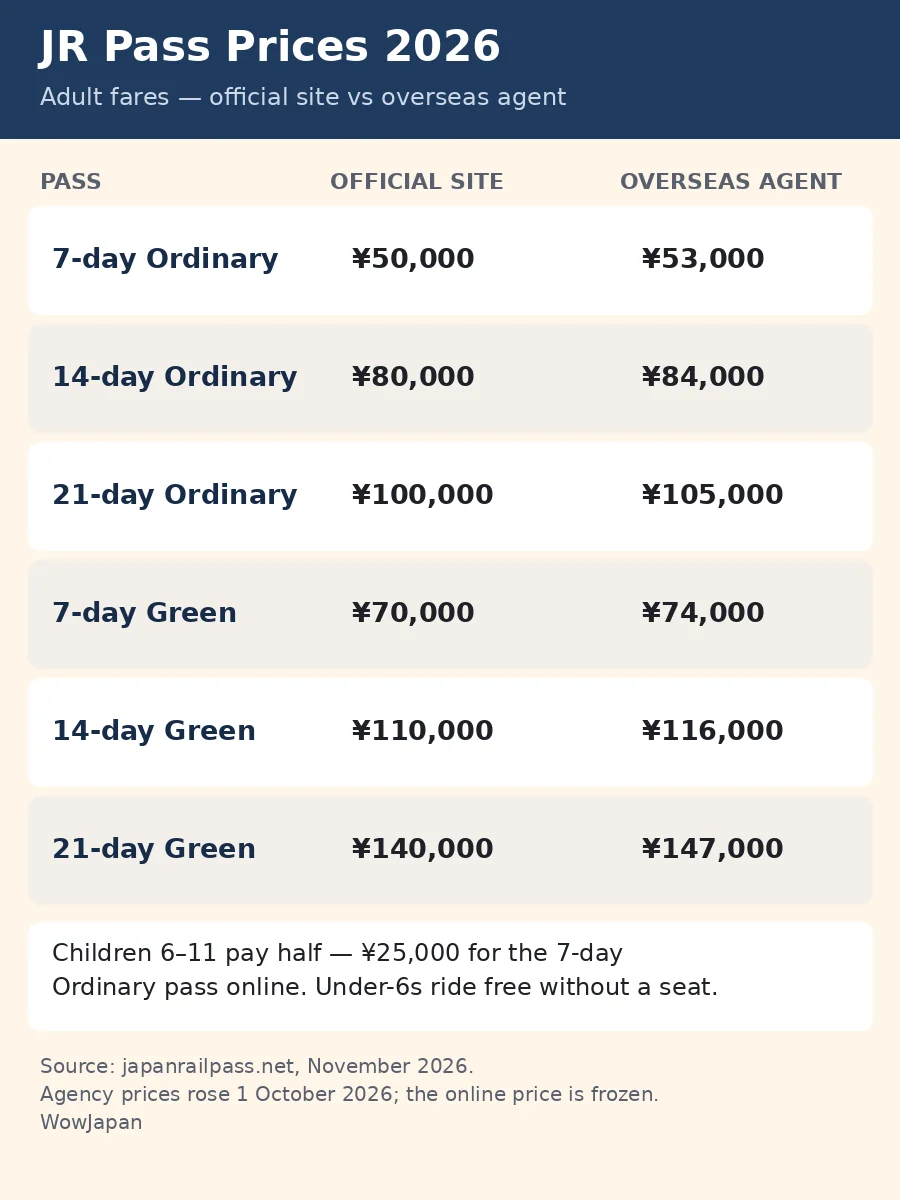
Six fares, two channels, one table. Buying direct saves ¥3,000 on the 7-day Ordinary pass.
Two prices exist because JR raised agency prices on 1 October 2026 while freezing the online price (JR East, 2026). No end date for the freeze has been published, so check the official site on the day you pay.
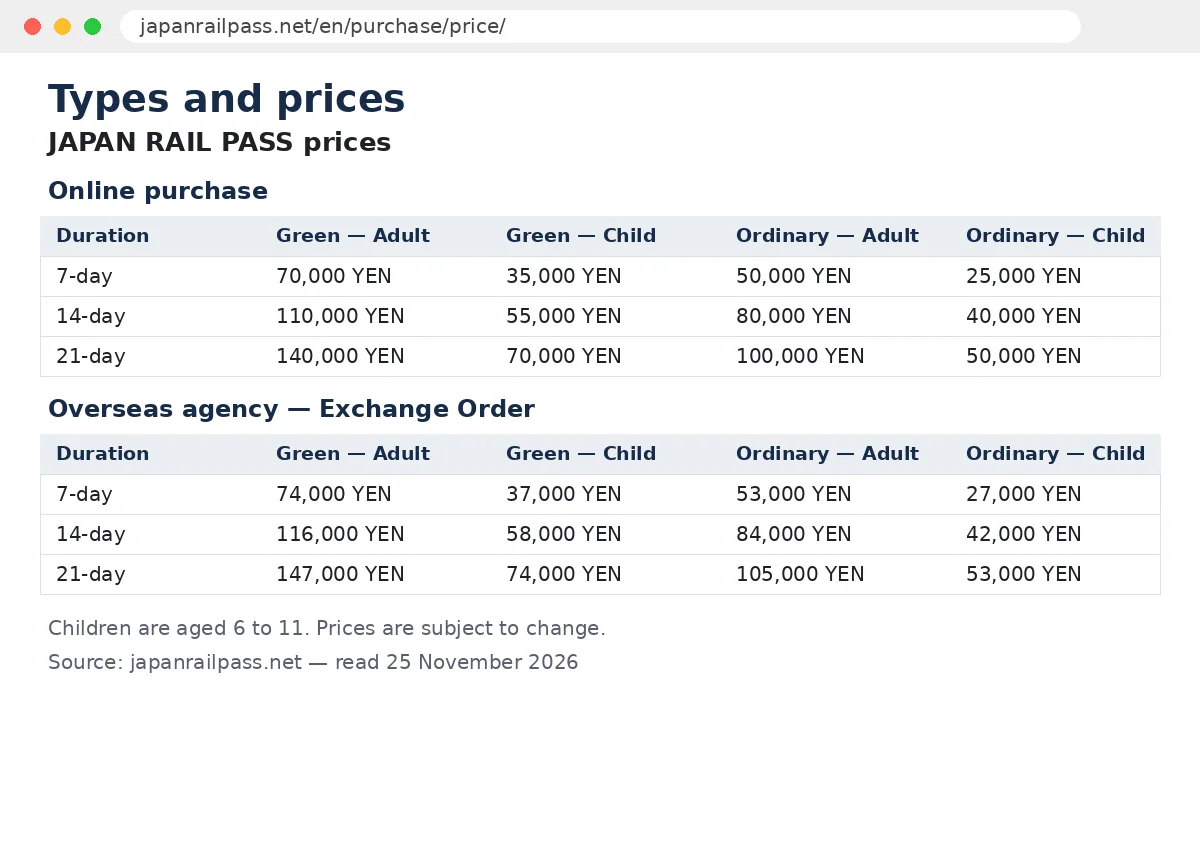
Both channels sit side by side on the official price page. Online is ¥50,000; the agent asks ¥53,000.
Half price applies to children aged 6 to 11: ¥25,000 for the 7-day Ordinary pass online (JR Group, 2026). Under-6s travel free when they share a seat with an adult.
All three durations run on consecutive days, starting on a date you choose at activation. Buy seven days for a 10-day trip and only seven of those days are covered.
The Break-Even Test: Five Itineraries, Priced
Your single tickets must add up past the pass price before it pays. Five routes below show the line clearly, using regular-season reserved seats.
| Itinerary | Singles | Pass | Result |
|---|---|---|---|
| Classic first trip: Tokyo–Kyoto return, Nara, Osaka | ¥30,940 | ¥50,000 | Loses ¥19,060 |
| Golden Route + Hiroshima | ¥50,240 | ¥50,000 | Wins ¥240 |
| Tokyo + Tohoku: Tokyo–Shin-Aomori return | ¥36,200 | ¥50,000 | Loses — take JR EAST PASS ¥35,000 |
| Hokuriku loop: Tokyo–Kanazawa–Osaka | ¥22,000–¥24,000 | ¥50,000 | Loses — Arch Pass ¥35,000 also loses |
| Kyushu loop: Hakata–Kagoshima return | ¥23,900 | ¥50,000 | Loses — All Kyushu 7-day ¥26,000 |
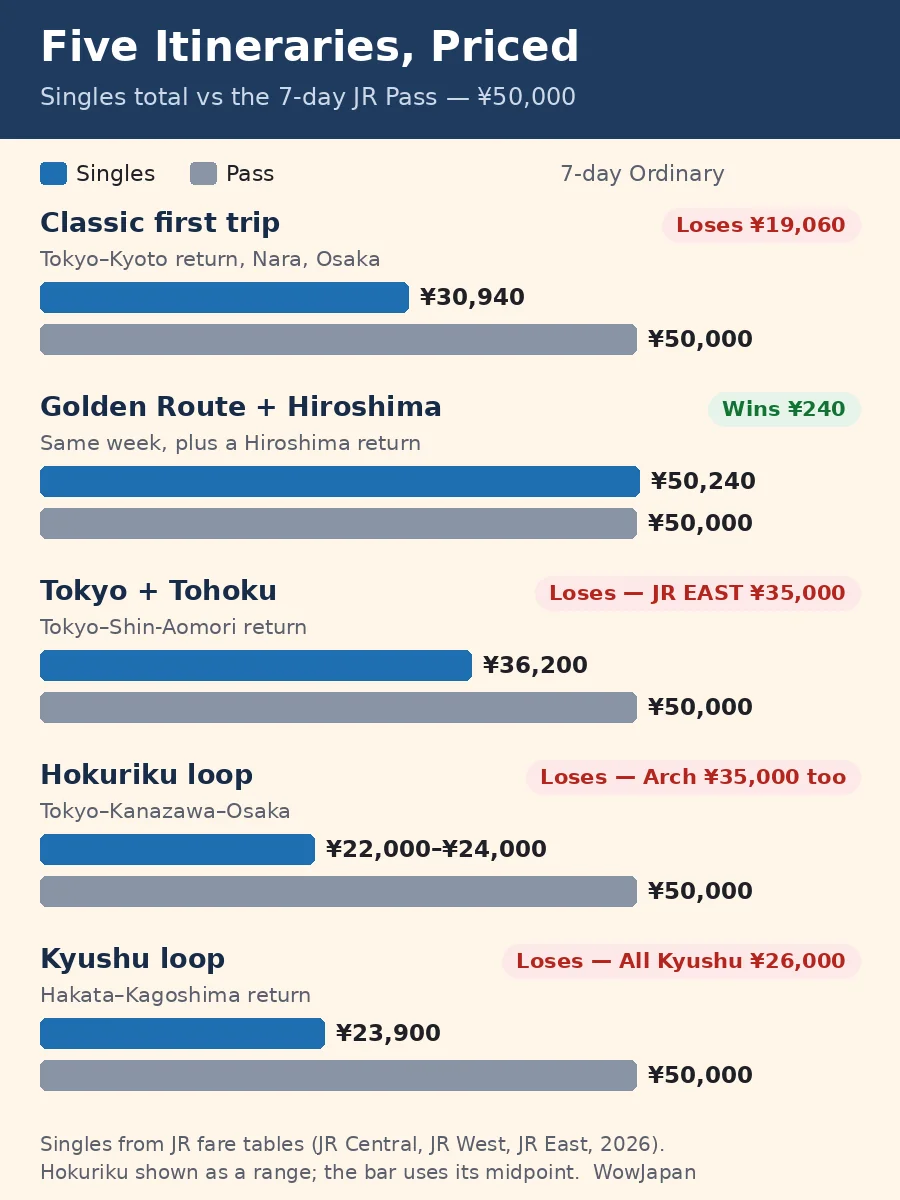
Five itineraries, priced against the ¥50,000 pass. Four lose; the Hiroshima leg wins by ¥240.
Add the day trips and the classic route totals ¥30,940. A Tokyo–Kyoto return runs ¥28,340, Nara ¥1,440 return, and Osaka ¥1,160 return (JR Central, 2026).
That leaves ¥19,060 of the pass unused, before a single local ride.
Add Hiroshima and the maths flips by a hair. From Shin-Osaka, a Hiroshima return runs about ¥21,900, lifting the same week to ¥50,240 — just ¥240 past the pass (JR West, 2026).
North beats the national pass differently. Head north and a Tokyo–Shin-Aomori return runs about ¥36,200, so the ¥35,000 JR EAST PASS wins where the ¥50,000 national pass loses (JR East, 2026).
Kanazawa changes nothing: the loop totals only about ¥22,000–¥24,000 in singles, so even the ¥35,000 Arch Pass loses (JR East, 2026). Kyushu tells the same story: a Hakata–Kagoshima return runs about ¥23,900, under the ¥26,000 All Kyushu pass (JR Kyushu, 2026).
Full prices for the whole week, hotels included, sit in the Japan trip cost 2026 guide. Day-by-day rail use for the classic route sits in the 7-day itinerary.
Regional Passes: Cheaper, and Usually Better
| Pass | Days | Price | Best for |
|---|---|---|---|
| JR EAST PASS | 5 / 10 | ¥35,000 / ¥50,000 | Tokyo + Tohoku, Nagano, Niigata |
| JR Tokyo Wide Pass | 3 | ¥16,000 | Nikko, Karuizawa, Fuji, Izu |
| Hokuriku Arch Pass | 7 | ¥35,000 | Tokyo–Kanazawa–Osaka via the north coast |
| Kansai WIDE Area Pass | 5 | ¥12,000 | Kansai day trips, Okayama, Kinosaki |
| Kansai-Hiroshima Area Pass | 5 | ¥17,000 | Kansai + Hiroshima, Miyajima ferry |
| Sanyo-San’in Area Pass | 7 | ¥23,000 | Osaka to Fukuoka, both coasts |
| All Kyushu Area Pass | 3 / 5 / 7 | ¥22,000 / ¥24,000 / ¥26,000 | Kyushu loop |
March 2026 reshuffled the regional shelf. JR East merged its Tohoku and Nagano–Niigata passes into one ¥35,000 pass on 14 March 2026 (JR East, 2026).
That same day, the Arch Pass rose from ¥30,000 to ¥35,000, yet old guides still quote the dead prices.
Any site offering a ¥30,000 Tohoku pass or a ¥27,000 Nagano pass sells a product that no longer exists (JR East, 2026).
For value, the Kansai WIDE pass stands out. At ¥12,000 for five days it covers the Sanyo Shinkansen to Okayama, and a Shin-Osaka–Okayama return alone runs about ¥12,900 (JR West, 2026).
Unlike the national pass, the Kansai WIDE pass includes Nozomi trains between Shin-Osaka and Okayama (JR West, 2026). Its Kansai-Hiroshima sibling extends that Nozomi cover all the way to Hiroshima.
How to Buy the Pass
Buy on the official site, japanrailpass.net, for the lower price. Overseas agents sell the same pass as an exchange order, which you swap for the pass after landing (JR Group, 2026).
Online buyers reserve shinkansen seats from one month before departure, before collecting the pass. Exchange counters sit in major stations and both Tokyo airports, and you need your passport with the temporary-visitor stamp (JR Group, 2026).
Only visitors with a temporary-visitor stamp can buy the pass. Residents of Japan, including long-term visa holders, cannot use it at all (JR Group, 2026).
Activation sets the clock running. Choose the start date when you exchange or collect the pass, and the 7, 14, or 21 consecutive days run from there.
The Nozomi Supplement, Explained
The fastest trains sit outside the pass: Nozomi and Mizuho need a special ticket on top of it, bought before boarding (JR Central, 2026).
From Tokyo or Shinagawa to Kyoto, the supplement runs ¥4,960 each way (JR Central, 2026). Ride Nozomi both ways and the week costs ¥59,920 — pass plus supplements — against ¥28,340 in singles.
Hikari and Kodama need no supplement and cost less per ride. Tokyo–Kyoto runs ¥13,850 by Hikari, against ¥14,170 by Nozomi, for about 25 minutes more (JR Central, 2026).
One more change sits on the calendar. JR Central and JR West announced a Nozomi reserved-seat rise for tickets bought from 1 July 2027, adding ¥700 on Tokyo–Shin-Osaka (JR Central, 2026).
Green Car: Worth the Extra ¥20,000?
Green Car means wider seats, fewer passengers per car, and more legroom. Green Car costs ¥70,000 online for seven days, ¥20,000 above Ordinary (JR Group, 2026).
On a first trip of short hops, the extra buys little. Save Green Car for long daily rides, or for travelers who value the quiet car above the saving.
The Verdict, by Trip Type
| Trip | Buy? |
|---|---|
| Classic Tokyo–Kyoto–Osaka week | No — pay per ride (¥30,940) |
| Golden Route + Hiroshima | Yes, barely — ¥50,240 vs ¥50,000 |
| Tokyo + Tohoku | JR EAST PASS, not national |
| Kansai base, day trips | Kansai WIDE ¥12,000 |
| Kyushu loop | All Kyushu pass |
| Two weeks, three regions | 14-day national ¥80,000 |
Count your long legs before you buy. Three or more shinkansen legs in seven days is the rough line where the pass starts to pay (JR Group, 2026).
Plan the route in the Japan trip for beginners guide before deciding on the pass.
Methodology
Every fare above comes from JR fare tables or the official pass site, checked in November 2026. Approximate figures carry the word “about”, and regional-pass prices follow the March 2026 revisions.
Fares move with the season and the exchange rate. Fares change, so confirm each figure on the official site before you pay.
Frequently Asked Questions
When does the JR Pass pay for itself in 2026?
Only on train-heavy routes. Singles for the classic week run ¥30,940, well under the ¥50,000 pass, while a Hiroshima leg flips it to a small win.
Where is the JR Pass cheapest?
On the official site, japanrailpass.net. The 7-day Ordinary pass costs ¥50,000 there, against ¥53,000 through an overseas agent since 1 October 2026 (JR Group, 2026).
Does the JR Pass cover the Nozomi?
No, not without a supplement. Neither rides free: Nozomi and Mizuho need a special ticket, ¥4,960 each way between Tokyo and Kyoto (JR Central, 2026).
Can I use the JR Pass on the Narita Express?
Yes, the Narita Express rides free on the pass (JR East, 2026). Keisei is a private railway, so the Skyliner stays outside the pass.
Do children need a JR Pass?
Ages 6 to 11 ride at half price, and under-6s ride free without a seat. Two adults and one child pay ¥125,000 online for three 7-day Ordinary passes (JR Group, 2026).
References
- Japan Rail Pass — Official Site
- Types and Prices — Japan Rail Pass
- Price Changes for the Japan Rail Pass — JR East
- Special ticket for NOZOMI with JAPAN RAIL PASS — JR Central
- N’EX (Narita Express) Tickets — JR East
- smartEX Service Prices (Reserved Seat in Ordinary Cars) — JR Central
- JR West — Official Site
- New Rail Passes for Inbound Visitors — JR East
- All Kyushu / Northern Kyushu / Southern Kyushu — JR Kyushu
1 thought on “JR Pass 2026: Prices, How to Buy, and Is It Still Worth It?”