Author: admin

  • Japan 7-Day Itinerary for First-Timers: Tokyo, Kyoto, Osaka

    Japan 7-Day Itinerary for First-Timers: Tokyo, Kyoto, Osaka

    Main image: AI illustration.

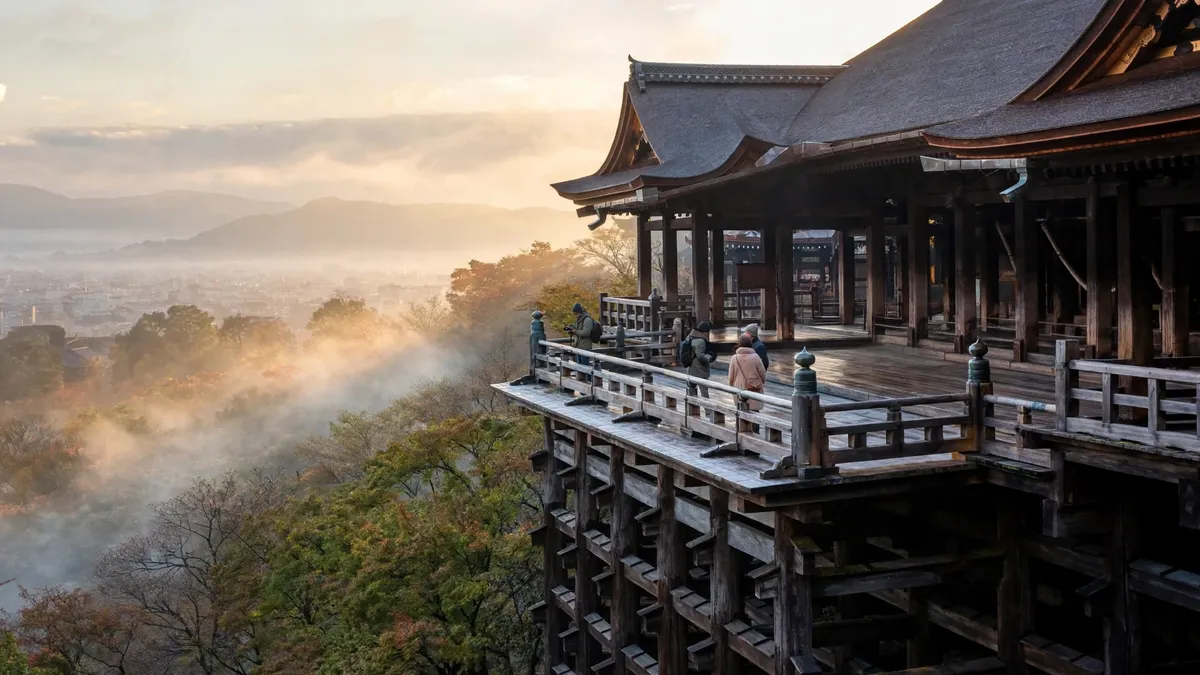
    Kyoto at 6:00 (Kiyomizu-dera, 2026) belongs to the temple sweepers and a handful of early risers. That quiet hour is where this itinerary earns its keep.

    Seven days, three cities, two hotel bases, and one rule: mornings belong to the sights, evenings belong to the streets.

    Everything below runs on trains and feet, with prices checked against the venues themselves in 2026. Start in Tokyo, move once to Kyoto, and let Osaka come to you as a day trip.

    Japan 7-Day Itinerary for First-Timers in Short

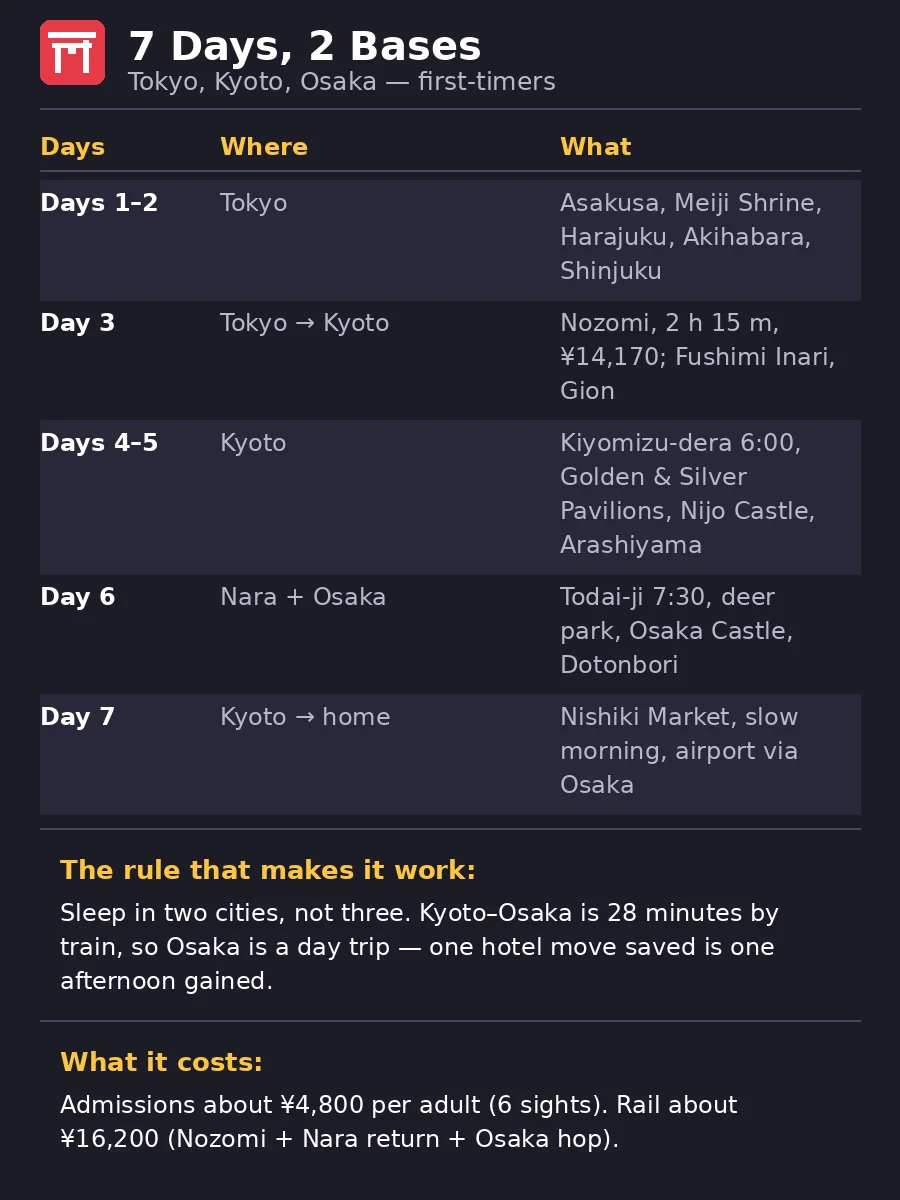
    • Days 1–2: Tokyo — Asakusa and Senso-ji, Meiji Shrine in Shibuya, Harajuku, Akihabara, and Shinjuku at night.
    • Day 3: Nozomi to Kyoto, about 2 hours 15 minutes (JR Central, 2026), Fushimi Inari in the afternoon, Gion after dark.
    • Days 4–5: Kyoto — Kiyomizu-dera at 6:00 (2026), the Golden and Silver Pavilions, Nijo Castle, and Arashiyama.
    • Days 6–7: Nara and Osaka as day trips from Kyoto, then a slow last morning before the airport.

    How Is This Itinerary Built?

    Two bases carry the whole week. Tokyo holds nights one and two, Kyoto holds nights three to six, and Osaka never gets a suitcase.

    Kyoto and Osaka sit about 28 minutes apart by train (JR West, 2026), so a Kyoto base covers both. Moving hotels for one Osaka night would cost an afternoon of packing for nothing.

    Mornings start at opening time, because the crowds arrive an hour later. Afternoons stay loose, so a missed train or a long lunch never breaks the day.

    Day 1: Tokyo — Arrive and Find Your Feet

    Land, drop your bags, and head for Asakusa in eastern Tokyo. Senso-ji, the city’s oldest temple, costs nothing to enter, and the Nakamise shopping street leads straight to its gate.

    Give the afternoon to the river and the old streets around the temple. Evening belongs to Shibuya, where the crossing outside the station moves more people than most towns hold.

    Day 2: Tokyo — Shrines, Streets, and Neon

    Morning starts at Meiji Shrine in Shibuya, Tokyo, under a forest canopy in the middle of the city. Its grounds open early and cost nothing, and the walk from Harajuku station sets the pace for the day.

    Harajuku follows, one stop of color after the shrine’s calm. Akihabara comes next for electronics and arcades, and Shinjuku closes the day with neon, ramen, and the city’s biggest station crowds.

    Ride the Yamanote line loop between the day’s stops and the city does the navigating for you. Stations sit beside every stop in this plan, and one IC card covers the trains, the subway, and the buses.

    Day 3: Tokyo to Kyoto — The Shinkansen Morning

    Check out after breakfast and walk to Tokyo Station for the shinkansen. A reserved Nozomi seat to Kyoto costs ¥14,170 in the regular season and takes about 2 hours 15 minutes (JR Central, 2026).

    Slower trains cost less and still arrive before lunch. The Hikari runs the same route for ¥13,850 in about 2 hours 40 minutes, and the Kodama takes about four hours (JR Central, 2026).

    Drop your bags in Kyoto and head straight for Fushimi Inari in the south of the city. Its vermilion gates run up the mountain for free, and the climb thins the crowds with every flight of steps.

    Evening belongs to Gion, the old entertainment district in eastern Kyoto. Walk its lanes after dark, keep your voice down on the residential streets, and leave the geiko spotting to luck.

    Day 4: Kyoto — The 6:00 Start

    Set an alarm for 5:30 and reach Kiyomizu-dera in eastern Kyoto as its gates open at 6:00. Admission is ¥500 for adults, and the wooden stage over the city is nearly empty at that hour (2026).

    Walk downhill through the old lanes of Sannenzaka and Ninenzaka toward the center. Kinkaku-ji, the Golden Pavilion in northwest Kyoto, opens at 9:00 and charges ¥500 for adults (2026).

    Cross the city to Ginkaku-ji, the Silver Pavilion at the north end of the Philosopher’s Path. Admission doubled to ¥1,000 on 1 April 2026, the first rise in 32 years, and the temple opens at 8:30 from March to November.

    Day 5: Kyoto — Castle Morning, Bamboo Afternoon

    Nijo Castle in central Kyoto opens the day, with its painted corridors and the Ninomaru Palace inside. Entry costs ¥800, or ¥1,300 with the palace, and the last admission is 16:00 (2026).

    Afternoon belongs to Arashiyama in western Kyoto and its bamboo grove. The grove itself is free, and the river walk below it makes the best slow hour of the week.

    End the day back in central Kyoto with dinner on Pontocho Alley, the narrow lane along the river. Restaurants there book out early, so arrive before the evening crowd or reserve ahead.

    Day 6: Nara in the Morning, Osaka in the Afternoon

    Catch the JR Miyakoji Rapid from Kyoto Station to Nara, about 45 minutes for ¥720 (JR West, 2026). Todai-ji opens at 7:30 from April to October, and its Great Buddha Hall charges ¥800 for adults (2026).

    Bring cash: each of Todai-ji’s four halls takes ¥800 (Todai-ji, 2026) and none takes cards. Nara Park outside is free, and its deer numbered 1,687 in the July 2026 census (Nara Deer Preservation Foundation, 2026), a record since 1953.

    Feed the deer only the official shika senbei crackers, about ¥200 a bundle (Time to Japan, 2026). Ride on to Osaka for the castle, then Dotonbori after dark, and catch the 28-minute train back to Kyoto to sleep (JR West, 2026).

    Osaka Castle’s Main Tower costs ¥1,200 for adults, double the ¥600 older guides still quote. Around it, the park is free and open at all hours, and the tower closes at 18:00 with last entry at 17:30 (2026).

    Day 7: Kyoto Morning, Then Home

    Keep the last morning slow. Nishiki Market in central Kyoto fills a relaxed hour of tasting, and Fushimi Inari waits for anyone who skipped it on day three.

    Leave Kyoto by early afternoon and ride to the airport through Osaka. One last look back at the mountains from the train window is the right way to end the week.

    What Does This Itinerary Cost?

    Add up the paid sights and the number stays small. Kiyomizu-dera, Kinkaku-ji, Ginkaku-ji, Nijo Castle, Todai-ji, and Osaka Castle together cost about ¥4,800 in admission fees for one adult.

    Rail legs add about ¥16,200: the Nozomi to Kyoto, the Nara return, and the Osaka hop. Full budgets for each style of travel sit in the Japan trip cost 2026 guide.

    Children pay less at every sight in this plan, and the youngest enter free at several of them.

    Seven days is short, and this plan spends them where they count. Early mornings go to the temples, slow afternoons to the old streets, and one bright night to each city.

    Pack light, start early, and let the trains do the rest. Before you book, check the Japan visa 2026 guide for entry rules and the Japan trip cost 2026 guide for budgets.
    Infographic: 7-day Japan itinerary, two bases, costs

    Methodology

    Every time, fee, and fare in this plan was checked against the venue or operator page, or against two independent 2026 guides. Opening hours and fees change with the season, so confirm each one on the official page before you go.

    An AI-assisted first draft was checked by hand against every source in References.

    Frequently Asked Questions

    Is 7 days enough for Tokyo, Kyoto, and Osaka?

    Yes, with two bases and early mornings. Tokyo takes two days, Kyoto takes three with Nara and Osaka as day trips, and the seventh day is a slow departure.

    Should I stay in Osaka too?

    No, unless your flight leaves very early. One Kyoto base covers both cities, and the 28-minute train saves a hotel move.

    Do I need the JR Pass for this itinerary?

    Probably not. Nozomi one-way fares run ¥14,170, and the local day trips are cheap, so add up your rides against the ¥50,000 pass (JR, 2026) before buying.

    What time should I start each day?

    At opening time for the big temples: 6:00 at Kiyomizu-dera, 7:30 at Todai-ji from April to October (2026). Afternoons can stay loose, because the crowds thin after 16:00.

    How much cash should I carry?

    More than you think. Todai-ji takes cash only, many temples take cash at the gate, and small restaurants and shrines often do too.

    References

  • Japan Visa 2026: Who Needs One, the New Fees, and How to Apply

    Japan Visa 2026: Who Needs One, the New Fees, and How to Apply

    Main image: AI illustration.

    A Japan visa in 2026 costs five times what it cost the year before, and most travelers still do not need one at all.

    That split — steep fees for some, no visa for most — is the whole story of the Japan visa 2026 rules. It rewards one habit above all: check your passport against the official list before you book anything.

    Japan Visa 2026 in Short

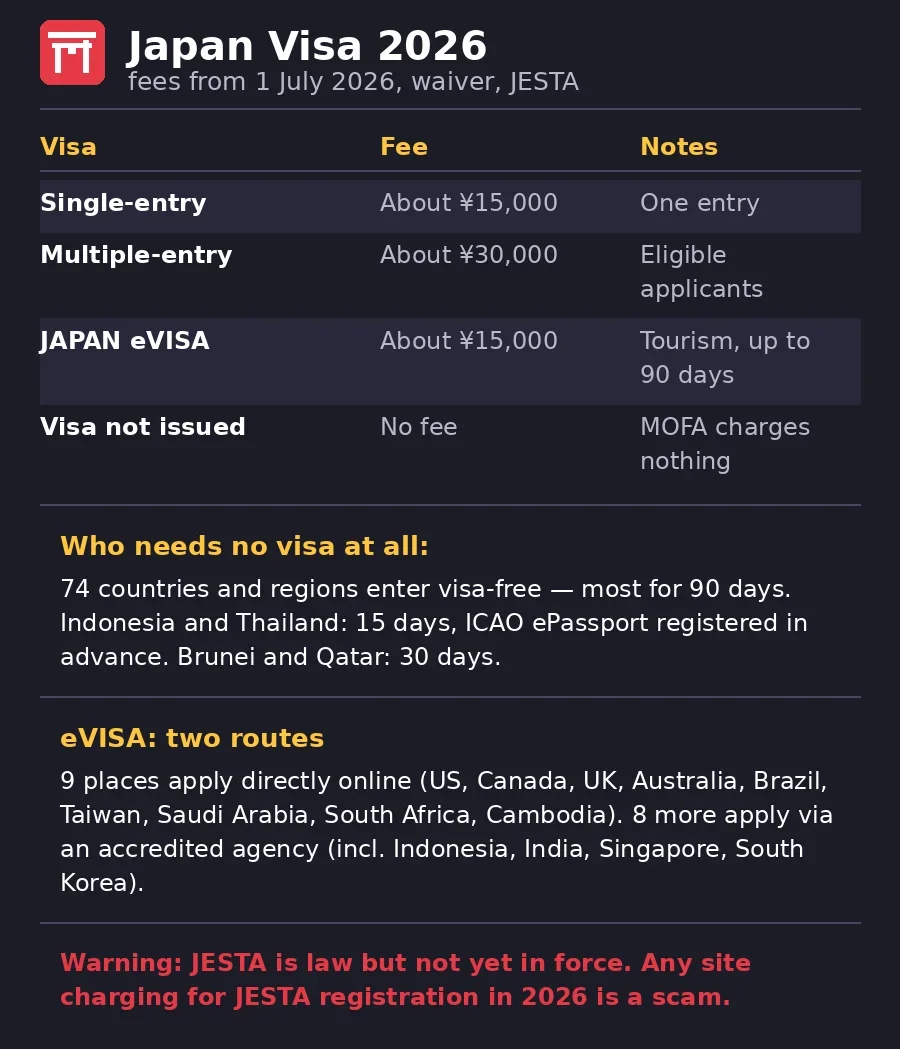
    • Single-entry visas cost about ¥15,000 and multiple-entry visas about ¥30,000 for applications accepted from 1 July 2026 (MOFA, 2026).
    • Citizens of 74 countries and regions enter visa-free, most for 90 days (MOFA, 2025).
    • JAPAN eVISA covers single-entry tourist visas of up to 90 days, applied for online (MOFA, 2026).
    • JESTA, the coming travel authorization for visa-free visitors, is law but not yet in force (Immigration Services Agency, 2026).

    Visa rules change without much warning. Check the MOFA list and your local Japanese embassy before you apply.

    Treat any fee quoted here as current only on the day you read it.

    Do You Need a Visa for Japan?

    Your passport decides the answer, not your destination. Japan grants visa-free entry to 74 countries and regions, and everyone else applies in advance (MOFA, 2025).

    Short stays cover tourism, business meetings, and visits to friends or relatives, up to 90 days for most passports (MOFA, 2025). Work of any kind needs a different visa, and this guide does not cover it.

    Three countries joined the visa-free list in 2025. Paraguay joined from 1 June, Peru from 1 July, and Montenegro from 1 September, each for ePassport holders (MOFA, 2025).

    If your passport is new to the list, confirm the ePassport condition before you travel.

    The 74 Visa-Free Countries

    Most travelers from the United States, Canada, the United Kingdom, Australia, and New Zealand land without a visa. Singapore, South Korea, and most of Europe join them, with 90 days on arrival (MOFA, 2025).

    Four passports get shorter stays, and the exceptions catch people out.

    PassportStay on arrivalCondition
    Most of the 74, including the US, Canada, UK, EU, Australia, New Zealand, Singapore, South Korea90 daysOrdinary passport
    Indonesia, Thailand15 daysICAO ePassport; Indonesia registers it in advance
    Brunei, Qatar30 daysQatar registers its ePassport in advance
    Brazil, Malaysia, UAE, Paraguay, Peru, Montenegro, Panama, Serbia90 daysICAO ePassport required

    Indonesia shows how the conditions work. Its citizens need an ICAO ePassport registered in advance at a Japanese mission in Indonesia (MOFA, 2025).

    Registration lasts three years or until the passport expires, whichever comes first. Qatar follows the same registered-passport rule for its 30 days.

    Germany, the United Kingdom, Ireland, Austria, Switzerland, Liechtenstein, and Mexico hold a quieter perk. Their agreements allow stays up to six months.

    Any stay past 90 days needs an extension from the Immigration Services Agency before day 90 ends (MOFA, 2025).

    What a Japan Visa Costs Now

    Fees changed on 1 July 2026, and the date that matters is the day your application is accepted. Applications accepted from that date cost about ¥15,000 for a single entry and about ¥30,000 for multiple entries (MOFA, 2026).

    Each embassy converts the yen amount into local currency, so the figure on your receipt moves with the exchange rate. MOFA charges nothing when a visa is not issued, and some nationalities pay less or nothing under reciprocal deals (MOFA, 2026).

    VisaFee from 1 July 2026Notes
    Single-entry tourist visaAbout ¥15,000Paid in local currency; valid for one entry
    Multiple-entry visaAbout ¥30,000For eligible applicants
    JAPAN eVISA, single-entryAbout ¥15,000Tourism only; up to 90 days
    Visa not issuedNo feeMOFA charges nothing when no visa is granted

    Fivefold sounds dramatic, and it is: the old fees were ¥3,000 and ¥6,000, unchanged since 1978 (MOFA, 2026). Travelers from visa-exempt countries pay nothing at all, which makes the waiver the cheapest document in travel.

    Infographic: Japan visa 2026 fees, waiver and JESTA at a glance

    How to Apply: eVISA or Embassy

    JAPAN eVISA handles single-entry tourist visas of up to 90 days, entirely online. Residents of nine places apply directly on the official portal (MOFA, 2026).

    Australia, Brazil, Cambodia, Canada, Saudi Arabia, South Africa, Taiwan, the United Kingdom, and the United States make the list.

    Eight more places of residence go through an accredited agency instead (MOFA, 2026). Hong Kong, India, Indonesia, Macau, Mongolia, South Korea, Singapore, and the United Arab Emirates make that list.

    South Korea’s Jeju consular district is the one exception inside that list.

    Expect about five working days after a complete application, though MOFA warns that extra checks can stretch the wait past a month (MOFA, 2026). Apply no earlier than three months before travel, and never pay through a lookalike site: the only portal is evisa.mofa.go.jp.

    Approval brings one more rule worth knowing. Travelers with an eVISA must display the “Visa issuance notice” online at the airport, and screenshots or printed copies are not accepted (MOFA, 2026).

    Paper applications still exist for every visa the eVISA does not cover. Visit the Japanese embassy or consulate for your place of residence, and confirm its document list first — requirements vary by mission (MOFA, 2026).

    Start with your passport: it must stay valid for your whole trip, and ePassport holders from several countries need the chip version (MOFA, 2025). Each mission publishes its own document list, so confirm it on the mission’s site before you gather papers (MOFA, 2026).

    JESTA: The Travel Authorization That Is Not Here Yet

    JESTA will one day ask visa-free travelers to register online before flying, much like the American ESTA. The law creating it passed Japan’s Diet on 29 May 2026, and the government plans to start it in fiscal 2028 (Immigration Services Agency, 2026).

    No final start date exists yet, and no traveler needs JESTA today. Treat any site charging for JESTA registration in 2026 as a scam, and check the Immigration Services Agency before your trip for the launch announcement.

    Visa-required travelers keep applying as they do now; the authorization is only for visa-free visitors.

    Before You Fly: Visit Japan Web

    Visit Japan Web, run by Japan’s Digital Agency, lets you complete immigration and customs forms online before landing. Paper forms still work, but the digital queue moves faster at Narita and Haneda (Digital Agency, 2026).

    Budget one more line: the departure tax. Japan’s International Tourist Tax rose from ¥1,000 to ¥3,000 on 1 July 2026 (JNTO, 2026).

    Airlines fold it into the ticket price, so most travelers never see it as a separate charge.

    The Decision: Check First, Book Second

    Start with the MOFA list, not with a flight search. A two-minute check of your passport against the 74 names settles the visa question.

    No fee bites when your passport is on the list.

    With the visa question settled, the money question follows. The Japan trip cost 2026 guide breaks down what seven days actually cost, and the 7-day itinerary turns those numbers into a route.

    Methodology

    Facts here come from MOFA’s visa pages, the JAPAN eVISA FAQ, JNTO’s tourist tax notice, and the Digital Agency, all read in November 2026.

    Fees and lists are quoted as published on those pages, with the check date in References.

    Prices in yen are the official figures; local-currency amounts move with the exchange rate.

    Nothing here comes from a visa agent, and no fee was paid to any source.

    An AI-assisted first draft was checked by hand against every source in References.

    Frequently Asked Questions

    Do I need a visa for Japan?

    It depends on your passport. Citizens of 74 countries and regions enter visa-free (MOFA, 2025), and everyone else applies in advance.

    How much does a Japan visa cost in 2026?

    About ¥15,000 for a single entry and about ¥30,000 for multiple entries, for applications accepted from 1 July 2026 (MOFA, 2026).

    Can I apply for a Japan visa online?

    Yes, through JAPAN eVISA, if you live in one of the nine direct-application countries or apply via an accredited agency (MOFA, 2026). Tourism is the only purpose the eVISA covers.

    What is JESTA, and do I need it?

    JESTA is Japan’s coming electronic travel authorization for visa-free visitors, passed into law in May 2026 but not yet in force (Immigration Services Agency, 2026). Nobody needs it for travel today.

    How long does a Japan visa take?

    About five working days after a complete application, though extra checks can stretch it past a month (MOFA, 2026). Earliest applications open three months before travel.

    References

  • Japan Trip Cost 2026: Flights, Hotels, JR Pass, and Food, Broken Down

    Japan Trip Cost 2026: Flights, Hotels, JR Pass, and Food, Broken Down

    Main image: AI illustration.

    Seven days in Japan costs less than most travelers fear, and more than the cheapest guides admit. One person needs about ¥60,000 on a careful backpacker budget, and ¥280,000 or more in comfort, before flights (Japan Tourism Agency, 2026).

    Flights swing the total more than any other line. Route, season, and sleep style decide the rest, so this guide prices each part on its own.

    Japan Trip Cost 2026 in Short

    The ranges below come from 2026 travel guides and the Japan Tourism Agency (2026).

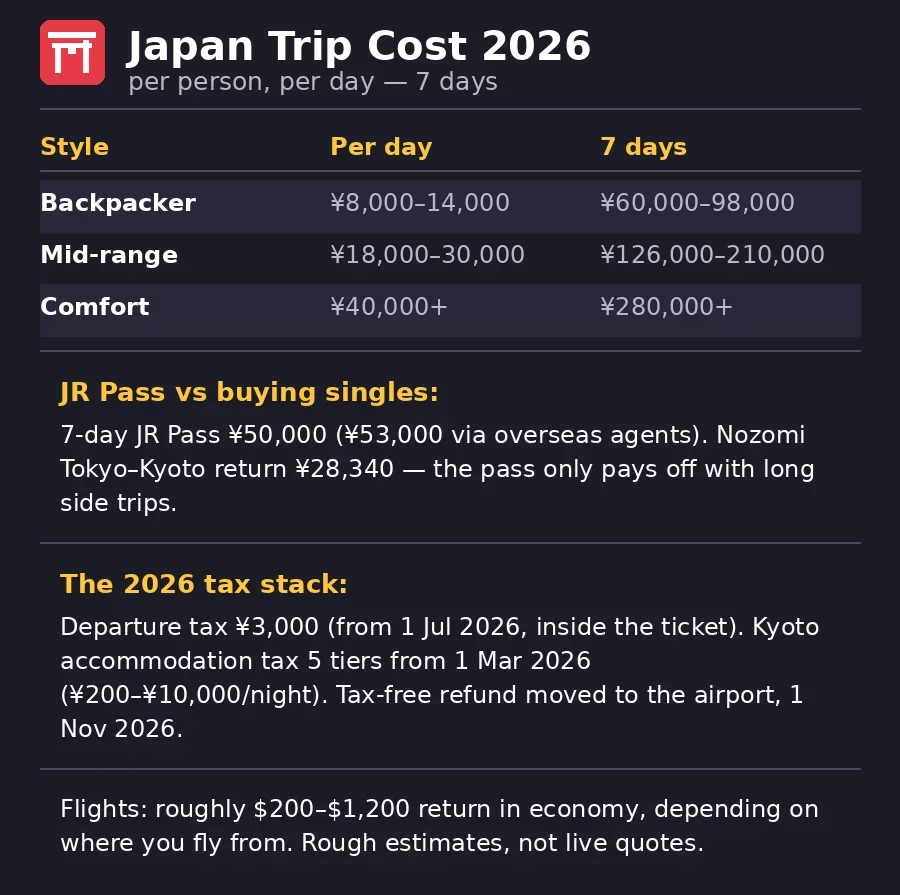
    • Backpacker: about ¥8,000–¥14,000 a day, or ¥60,000–¥98,000 for seven days, before flights.
    • Mid-range: about ¥18,000–¥30,000 a day, or ¥126,000–¥210,000 for seven days, before flights.
    • Comfort: ¥40,000 a day and up, or ¥280,000 and more for seven days, before flights.
    • The JR Pass pays off only on heavy rail weeks; a Tokyo–Kyoto return alone costs less than the pass.
    • Flights: roughly $200–$1,200 return in economy, depending on where you fly from.

    What Does a 7-Day Japan Trip Cost in Total?

    This table turns the summary ranges into per-day and 7-day totals (Japan Tourism Agency, 2026).

    StylePer day7 daysWho it fits
    Backpacker¥8,000–¥14,000¥60,000–¥98,000Hostels, konbini meals, city passes
    Mid-range¥18,000–¥30,000¥126,000–¥210,000Business hotels, sit-down meals, some trains
    Comfort¥40,000+¥280,000+Central hotels, fine dining, Green Car

    These ranges come from 2026 Japan travel guides that agree with each other, and the Japan Tourism Agency reports a similar scale. Foreign visitors spent about ¥244,457 per stay on average in April to June 2026, over stays averaging 8.7 nights (Japan Tourism Agency, 2026).

    That average covers trips of many lengths, so treat it as a sanity check. Your own total depends on how many nights you sleep in Tokyo and Kyoto, where rooms cost the most.

    Infographic: Japan trip cost 2026 daily budgets, JR Pass and taxes

    How Much Do Flights to Japan Cost?

    Fares swing the total more than any other line, so here are rough 2026 estimates (Tokyo Tourism, 2026). Treat them as planning figures, not quotes, and check live prices before you book.

    FromRough return fare, economy
    Southeast Asia$200–$450
    AustraliaAUD 900–1,400
    United Kingdom£430–£700
    Continental Europe€500–€800
    United States$650–$1,200

    These are typical good fares for round trips in economy (Tokyo Tourism, 2026). From Jakarta, low-cost one-stop returns run about Rp6–8 million, while direct full-service flights start near Rp10.5 million (Japan Travel Dreams, 2026).

    Three habits keep fares down. Book early, fly midweek, and compare the shoulder seasons — late autumn and late winter — against cherry blossom week and Golden Week.

    Arrive through Tokyo or Osaka, the two hubs with the most competition. Smaller airports can look cheaper until the domestic connection is added.

    Where Should You Sleep, and What Does It Cost?

    Sleep is the second-biggest line after flights, and the gap between choices is wide. Hostel dorm beds run ¥3,500–¥5,000 a night in 2026, while a business hotel room runs ¥9,000–¥15,000 (TravelDojo, 2026).

    Tokyo and Kyoto rooms cost more: the same business hotel room runs about ¥12,000–¥22,000 a night. Choose a room near a JR station and the saved taxi fares often cover the premium.

    Capsule hotels and hostels suit solo travelers who spend the day outside. Families and couples usually get better value from a business hotel room shared between two.

    Kyoto’s rooms carry a tax on top of the rate. Since 1 March 2026, the city charges ¥200 a night for rooms under ¥6,000 (City of Kyoto, 2026).

    Top tiers reach ¥10,000 a night for rooms over ¥100,000 (City of Kyoto, 2026).

    Is the JR Pass Worth It in 2026?

    Most 2026 guides quote one JR Pass price, and most of them are wrong. Two prices now exist: ¥50,000 on the official site, and ¥53,000 through overseas agents (JR Group, 2026).

    Agency prices rose on 1 October 2026, while the online price stays frozen for a limited time (JR Group, 2026). JR has not published an end date for the freeze, so check the official site before you buy.

    PassOnline (official site)Overseas agent
    7-day Ordinary¥50,000¥53,000
    14-day Ordinary¥80,000¥84,000
    21-day Ordinary¥100,000¥105,000
    7-day Green¥70,000¥74,000

    Children aged 6 to 11 pay half price (JR Group, 2026). Run the arithmetic below to see when the pass pays for itself — and when it does not.

    Take the classic first-timer route: Tokyo to Kyoto and back on the Nozomi. Reserved seats cost ¥14,170 each way in the regular season, so the return runs ¥28,340 (JR Central, 2026).

    That is ¥21,660 short of the ¥50,000 pass, before any other ride. Add a Kyoto day trip to Nara (¥720 each way) and the Osaka hop (¥580 each way), and the pass still loses (JR Central, 2026).

    Longer routes flip the result. With a Tokyo–Kyoto–Hiroshima week, or daily long rides, the same ¥50,000 turns into a saving instead of a cost.

    One more charge hides inside the pass. Riding the fastest Nozomi or Mizuho trains with a pass needs a supplement.

    Each way costs ¥4,960 between Tokyo or Shinagawa and Kyoto (JR Central, 2026).

    What Does Food Cost in Japan?

    Food is where Japan surprises first-timers twice: once with the quality, once with the price. Ramen costs ¥1,000–¥1,300 a bowl, and a beef bowl runs ¥500–¥700 (TravelDojo, 2026).

    Convenience stores fill the gaps between meals. An onigiri rice ball costs ¥130–¥200, and a full konbini lunch stays under ¥1,000 for most travelers (TravelDojo, 2026).

    Dinner costs the most, and the range is wide. Izakaya evenings run ¥3,000–¥5,000 per person, while a sit-down restaurant meal lands between that and fine dining (TravelDojo, 2026).

    Konbini and noodle meals, three a day, add up to about ¥3,000 (TravelDojo, 2026). Relaxed days of sit-down meals land near ¥6,000, and water is free at most restaurants.

    What Do Sights and City Transport Cost?

    Venue fees below are from the official venue pages and 2026 guides (2026).

    Temples and castles are cheap by world standards, and one famous shrine costs nothing at all. Fushimi Inari in Kyoto is free, while Kinkaku-ji and Kiyomizu-dera each charge ¥500 (2026).

    Two 2026 fee changes catch repeat visitors out. Ginkaku-ji doubled to ¥1,000 on 1 April 2026, and Nijo Castle charges ¥800, or ¥1,300 with the Ninomaru Palace.

    In Nara, Todai-ji charges ¥800 for the Great Buddha Hall, and each of its four halls takes cash only (2026).

    In Osaka, the castle tower costs ¥1,200, double the ¥600 older guides still quote (2025).

    Its surrounding park is free and open at all hours.

    City transport is a small line, and day passes shrink it further. City buses cost a flat ¥230 a ride, and the Kyoto Subway and Bus 1-day pass costs ¥1,100 (2026).

    Day trips between cities stay cheap on local trains. Osaka runs ¥580 from Kyoto on the JR Special Rapid in about 28 minutes, and Nara runs ¥720 in about 45 minutes (JR West, 2026).

    What Hidden Taxes and Fees Should You Budget?

    Three 2026 changes sit outside the daily budget, and all three are easy to miss. All three take a little more than last year: the departure tax, the Kyoto room tax, and the new tax-free shopping system.

    Japan’s International Tourist Tax rose from ¥1,000 to ¥3,000 on 1 July 2026 (JNTO, 2026). Airlines fold it into the ticket, so you will not see it as a separate charge.

    Kyoto’s accommodation tax started on 1 March 2026 and scales with the room price (City of Kyoto, 2026). Budget ¥200 a night at the cheapest rooms, and up to ¥1,000 a night in the middle tiers (City of Kyoto, 2026).

    Tax-free shopping changed on 1 November 2026 (JNTO, 2026). Visitors now claim the refund at the airport instead of at the shop, so keep your receipts until departure.

    How Can You Cut the Cost Without Cutting the Trip?

    Sleep in two cities, not three. Kyoto and Osaka sit 28 minutes apart by train, so one Kyoto base covers both and saves a hotel move.

    Eat where office workers eat. Station noodle shops and department-store basements serve the same quality as tourist streets at half the price.

    Walk the free sights early and pay for one big ticket a day. Fushimi Inari, the Nara deer park, and riverside walks cost nothing, and they fill a morning well.

    Buy the JR Pass only after doing the arithmetic above. The wrong pass is the most expensive souvenir of the trip.

    A Note on Prices

    Prices in this guide come from official sources and 2026 travel guides, and they move with the season and the exchange rate. Check the official JR and venue sites before you book, and treat every figure here as a planning estimate.

    Seven days in Japan rewards the traveler who prices the trip before booking it. Pick your tier, do the rail arithmetic, and spend the savings on one meal you will remember.

    Your next step is the route itself. Next, the 7-day itinerary turns these numbers into a day-by-day plan, and the Japan visa 2026 guide checks whether you need a visa first.

    Methodology

    Every price in this guide was checked against an official source or against at least two independent 2026 travel guides. Flight figures are rough 2026 estimates by origin region, not live quotes, so check live fares before you book.

    An AI-assisted first draft was checked by hand against every source in References.

    Frequently Asked Questions

    How much does a 7-day Japan trip cost in 2026?

    About ¥60,000–¥98,000 for a backpacker, ¥126,000–¥210,000 mid-range, and ¥280,000 or more in comfort (Japan Tourism Agency, 2026). Airfares sit on top of those figures, roughly $200–$1,200 return in economy by origin (Tokyo Tourism, 2026), and Tokyo and Kyoto rooms cost the most.

    Is the JR Pass worth it for a first trip?

    Only when your route includes several long rides. Tokyo–Kyoto returns cost ¥28,340 (JR Central, 2026), well under the ¥50,000 pass, so a Hiroshima leg or daily long rides must fill the gap.

    How much should I budget for food per day?

    About ¥3,000 a day for konbini and noodle meals (TravelDojo, 2026), and near ¥6,000 for relaxed sit-down eating. Ramen bowls run ¥1,000–¥1,300, and an izakaya dinner runs ¥3,000–¥5,000 per person (TravelDojo, 2026).

    What is the cheapest way to travel between Tokyo, Kyoto, and Osaka?

    Book the shinkansen early through SmartEX for the Tokyo–Kyoto leg, and use local JR trains between Kyoto and Osaka. Kyoto–Osaka takes 28 minutes on the JR Special Rapid, for ¥580 (JR West, 2026).

    Are there any hidden costs I should know about?

    Yes, three. Departure tax now runs ¥3,000 (JNTO, 2026), and Kyoto charges an accommodation tax from ¥200 a night (City of Kyoto, 2026).

    Refunds moved to the airport in November 2026 (JNTO, 2026).

    References