
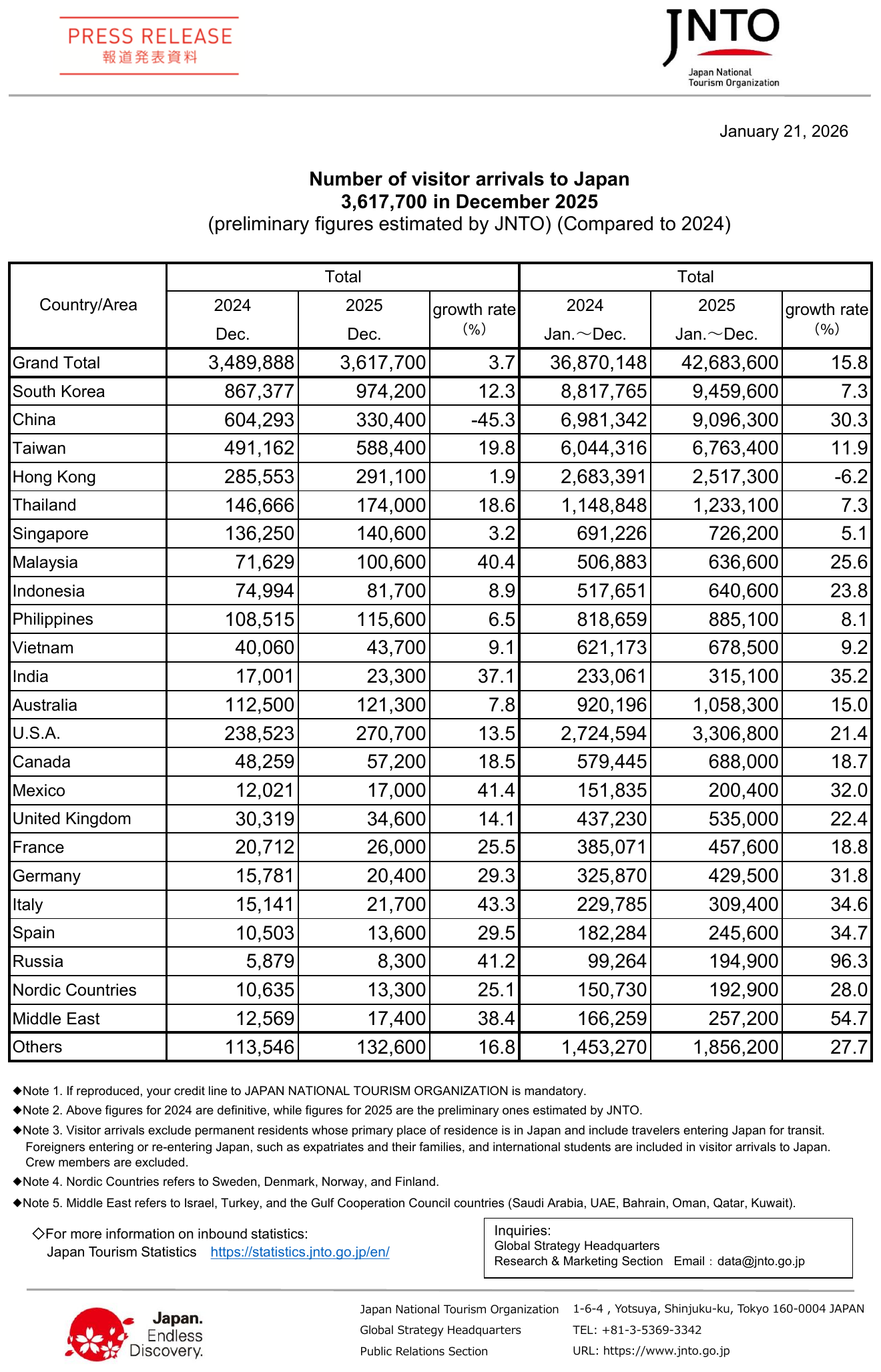
In 2025, Japan received 42,683,600 foreign visitors — the largest total ever recorded (JNTO, 2026). Most of them were first-timers, and most of them made the same three decisions: when to go, how much to spend, and where to sleep.
This guide answers those three decisions in order, with 2026 prices and official sources. It assumes seven days, two hotel bases, and no Japanese.
Japan Trip for Beginners in Short
- Passport holders from 74 countries and regions skip the visa queue, most for 90 days (MOFA, 2026).
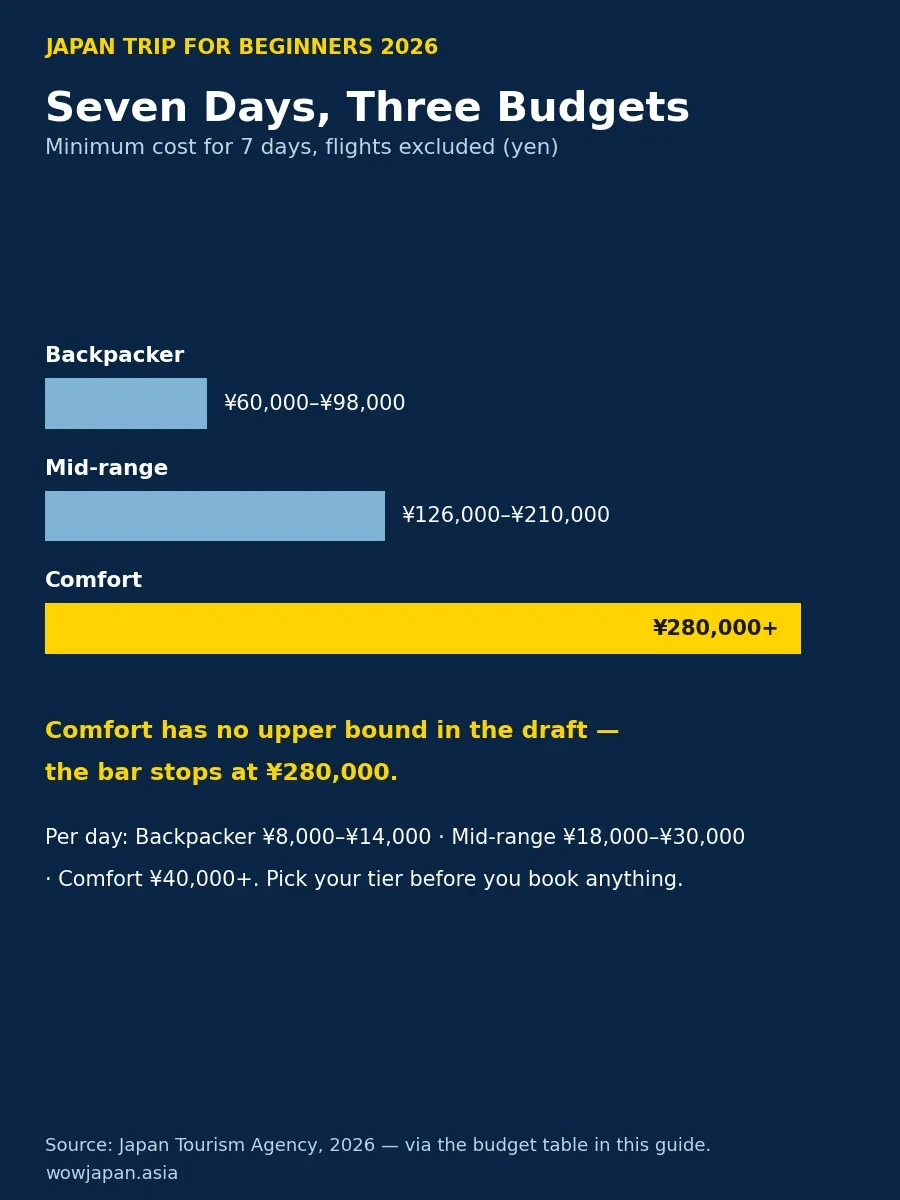
- Plan on about ¥60,000 for a careful week and ¥280,000-plus for comfort, flights excluded (Japan Tourism Agency, 2026).
- Two bases carry the week: Tokyo for two nights, Kyoto for four, with Osaka and Nara as day trips.
- Heavy rail weeks alone justify the JR Pass; one Tokyo–Kyoto return still costs less than the pass.
- Late March to early April brings cherry blossoms, late November brings autumn leaves, and Golden Week brings crowds to avoid.
Why Two Bases Beat Three
First-timers often book three hotels: Tokyo, Kyoto, and Osaka. That third move costs half a day of packing, checking out, and finding a new room.
Osaka sits about 28 minutes from Kyoto by train (JR West, 2026). One base in Kyoto covers both cities, freeing the saved afternoon for a temple instead of a suitcase.
Flights land in the capital first, so Tokyo holds the opening two nights. Kyoto holds the last four because the old capital rewards slow mornings.
Nara joins as a morning day trip from Kyoto, about 45 minutes each way (JR West, 2026). Osaka follows in the same pattern, an afternoon and an evening.
Do You Need a Visa?
Your passport settles the visa question, not the destination. Japan admits passport holders from 74 countries and regions without a visa, most for 90 days (MOFA, 2026).
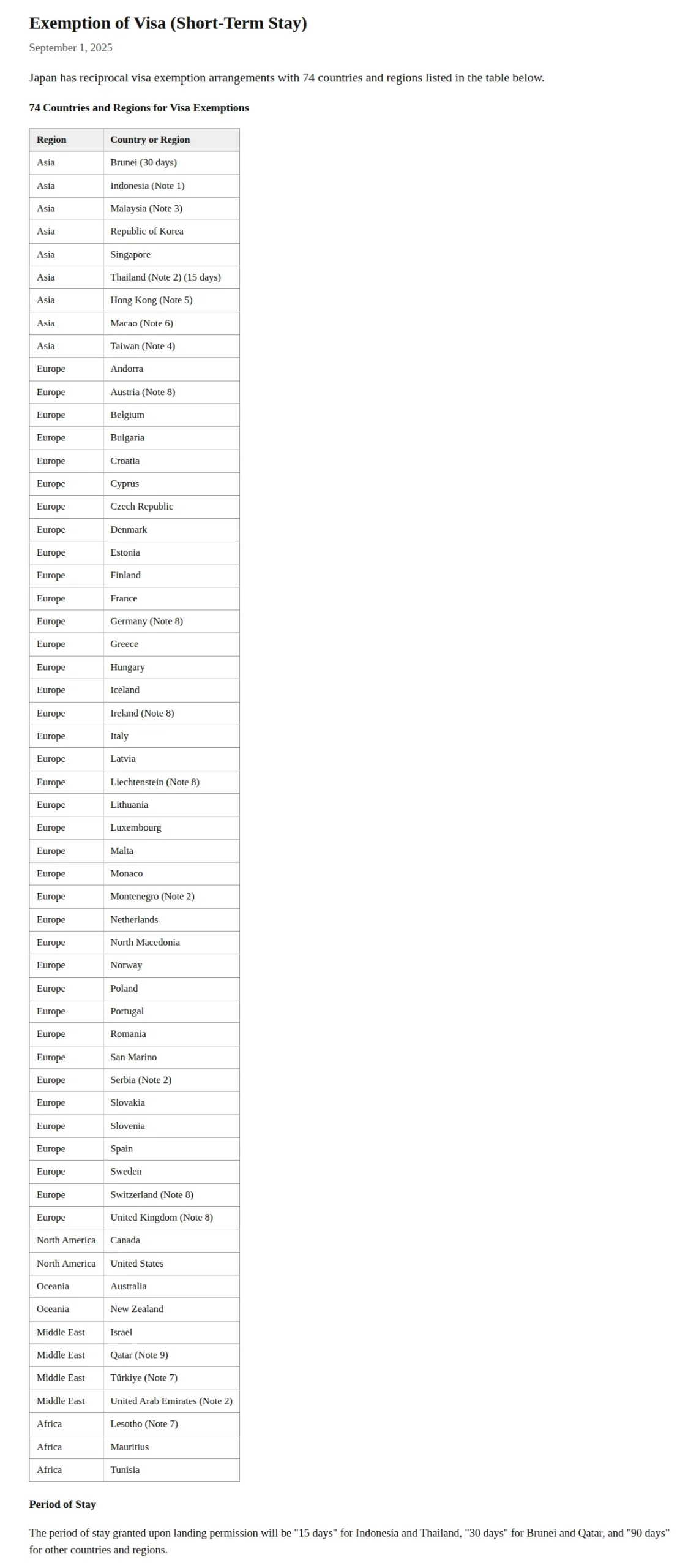
Visitors from the United States, Canada, Britain, Singapore, South Korea, Australia, New Zealand, and most of Europe arrive without a visa. Indonesia and Thailand get 15 days on an ICAO ePassport, registered in advance (MOFA, 2025).
Everyone else applies in advance, online or at an embassy. Single-entry visas run about ¥15,000; multiple-entry visas run about ¥30,000, at the fees in force since 1 July 2026 (MOFA, 2026).
Those fees are five times the old ones, unchanged since 1978 (MOFA, 2026). Visa-free entry costs nothing at all — the waiver beats every other travel document on price.
Tourist visas of up to 90 days, single-entry, run through JAPAN eVISA, entirely online (MOFA, 2026). Nine places let residents apply directly on the official portal, among them the United States and Canada, Britain, and Australia.
JESTA already stands as law for visa-free visitors, though enforcement still waits (Immigration Services Agency, 2026). Nobody needs JESTA today, and any site charging for registration in 2026 is a scam.
Entry rules shift with little warning. For the full list of 74 countries, the eVISA steps, and the JESTA timeline, see the Japan visa 2026 guide.
Before you fly, complete immigration and customs on Visit Japan Web. Paper forms still work, yet at Narita and Haneda the digital queue moves faster (Digital Agency, 2026).
When to Go: Pick Your Season First
Season decides the trip more than any other choice. Japan runs on four sharp seasons, and each one changes prices, crowds, and what you see.
Cherry blossom season peaks in late March and early April. Tokyo reaches full bloom around 27 March 2026, and Kyoto follows around 1 April (Japan Meteorological Corporation, 2026).
Across Tokyo, Kyoto, and Osaka, the safest single window for full bloom runs roughly 29 March to 7 April (Japan Meteorological Corporation, 2026). Forecasts shift with the weather, so check the latest one as your dates approach.
Golden Week follows the blossoms, and first-timers should avoid it. In 2026, the holiday cluster runs from 29 April to 6 May, and domestic travel fills every train and hotel (Japan Travel, 2026).
Summer brings heat, humidity, and rain, with the rainy season in June and early July. Autumn answers with the year’s calmest light: Kyoto’s maples peak from late November into early December (Japan Real Guide, 2026).
For autumn leaves in Kyoto and Tokyo together, the safest window runs roughly 20 November to 3 December (Japan Real Guide, 2026). Winter turns cold and dry, with thin crowds and clear skies.
| Season | What you get | What you pay |
|---|---|---|
| Late March–early April | Cherry blossoms at full bloom | Highest hotel rates of spring |
| Late April–early May | Golden Week holidays | Crowds and prices peak — avoid |
| June–July | Green hills, fewer visitors | Rain and humidity |
| Late November–early December | Autumn leaves, calm light | Moderate rates, cool evenings |
| December–February | Clear skies, thin crowds | Cold mornings, short days |
Pick late March or late November when you can. Both windows reward the early riser and punish the late booker.
How Much Does a First Trip Cost?
Your first week here comes in under what most travelers fear, yet above what the cheapest guides admit. Budget ¥60,000 for a careful backpacker week, or ¥280,000-plus in comfort, flights excluded (Japan Tourism Agency, 2026).
| Style | Per day | 7 days | Who it fits |
|---|---|---|---|
| Backpacker | ¥8,000–¥14,000 | ¥60,000–¥98,000 | Hostels, konbini meals, city passes |
| Mid-range | ¥18,000–¥30,000 | ¥126,000–¥210,000 | Business hotels, sit-down meals, some trains |
| Comfort | ¥40,000+ | ¥280,000+ | Central hotels, fine dining, Green Car |
Per stay, visitors spent about ¥244,457 in April to June 2026, over 8.7 nights on average (Japan Tourism Agency, 2026). Trips of many lengths sit behind that average — use it only as a rough guide.
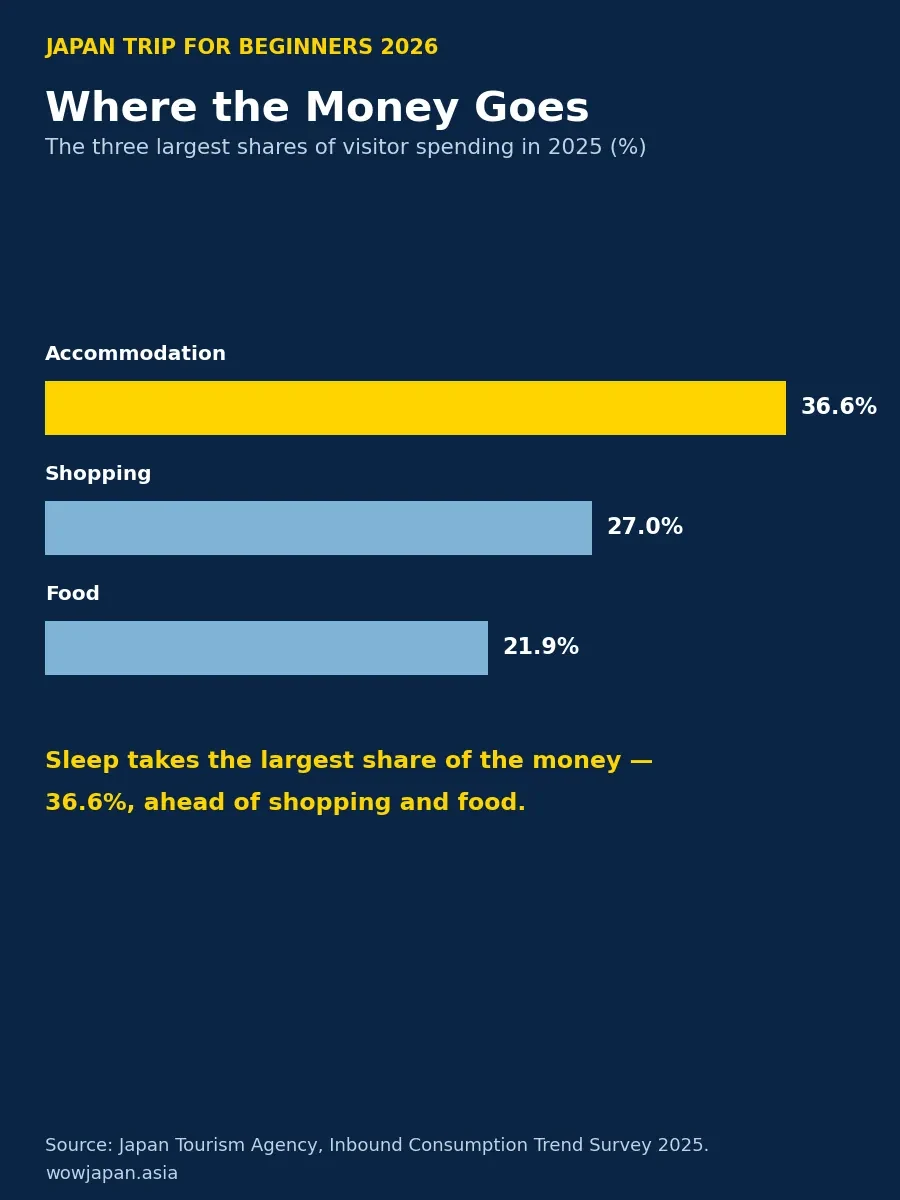
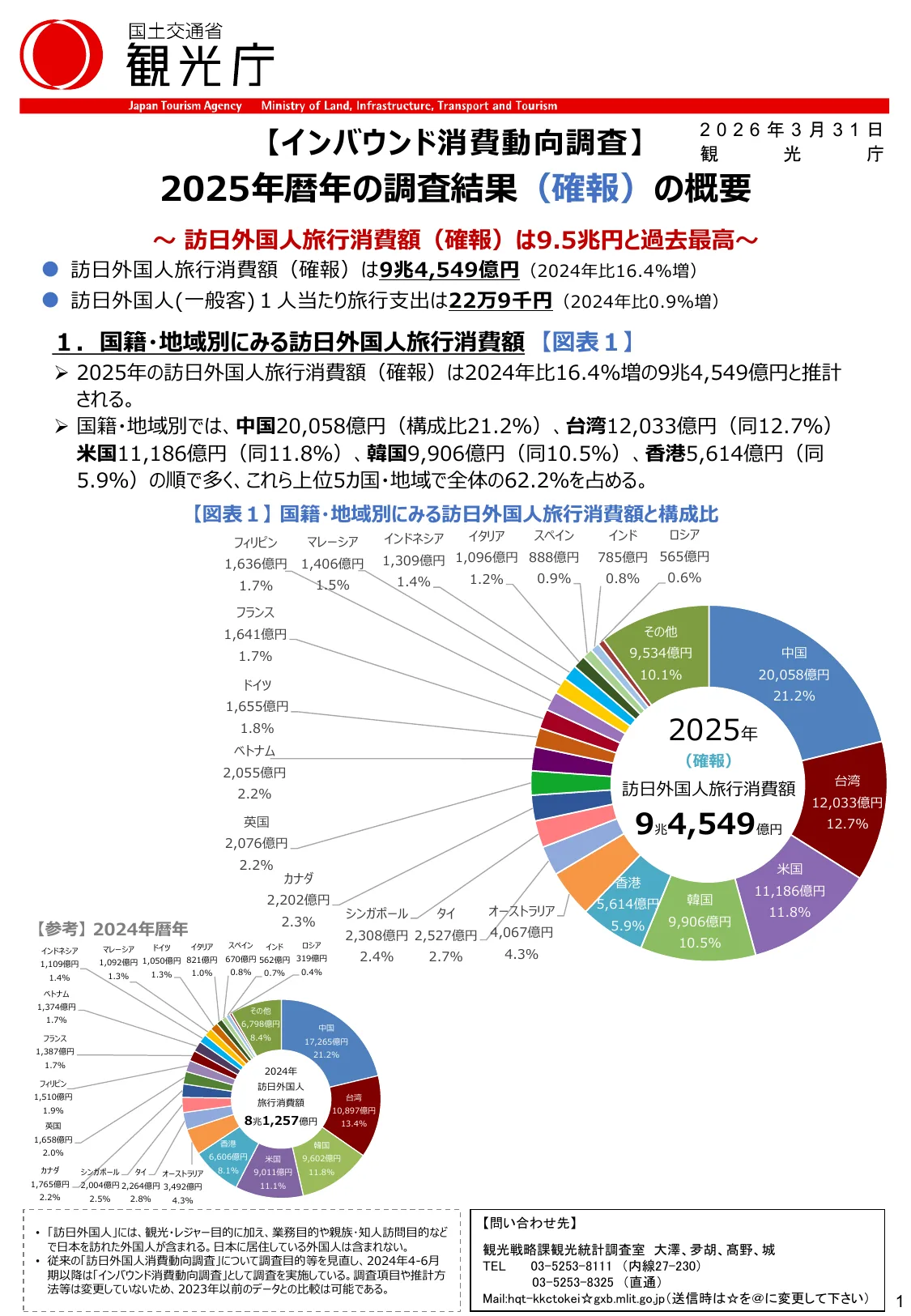
Sleep takes the largest share of the money. Accommodation took 36.6% of all visitor spending in 2025, ahead of shopping at 27.0% and food at 21.9% (Japan Tourism Agency, 2026).
No other line shifts the total as much as flights. Return economy fares run roughly $200–$1,200, depending on where you fly from (Tokyo Tourism, 2026).
Early booking and midweek flights beat peak prices — compare the shoulder seasons with cherry blossom week, then Golden Week. Land in Tokyo or Osaka — the hubs where fares compete hardest.
Price tables in full, flight ranges by origin, and JR Pass arithmetic all live in the Japan trip cost 2026 guide. Choose your tier there before you book anything.
Where to Sleep: Tokyo and Kyoto Hold the Nights
Japanese accommodation recorded 179,922,130 foreign guest nights in 2025, 9.4% more than 2024 (Japan Tourism Agency, 2026). Together, Osaka, Kyoto, and Tokyo held 57.2% of those nights.
Alone, Tokyo took 60,115,730 of the foreign guest nights — about one in three nationwide (Japan Tourism Agency, 2026). Next came Osaka with 24,517,740, then Kyoto with 18,291,230.
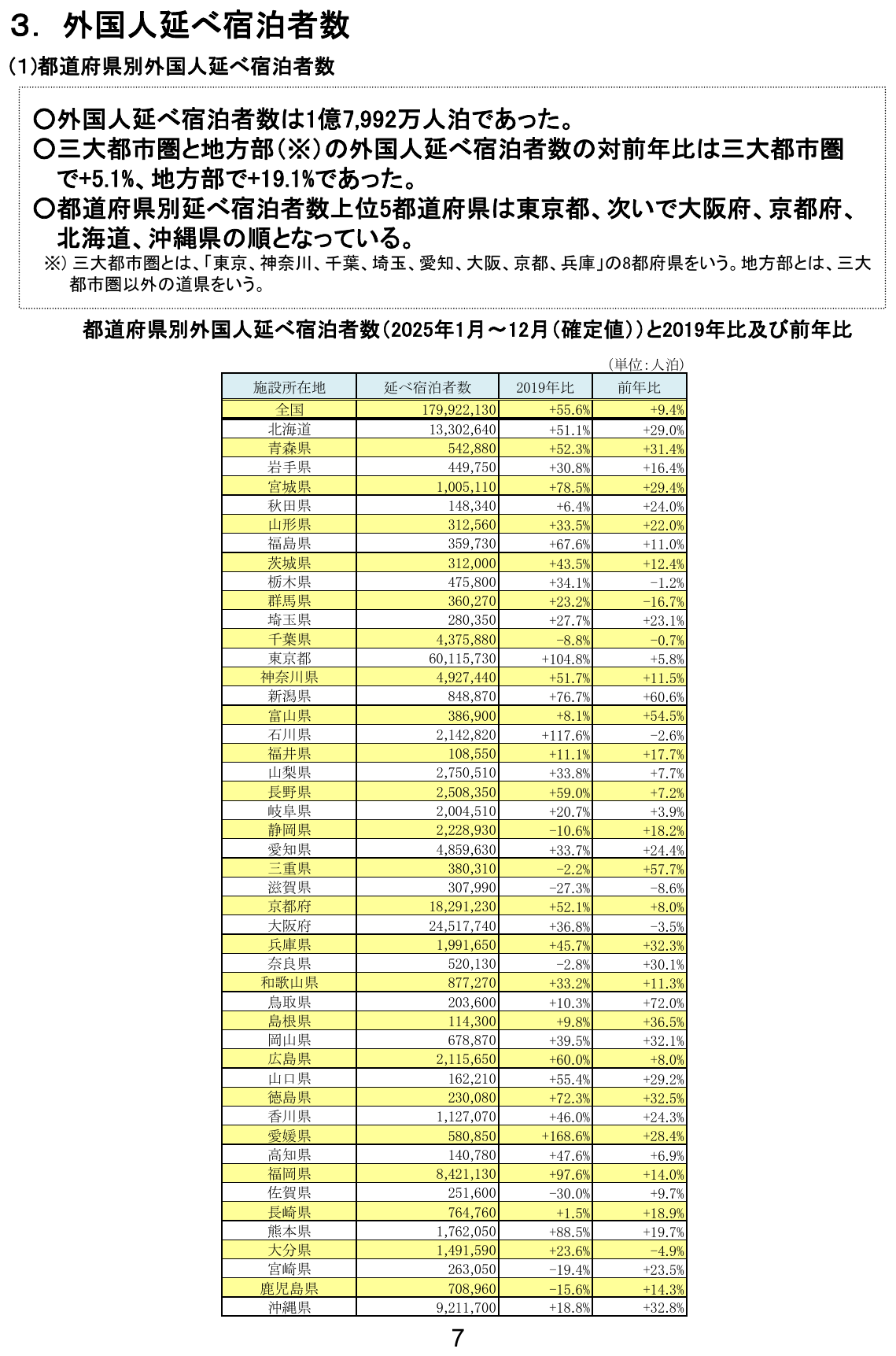
Tokyo’s guest nights ran 55.7% foreign, Kyoto’s 55.2%, in 2025 (Japan Tourism Agency, 2026). Rooms by stations cost more, but the taxi fares you skip often cover the premium.
Nightly, a hostel dorm bed costs ¥3,500–¥5,000 and a business hotel room ¥9,000–¥15,000, per TravelDojo’s 2026 figures. Same business hotel room, higher price in Tokyo and Kyoto: about ¥12,000–¥22,000 a night.
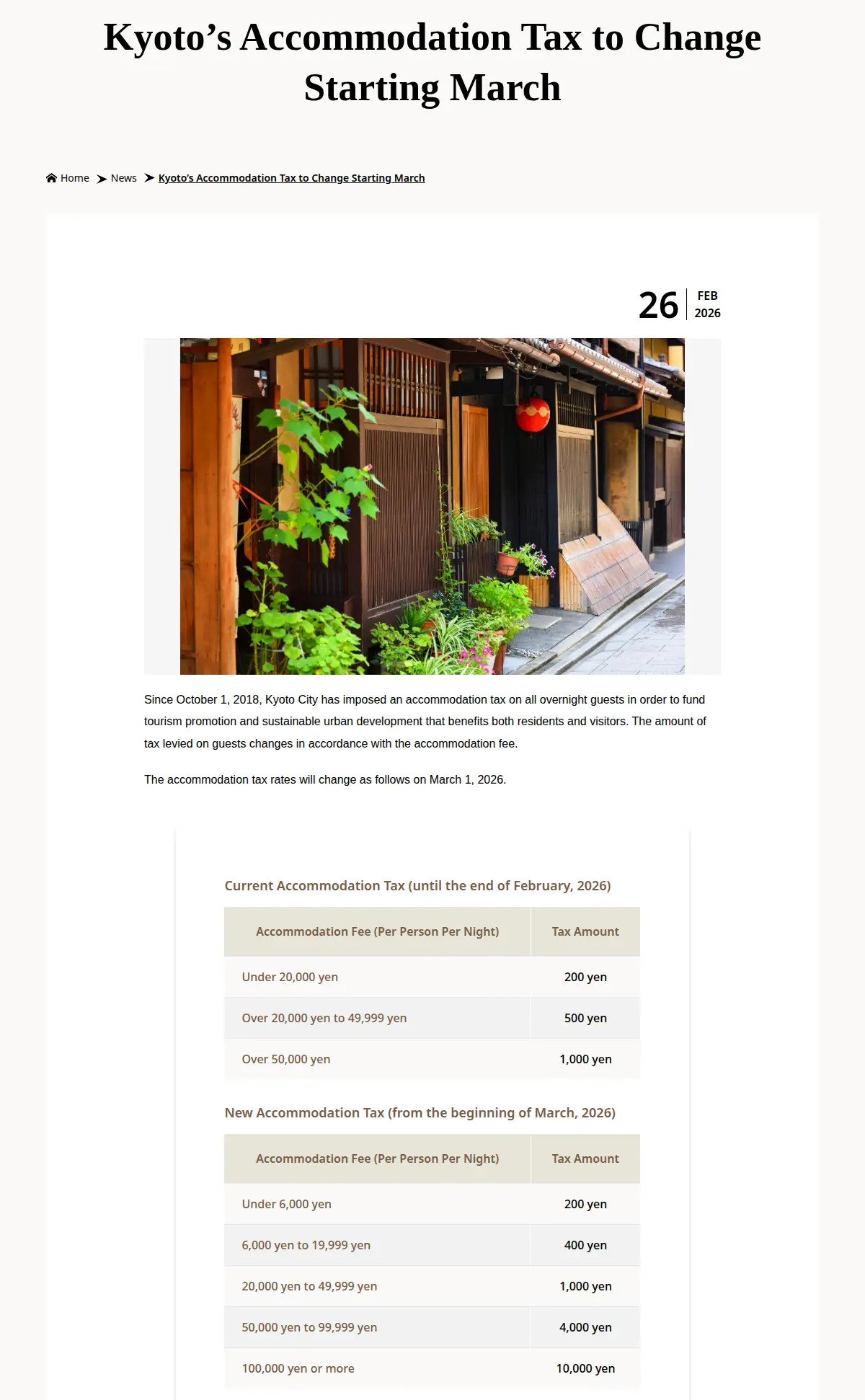
City tax sits on top of the rate. A night in a room under ¥6,000 now carries a ¥200 city tax per person, from 1 March 2026 (City of Kyoto, 2026).
Stays over ¥100,000 pay the top tier: ¥10,000 per person per night (City of Kyoto, 2026).
Let the route wander beyond the big three when it allows. Hokkaido’s guest nights rose 29.0% in 2025; Okinawa’s rose 32.8% (Japan Tourism Agency, 2026).
Hokkaido and Okinawa still trail Tokyo by far in foreign guests.
Where visitors sleep, night by night, sits in the Tokyo, Osaka and Kyoto Hold 57% of Japan’s Foreign Guest Nights. Find the spending behind those nights via the Japan Tourism Statistics 2026.
Which Airport, and How to Reach the City
Tokyo has two international airports, and the choice shapes your first hour. Haneda sits close to the city; Narita sits about 60 kilometres out in Chiba (Time to Japan, 2026).
At Haneda, take the Tokyo Monorail to Hamamatsucho in 13 minutes for ¥520, then change to the JR Yamanote Line (Time to Japan, 2026). Keikyu trains reach Shinagawa in 11 to 18 minutes for ¥330, and run through to Asakusa without a change.
From Narita, the Narita Express reaches Tokyo Station in 53 to 60 minutes for ¥3,140, with no change (Time to Japan, 2026). Faster to the east side, the Keisei Skyliner reaches Ueno in 41 to 50 minutes for ¥2,580.
Cheapest of all is the TYO-NRT bus from Narita. Buses run to Tokyo Station and Ginza for a flat ¥1,500, in about 68 minutes (Time to Japan, 2026).
If you get to choose your airport, choose Haneda. Most central stations sit 25 to 45 minutes away and under ¥750, while Narita costs ¥1,060 to ¥3,330 by train (Time to Japan, 2026).
Note one more detail as a pass holder. Pass holders ride free on the Narita Express and the Tokyo Monorail, but not the Keisei or Keikyu private lines (Time to Japan, 2026).
Getting Around Without a Car
Trains carry the whole trip, and a single IC card covers trains, subway, and buses. Buy the card at the airport and top it up at any station machine.
Shinkansen trains do the moving between the bases. Regular-season Nozomi seats to Kyoto are ¥14,170 with a reservation, and the ride lasts two hours and a quarter (JR Central, 2026).
Slower trains still arrive before lunch, for less. Hikari on the same route takes about 2 hours 40 minutes and costs ¥13,850; Kodama needs about four hours (JR Central, 2026).
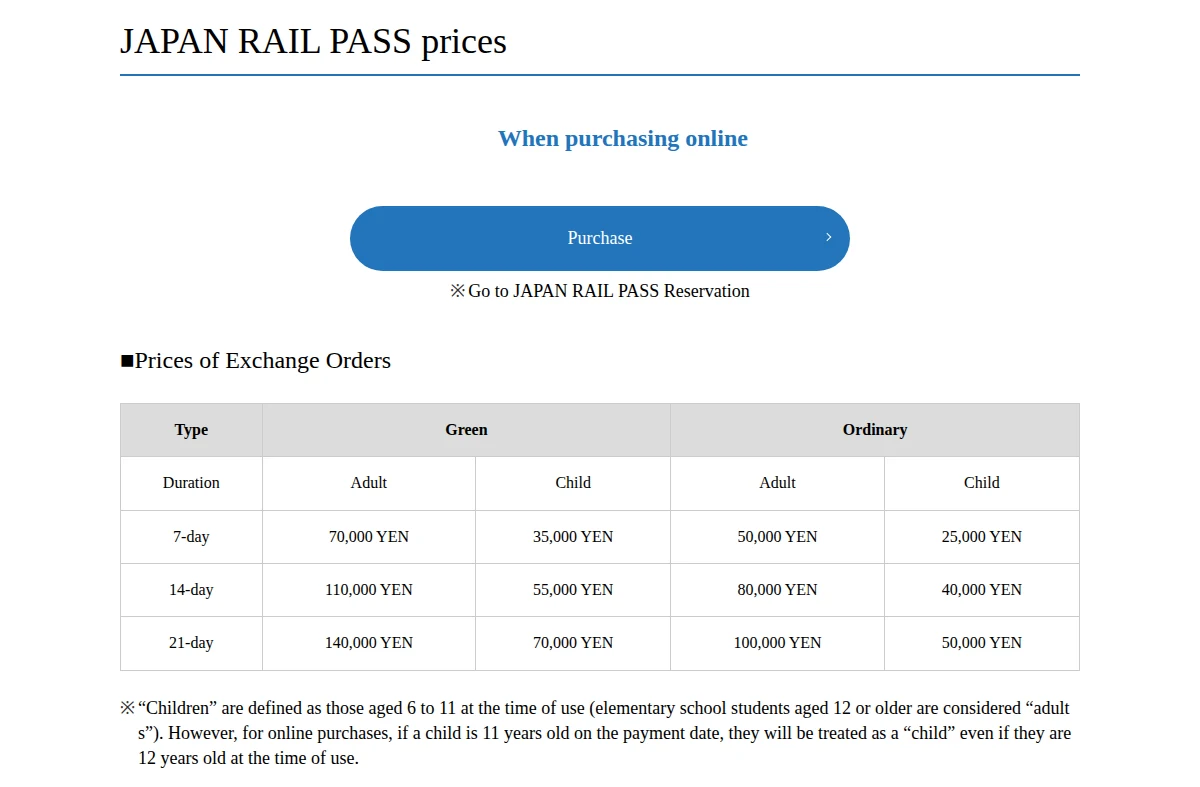
Only heavy rail weeks make the JR Pass pay off. Two prices apply: the official site charges ¥50,000, overseas agents ¥53,000 (JR Group, 2026).
Run the arithmetic before you buy. Nozomi returns between Tokyo and Kyoto run ¥28,340, leaving ¥21,660 of the ¥50,000 pass unused (JR Central, 2026).
Even the Osaka hop (¥580 each way) plus a day trip from Kyoto to Nara (¥720 each way) leaves the pass losing (JR Central, 2026). Longer routes flip the result: a week stretching Tokyo–Kyoto–Hiroshima, or daily long rides, turns the same ¥50,000 into a saving.
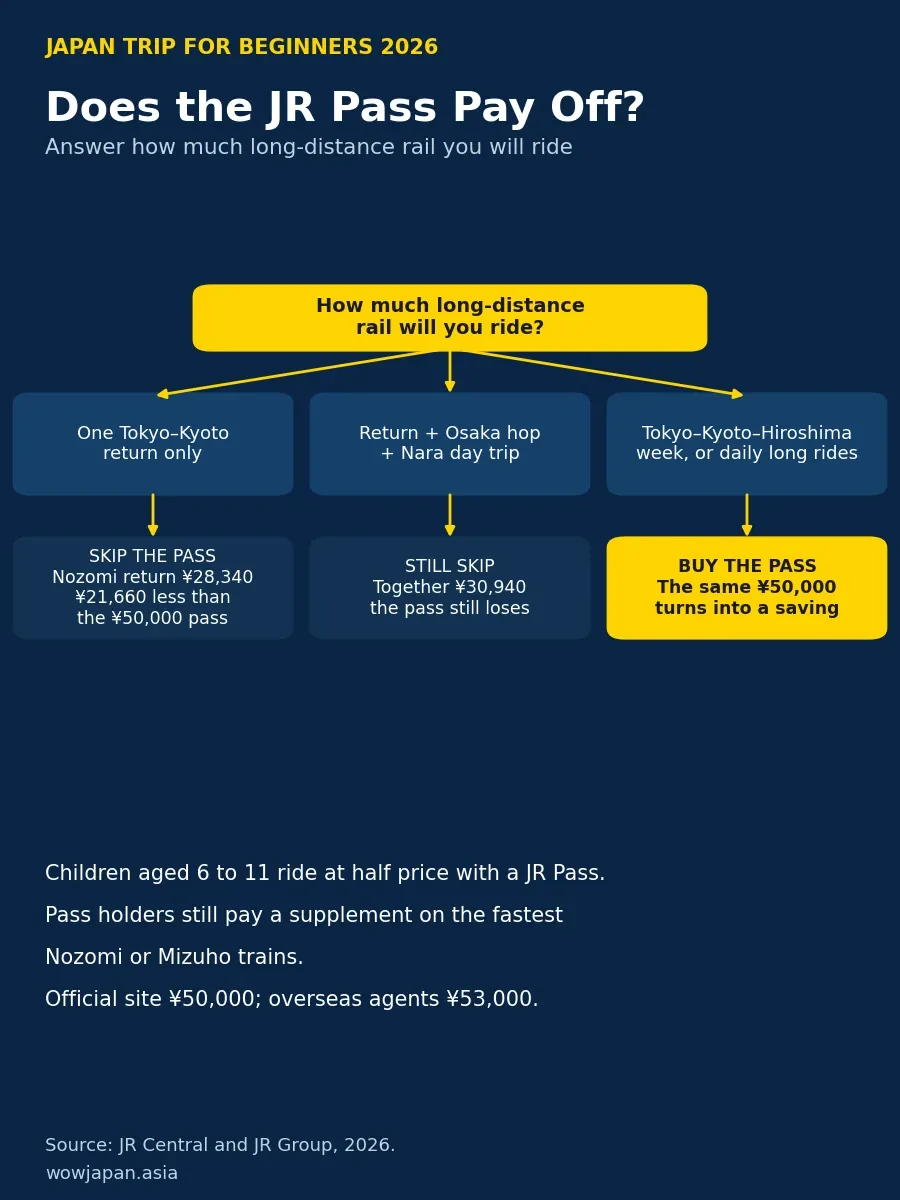
Supplements still lurk inside the pass. Pass holders still pay a supplement on the fastest Nozomi or Mizuho trains (JR Central, 2026).
Between Tokyo or Shinagawa and Kyoto, one way runs ¥4,960.
Local trains keep intercity day trips cheap. Kyoto–Osaka trains run ¥580 on the JR Special Rapid, about 28 minutes (JR West, 2026).
To Nara, the fare runs ¥720 and the ride takes about 45 minutes (JR West, 2026).
Children aged 6 to 11 ride at half price with a JR Pass (JR Group, 2026). Luggage goes on the overhead rack or in the end-of-car space; large suitcases need a reserved seat with oversized baggage space on the Tokaido line.
The 7-Day Route in Brief
Sights fill the mornings and streets the evenings, across three cities on two hotel bases. Trains and feet carry everything below.
| Day | Base | What happens |
|---|---|---|
| 1 | Tokyo | Arrive, Asakusa and Senso-ji, Shibuya crossing at night |
| 2 | Tokyo | Meiji Shrine, Harajuku, Akihabara, Shinjuku after dark |
| 3 | Kyoto | Nozomi to Kyoto, Fushimi Inari in the afternoon, Gion after dark |
| 4 | Kyoto | Kiyomizu-dera at 6:00, Golden and Silver Pavilions |
| 5 | Kyoto | Nijo Castle in the morning, Arashiyama bamboo grove in the afternoon |
| 6 | Kyoto | Nara in the morning, Osaka Castle and Dotonbori in the afternoon |
| 7 | Kyoto | Slow morning at Nishiki Market, then the airport |
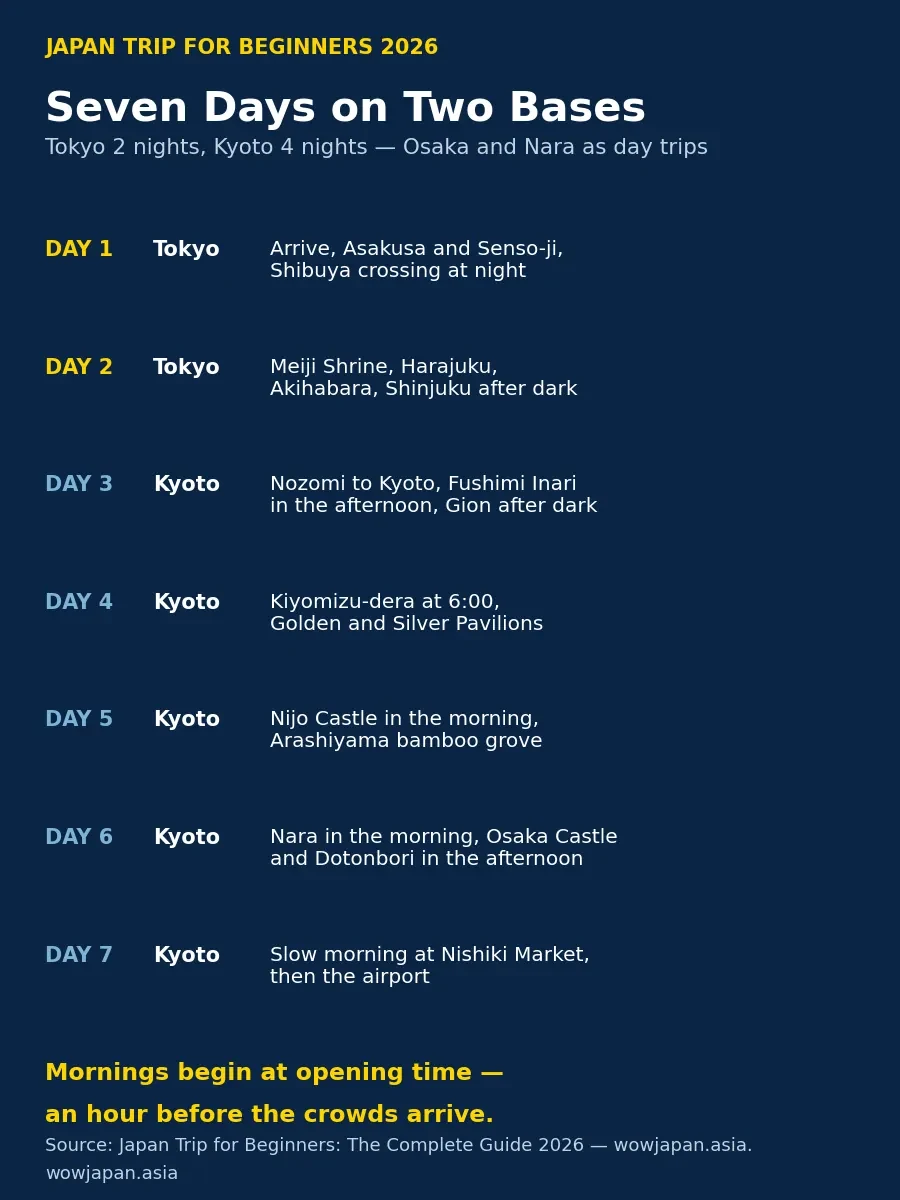
Mornings begin at opening time, an hour before the crowds arrive. Leave afternoons open — a delayed train or a slow lunch then costs nothing.
Venue fees and opening hours below come from official venue pages and 2026 guides (2026).
Kiyomizu-dera opens at 6:00, when its wooden stage over the city still sits nearly empty (2026). From April to October, Todai-ji in Nara opens at 7:30, its Great Buddha Hall charging ¥800 for adults (2026).
Count the paid sights: the total stays small. Six paid sights together run about ¥4,800 per adult in admission fees: Todai-ji, Osaka Castle, Kiyomizu-dera, Nijo Castle, Kinkaku-ji, and Ginkaku-ji.
Fushimi Inari costs nothing at all, and neither does the Nara deer park. Nara’s July 2026 census counted 1,687 deer — the most since 1953 (Nara Deer Preservation Foundation, 2026).
Day-by-day details, with opening hours and fares for every stop, sit in the 7-day itinerary. This guide’s budget and rail arithmetic were built around that route.
How Long Should You Stay?
Seven days fits the average leisure trip, and the numbers say so. Across all purposes, the average stay ran 9.5 nights in 2025; on leisure trips, 7.1 nights (Japan Tourism Agency, 2026).
Stay length varies sharply by market. Koreans stayed only 4.0 nights on average, against 18.4 for French visitors, 14.4 for Britons, and 12.0 for Americans (Japan Tourism Agency, 2026).
Stay longer and the nights, meals, and rides add up. Budget above the per-visitor average for long-haul trips — a dozen nights or more lifts spending.
Ten days buys a second region without rushing the first. Save Hokkaido or Okinawa for when the extra nights exist; squeezing either into seven days costs the trip its slow mornings.
What to Eat, and What It Costs
First-timers meet two surprises in Japanese food: the quality, then the price. Expect ¥1,000–¥1,300 for ramen and ¥500–¥700 for a beef bowl (TravelDojo, 2026).
Meals leave gaps that convenience stores fill. Konbini lunches stay below ¥1,000 for most travelers; onigiri rice balls cost ¥130–¥200 (TravelDojo, 2026).
Dinner costs the most, with the widest range. Evenings at an izakaya run ¥3,000–¥5,000 a person; sit-down meals sit between that level and fine dining (TravelDojo, 2026).
Three konbini or noodle meals a day cost about ¥3,000 (TravelDojo, 2026). Sit-down meals on slow days land near ¥6,000, and most restaurants serve water free.
Follow office workers to lunch. Department-store basements and station noodle shops serve food as good as tourist streets for half the money.
Book the one meal you will remember. Pontocho Alley in Kyoto fills early — get there before the evening crowd, or reserve ahead.
Money, Cash, and the Small Fees
Cash still rules in the places first-timers love most. Temple gates run on cash — Todai-ji included; small restaurants and shrines often take cash too.
Carry more cash than you think. ATMs in convenience stores take foreign cards, and they stay open late.
Outside the daily budget sit three 2026 changes, and all three slip past first-timers. On 1 July 2026, the tax on departure rose from ¥1,000 to ¥3,000 (JNTO, 2026).
You never see the tax as its own line — the airline folds it into the fare. What you pay for a Kyoto room decides your accommodation tax (City of Kyoto, 2026), from 1 March 2026.
Tax-free shopping follows new rules from 1 November 2026 (JNTO, 2026). Keep your receipts until departure — collect the refund at the airport, not the shop.
Cards work in hotels, department stores, and chain restaurants. Cash covers the temples, the markets, and the ramen counter.
What the Record Crowds Mean for Your Dates
2026 changed the map again after the record year. January to September 2026 saw China arrivals fall 55.5% (JNTO, 2026), down to 3,335,500.
Read the full story in Chinese Visitors to Japan Fall by More Than Half in 2026.
Arrivals peaked in April 2025 at 3,909,128 in a single month (JNTO, 2026). December’s arrivals reached 3,617,700, up 3.7% year on year, to close the year (JNTO, 2026).
Total arrivals slipped 2.9% over the same nine months, to 30,730,200 (JNTO, 2026). Korea and Taiwan covered much of the gap: Taiwan sent 5,997,600 visitors, up 19.1%; Korea sent 8,262,700, up 21.6% (JNTO, 2026).
July to September 2026 saw Taiwan pass China as the biggest-spending market — see Taiwan Overtakes China as Japan’s Biggest-Spending Market. Taiwan led the quarter at ¥381.8 billion, up 26.2%; Chinese spending fell to ¥358.3 billion, a 39.8% drop (Japan Tourism Agency, 2026).
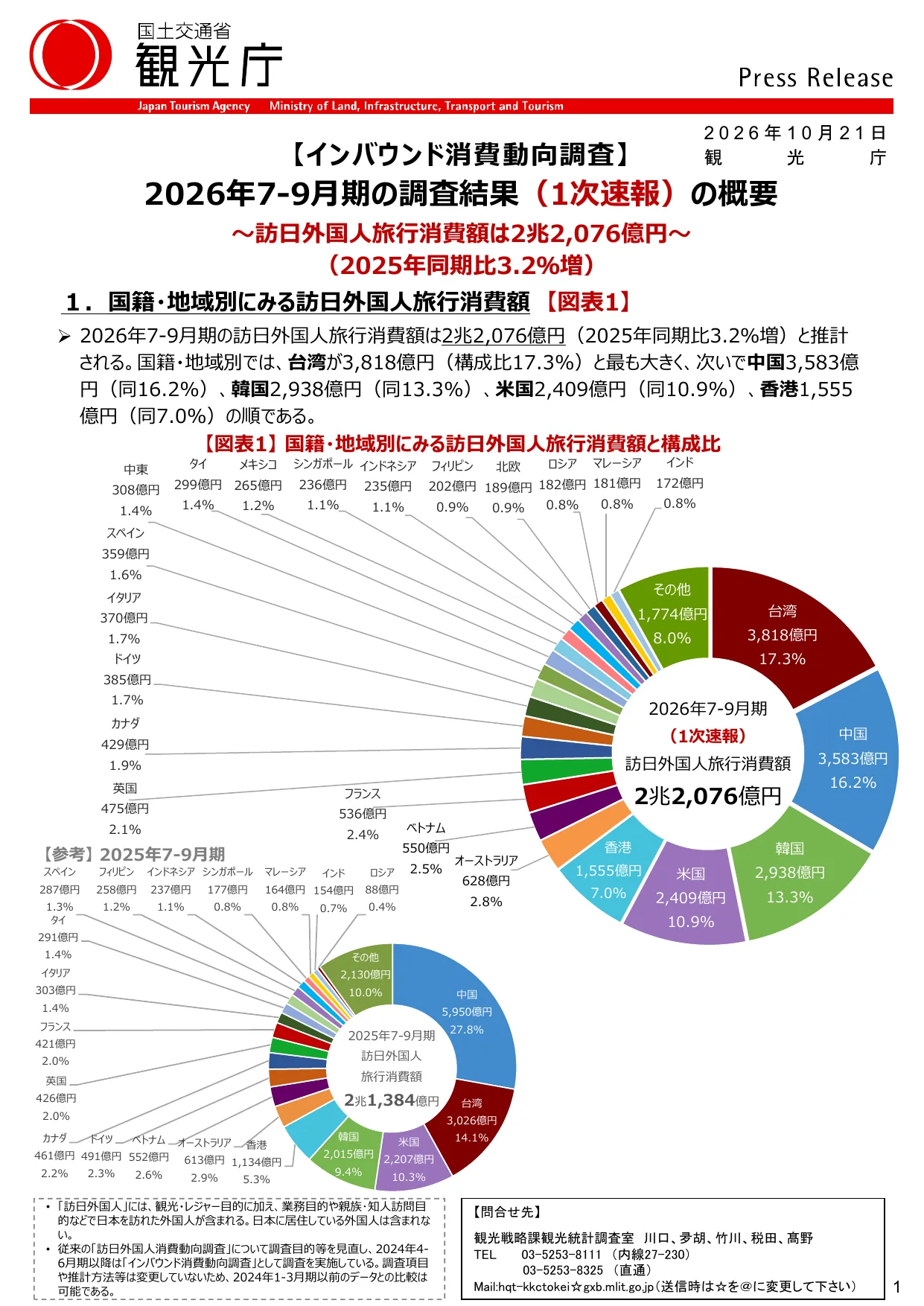
Total visitor spending still rose in the quarter, reaching ¥2.2076 trillion, up 3.2% (Japan Tourism Agency, 2026). Arrivals fell while spending rose, so each visitor spent more.
Each visitor spent ¥233,677 on average in July to September 2026, up 6.1% on the year before (Japan Tourism Agency, 2026). Americans kept coming too: the United States sent 2,522,800 visitors in the first nine months of 2026, up 5.2% (JNTO, 2026).
What does that mean for a first trip? Three things.
First, the big three cities stay crowded even as the total dips, because Korea and Taiwan send their visitors to the same places.
Second, the quiet months got quieter. August 2026 brought the weakest month, with arrivals down 9.6% to 3,098,900 (JNTO, 2026).
Third, book the popular sights early anyway. Twenty markets set annual records in 2025, so the crowds come from everywhere now, not one country (JNTO, 2026).
Full numbers behind the shift sit with the Japan Tourism Statistics 2026. Read the record year itself in the Japan Sets a Tourism Record in 2025 With 42.68 Million Visitors.
Spending numbers sit in the Japan Visitor Spending Hits a Record ¥9.45 Trillion in 2025.
Beyond the Big Three
Five prefectures held 69.7% of all foreign guest nights between them in 2025, per the Japan Tourism Agency’s 2026 figures. Just behind the big three sit Hokkaido and Okinawa, and both grew fastest among the leaders.
Hokkaido’s foreign guest nights hit 13,302,640, up 29.0%; Okinawa’s hit 9,211,700, a 32.8% rise (Japan Tourism Agency, 2026). After the big three, Fukuoka held 8,421,130 guest nights from abroad.
The foreign share of all guest nights in Japan reached 27.2% in 2025 (Japan Tourism Agency, 2026). Outside the big cities, guest nights from abroad rose 19.1% that year.
Save these places for a second trip, or for the extra nights of a ten-day plan. The first week belongs to Tokyo and Kyoto, where the trains, the temples, and the crowds all meet.
Five Mistakes First-Timers Make
Buying the JR Pass before doing the arithmetic. A Tokyo–Kyoto return costs ¥28,340, well under the ¥50,000 pass (JR Central, 2026). Do the arithmetic first, or the pass turns into the trip’s priciest souvenir.
Traveling during Golden Week. Golden Week’s 29 April to 6 May cluster fills trains, hotels, and temples with domestic travelers (Japan Travel, 2026). Shift a week either way and the same sights cost less.
Sleeping in three cities. One Kyoto base covers Kyoto, Osaka, and Nara, and the saved hotel move buys an afternoon (JR West, 2026). Base the week in Kyoto, then Tokyo.
Carrying no cash. At Todai-ji, only cash works; small restaurants and shrines often take cash too. Withdraw at a convenience store ATM on arrival.
Booking nothing ahead for the peak days. Cherry blossom week and autumn weekends sell out the good rooms first. Reserve the hotel before the flight, not after.
Your Trip, Step by Step
Check your passport against the 74 visa-free countries first. Checking takes two minutes and settles the visa question before you spend anything.
Pick your season next: late March for blossoms, or late November for leaves. Avoid Golden Week and the New Year holidays.
Set your tier from the budget table, then book flights early and midweek. Reserve hotels near a JR station in Tokyo and Kyoto.
Do the rail arithmetic before buying a JR Pass. Load an IC card at the airport and keep cash for temples.
Complete Visit Japan Web before landing. Start early, pack light, and leave the rest to the trains.
Methodology
Each price, fare, and fee below rests on an official source or on two independent 2026 guides. Visitor numbers come from JNTO and the Japan Tourism Agency, quoted as published and checked in November 2026.
JNTO labels its 2025 arrival figures preliminary estimates, so small revisions remain possible. Season dates are forecasts, not guarantees, and hotel rates move with the season.
No travel agent supplied anything here, and no source received a fee. Figures that could not be verified were left out rather than estimated.
Frequently Asked Questions
Do I need a visa for Japan?
That depends on the passport you hold. Passport holders from 74 countries and regions skip visas, most for 90 days (MOFA, 2026), and everyone else applies in advance.
How much does a first trip to Japan cost?
Roughly ¥60,000–¥98,000 covers seven careful days, mid-range runs ¥126,000–¥210,000, and comfort starts at ¥280,000, before flights (Japan Tourism Agency, 2026). Return fares add roughly $200–$1,200 by origin (Tokyo Tourism, 2026).
Do 7 days cover Tokyo, Kyoto, and Osaka?
Yes — two bases and early starts cover it. Spend two days in Tokyo and three in Kyoto; Nara and Osaka fill day trips, and the seventh day stays slow.
When is the best time for a first trip?
Late March to early April for cherry blossoms, or late November to early December for autumn leaves. Avoid Golden Week, 29 April to 6 May 2026, when domestic crowds peak.
Does the JR Pass pay off on a first trip?
Several long rides on one route are the only case where the pass pays off: Tokyo–Kyoto returns run ¥28,340 (JR Central, 2026), well under ¥50,000. Without a Hiroshima leg or daily long rides, the gap stays open.
References
- Number of visitor arrivals to Japan in December 2025 — Japan National Tourism Organization
- Number of visitor arrivals to Japan in September 2026 — Japan National Tourism Organization
- Inbound Consumption Trend Survey, 2025 calendar year (final) — Japan Tourism Agency
- Inbound Consumption Trend Survey, July–September 2026 (first preliminary) — Japan Tourism Agency
- Overnight Travel Statistics Survey, 2025 annual figures (final) — Japan Tourism Agency
- Visa Fees — Ministry of Foreign Affairs of Japan
- Exemption of Visa (Short-Term Stay) — Ministry of Foreign Affairs of Japan
- The JAPAN eVISA system — Ministry of Foreign Affairs of Japan
- The 2026 amendment to the Immigration Control Act — Immigration Services Agency
- Japan’s International Tourist Tax is Increasing — Japan National Tourism Organization
- Visit Japan Web — Digital Agency
- Japan Rail Pass — Official Site
- smartEX Service Prices (Reserved Seat in Ordinary Cars) — JR Central
- Kyoto’s Accommodation Tax to Change Starting March — Kyoto City Official Travel Guide
- 2026 Cherry Blossom Forecast — japan-guide.com
- Guide to Golden Week — Japan Travel
- Japan Autumn Foliage 2026: When and Where to See Koyo — Japan Real Guide
- Narita & Haneda Airport to Tokyo: Trains, Buses, Fares (2026) — Time to Japan
- Japan Travel Costs — TravelDojo
- JR West — Official Site
- Tokyo Tourism — Official Site
- Nara Deer Population Record High — Discover Nara
- Inbound Consumption Trend Survey, April–June 2026 — Japan Tourism Agency
- Everything You Need to Know About Japan’s New Tax-Free Shopping System — Japan National Tourism Organization
- Kiyomizu-dera — Official Site
- Todai-ji — Official Site