
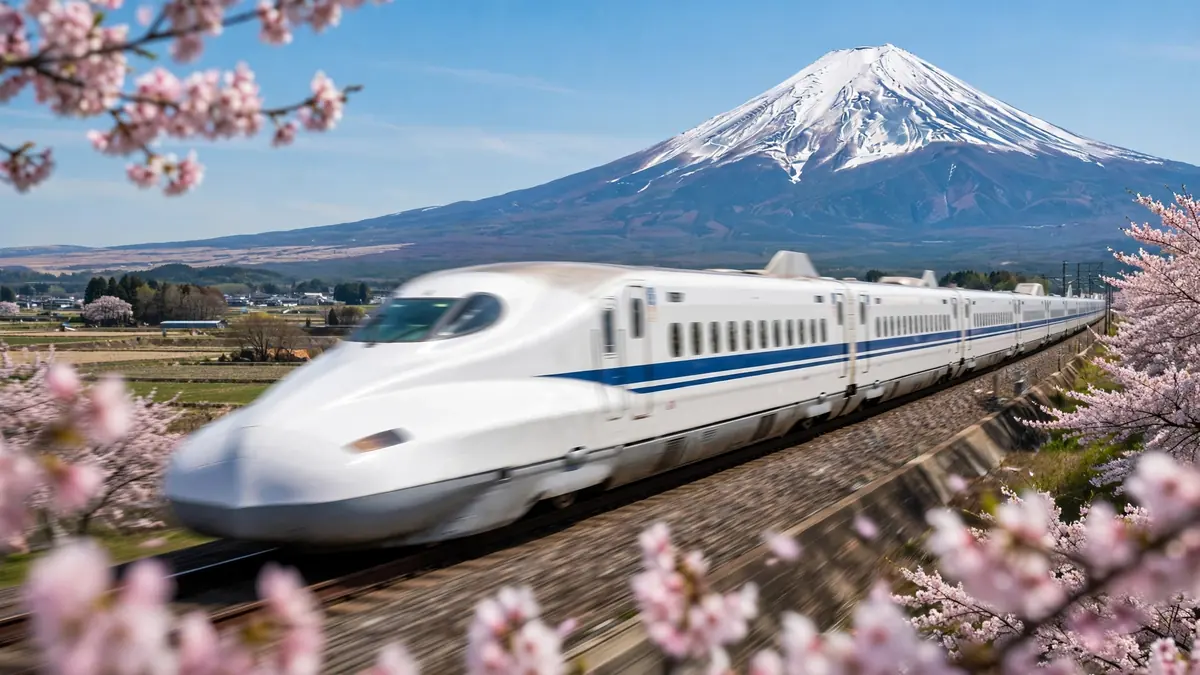
Main image: AI illustration.
A train leaves Tokyo Station every few minutes, and nearly all of them arrive on time. Japan moves on rails, so learning the system once pays off for the whole trip.
This guide covers the three things that confuse first-timers: IC cards, shinkansen seats, and the baggage rule. Fares below are 2026 prices from the operators themselves.
Summary
- One IC card covers nearly every train, subway, and bus in the country (JR East, 2026).
- Suica costs a ¥500 deposit and lasts 10 years; Welcome Suica skips the deposit and expires after 28 days (JR East, 2026).
- Shinkansen seats come in three kinds: non-reserved, reserved, and Green Car (JR Central, 2026).
- Bags over 160 cm need a free reserved seat with baggage space on Tokaido, Sanyo, and Kyushu shinkansen (JR Central, 2026).
- SmartEX books shinkansen seats online and lets you tap in with an IC card (JR Central, 2026).
How Japan’s Trains Fit Together
Three networks share the rails: JR, private railways, and subways. JR runs the shinkansen and most intercity trains, while private lines serve suburbs and subways serve city centres.
One ticket does not cross networks. Cross from a JR station to a subway station and the trip needs two fares, unless an IC card handles both ends.
The shinkansen sits on top of this system as a separate, faster network. It runs on its own tracks, so a shinkansen ticket never covers a local train (JR Central, 2026).
IC Cards: Suica, Pasmo, and the Welcome Versions
An IC card is a tap-to-pay card for trains, subways, buses, and even convenience stores. Tap in at the gate, tap out at the other end, and the fare comes off the balance.
Suica, from JR East, is the best-known card, and Pasmo covers the Tokyo metro and private lines. Either card works across Japan on the ten major IC networks (JR East, 2026).
A regular Suica needs a ¥500 deposit and stays valid for 10 years, including long gaps between trips. It went back on general sale in March 2025 after a chip shortage (JR East, 2026).
Welcome Suica skips the deposit and the refund queue, but it expires after 28 days and the balance is not refundable. Buy it in fixed amounts from ¥1,000 to ¥10,000 (JR East, 2026).
Phones work too: Mobile Suica lives in Apple Wallet, and Welcome Suica Mobile runs for 180 days on iOS. Keep the balance under ¥20,000, the card maximum (JR East, 2026).
| Card | Deposit | Validity | Best for |
|---|---|---|---|
| Suica | ¥500 | 10 years | Repeat visitors |
| Welcome Suica | None | 28 days | One trip, no refund queue |
| Welcome Suica Mobile | None | 180 days | iPhone users |
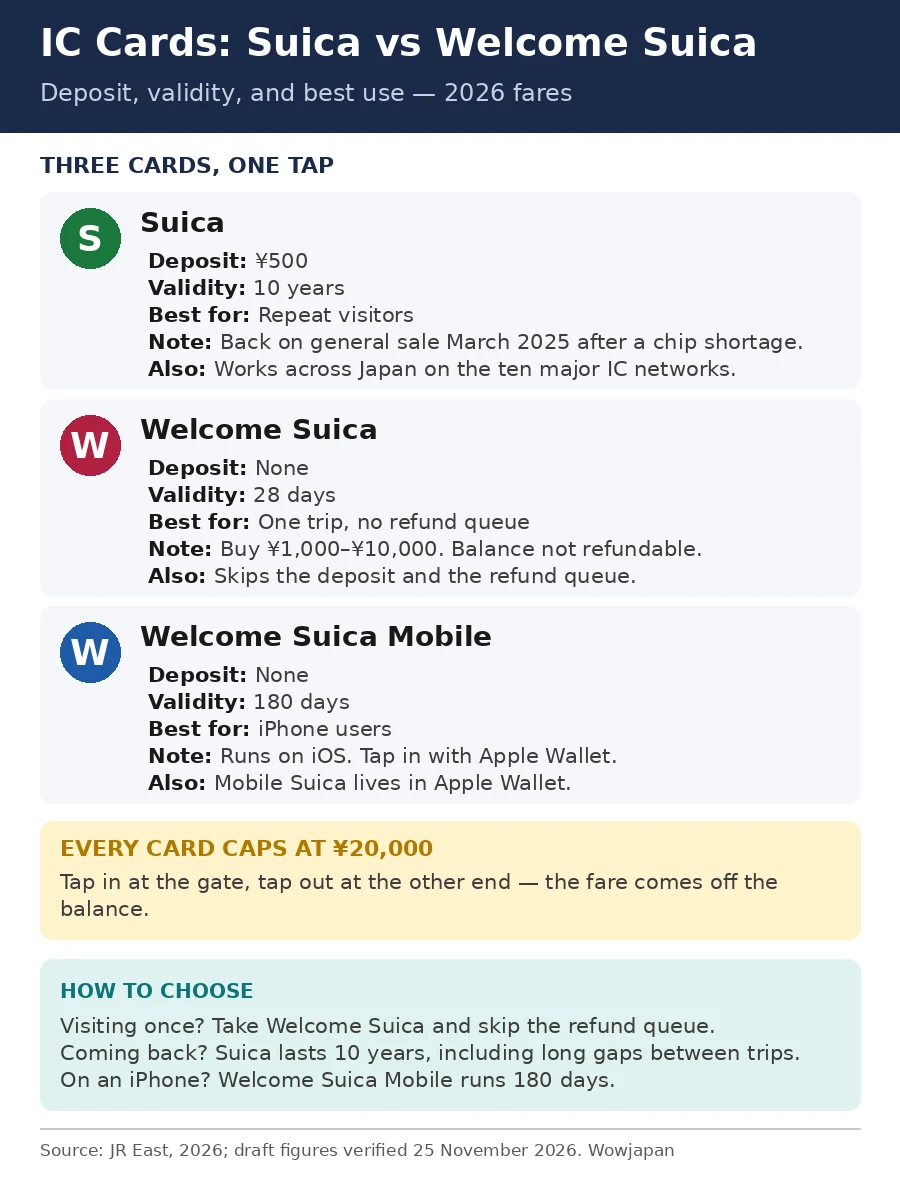
Each column compares one IC card on deposit, validity, and best use. Repeat visitors take the regular card; one-trip visitors take the welcome card.
Riding the Shinkansen: Reserved, Non-Reserved, and Green Car
Three seat kinds set the shinkansen price, and each step up costs more. Non-reserved seats cost least, reserved seats add a small fee, and Green Car adds comfort and space.
Non-reserved cars fill first on Friday evenings and holiday mornings, so families and peak-hour travellers should reserve. Reserved seats cost only slightly more and guarantee a place (JR Central, 2026).
Green Car buys space: broader seats, fewer people per car, and extra legroom, for roughly double the reserved-seat fee. Long rides suit it best, not short hops (JR Central, 2026).
Nozomi trains run fastest between Tokyo and Kyoto, at ¥14,170 one way in a reserved seat. Hikari trains stop more often and cost ¥13,850, while Kodama trains stop everywhere and take about four hours (JR Central, 2026).
Over the 2026–27 New Year, every Nozomi service runs all-reserved, with no non-reserved cars at all. Book early for that week, or ride Hikari instead (JR Central, 2026).
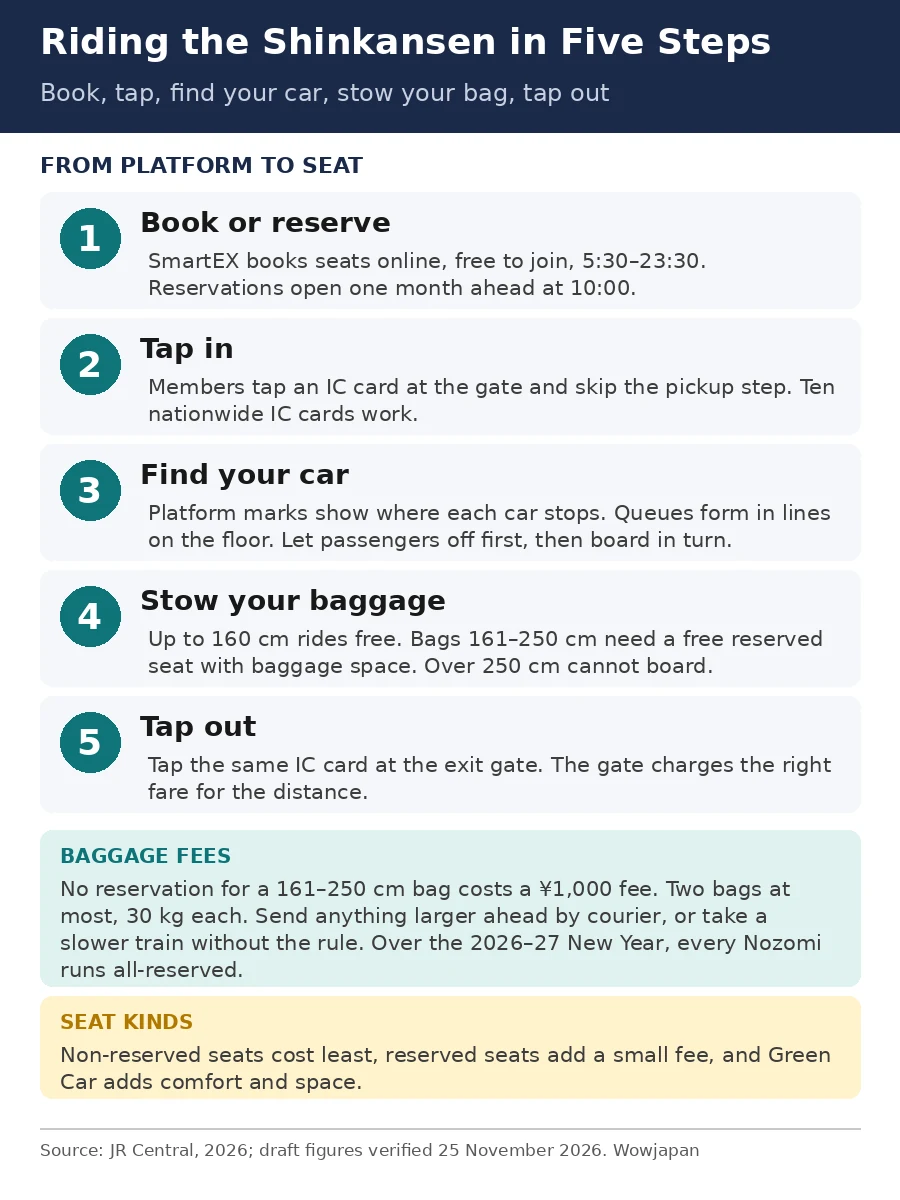
Five steps carry a rider from booking to the exit gate. Baggage size decides whether a seat needs reserving.
The Oversized Baggage Rule
Luggage adds up fast on the Tokaido, Sanyo, and Kyushu shinkansen, where a baggage rule applies. Measure height, width, and depth together before you board (JR Central, 2026).
Up to 160 cm in total, a bag rides free with no action needed. Bags from 161 to 250 cm need a free reserved seat with a baggage area, booked in advance (JR Central, 2026).
Anything over 250 cm in total cannot board the shinkansen at all, and staff will refuse it. Boarding with a 161–250 cm bag and no reservation costs a ¥1,000 fee (JR Central, 2026).
Two bags at most, 30 kg each, fall under the rule. Send anything larger ahead by courier, or take a slower train without the rule (JR Central, 2026).
Buying Tickets: Machines, Counters, and SmartEX
Ticket machines take cash and cards, and most offer an English menu. Counters help with complex routes, but the queues grow long at holiday time.
SmartEX books shinkansen seats online, free to join, from 5:30 to 23:30 each day. Reservations open one month ahead at 10:00, and members tap in with any of ten nationwide IC cards (JR Central, 2026).
Tickets bought online still need a pickup step, usually at a machine or counter. Members skip that step and tap straight through the gate (JR Central, 2026).
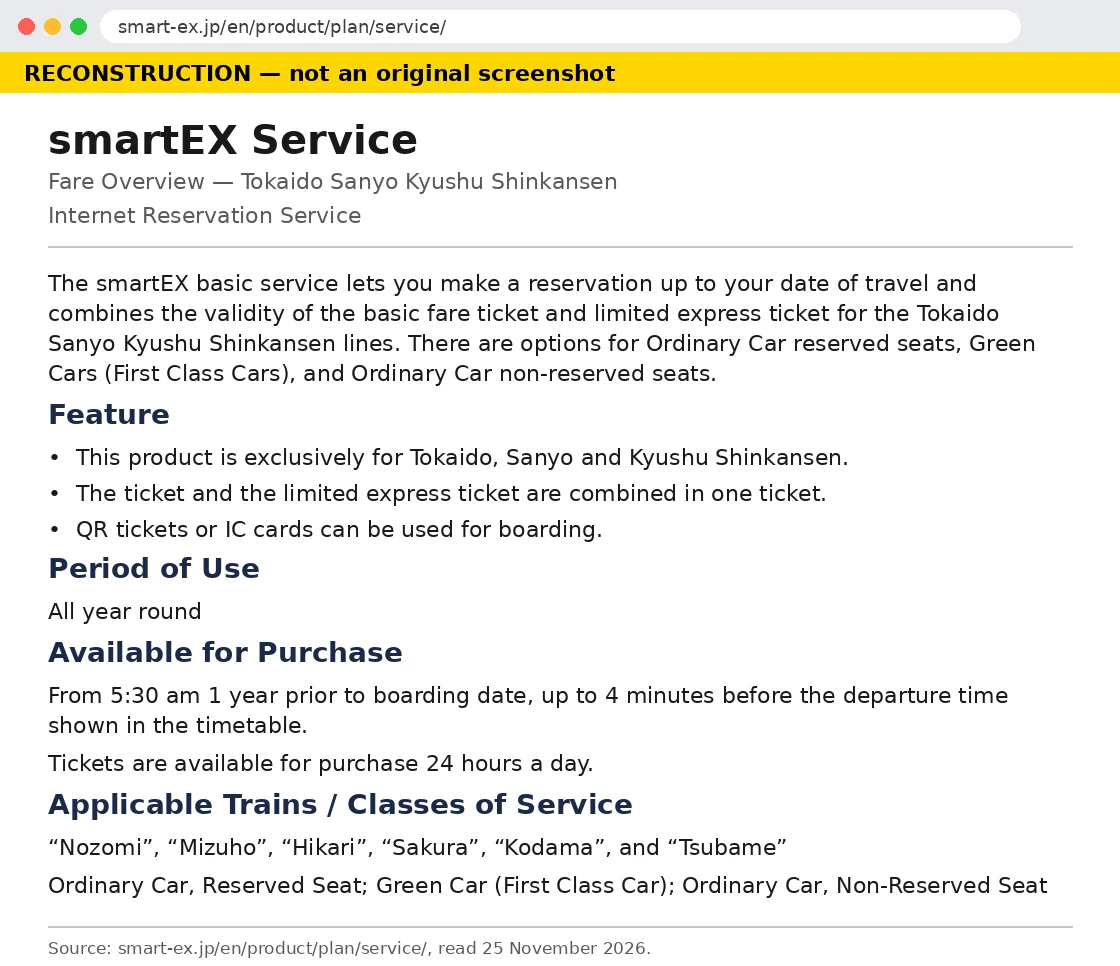
Booking here combines the fare and express tickets into one. QR tickets or IC cards open the gate.
City Trains, Subways, and Buses
City trains and subways run every few minutes, and the IC card covers both. Tap in, ride, tap out — the gate charges the right fare for the distance.
Platforms mark where each car stops, and queues form in lines on the floor. Let passengers off first, then board in turn (JR East, 2026).
Buses take IC cards too, though rural routes still run on cash and exact change. Front-door boarding with a numbered ticket is common outside the big cities.
Getting from the Airport into Town
Narita sits well outside central Tokyo, so the airport leg is a trip of its own. Full fares and times sit in the Narita Airport to Tokyo guide.
Narita Express trains reach Tokyo Station in 53 minutes for ¥3,140 (JR East, 2026). Keisei Skyliner trains reach Ueno in 41 minutes for ¥2,580 (Keisei, 2026).
Both beat the bus on a clear day, and both take IC cards or paper tickets.
Haneda sits closer in. The Tokyo Monorail reaches Hamamatsucho in 13 minutes for ¥520 (Tokyo Monorail, 2026).
Shinagawa sits 11 to 14 minutes away on the Keikyu line, for ¥330 (Keikyu, 2026). Either beats a taxi on price by a wide margin.
What First-Timers Get Wrong
Buying a paper ticket for every ride is the commonest first-timer mistake. Queues at the machines eat the time the card saves.
Another is boarding a shinkansen with a local ticket, or a local train with a shinkansen ticket. Each needs its own fare, and the gate will stop you (JR Central, 2026).
Third, travellers forget the baggage rule until the platform, when the free seats are gone. Measure the bag at the hotel, not at the gate.
Long-distance travel still rewards a rail pass on heavy train weeks. Price the route first, then decide on the pass — the JR Pass 2026 guide prices five itineraries.
Methodology
Fares and rules in this guide come from JR East, JR Central, JR West, Keikyu, and Tokyo Monorail pages checked in November 2026. Prices are regular-season fares; holiday peaks and future revisions can move them.
Figures were cross-checked between the operators’ own pages and the site’s own Japan Tourism Statistics 2026 where routes overlap. Prices move, so check the operator’s own site before you pay.
FAQ
How do I pay for trains in Japan?
Use an IC card like Suica at the gate, or buy a paper ticket at a machine. Nearly every train, subway, and bus in the country takes it (JR East, 2026).
Do I need a reserved seat on the shinkansen?
Not always, but peak hours fill the free cars fast. Reserve for Friday evenings, holiday mornings, and the New Year week (JR Central, 2026).
Can I use Suica on the shinkansen?
No, not for the fare itself — the shinkansen needs its own ticket. Members tap an IC card at the gate, but the seat itself is booked and paid separately (JR Central, 2026).
What is the oversized baggage rule?
Over 160 cm in total, a bag needs a free reserved seat with baggage space on Tokaido, Sanyo, and Kyushu shinkansen. Anything over 250 cm cannot board at all (JR Central, 2026).
Which airport train is fastest from Narita?
Skyliner trains reach Ueno in 41 minutes, the fastest of the airport trains. Every fare and time sits in the Narita Airport to Tokyo guide.
References
- Suica — JR East
- Welcome Suica — JR East
- SmartEX Service Prices (Reserved Seat in Ordinary Cars) — JR Central
- How to Bring a Large Suitcase on the Shinkansen — Travel Notes Japan
- Shinkansen on SmartEX: Booking, IC-Card Boarding and the 160 cm Baggage Rule — RSQ
- Shinkansen Tips for First-Time Riders — Migaku
- N’EX Tickets — JR East
- Skyliner Overview — Keisei Electric Railway
- Narita and Haneda to Central Tokyo — RSQ
- Haneda Airport Access Guide — Keikyu
- Access to Haneda Airport — Tokyo Monorail
- N’EX (Narita Express) — JR East
- Nozomi trains are all reserved seating due to predicted congestion during the peak periods. — JR Central
- Luggage information — JR Central
- smartEX Service — JR Central
- Purchase of Welcome Suica — JR East
- Welcome Suica Mobile — JR East
- Resumption of sales for non-personalized Suica and PASMO Cards — JR East