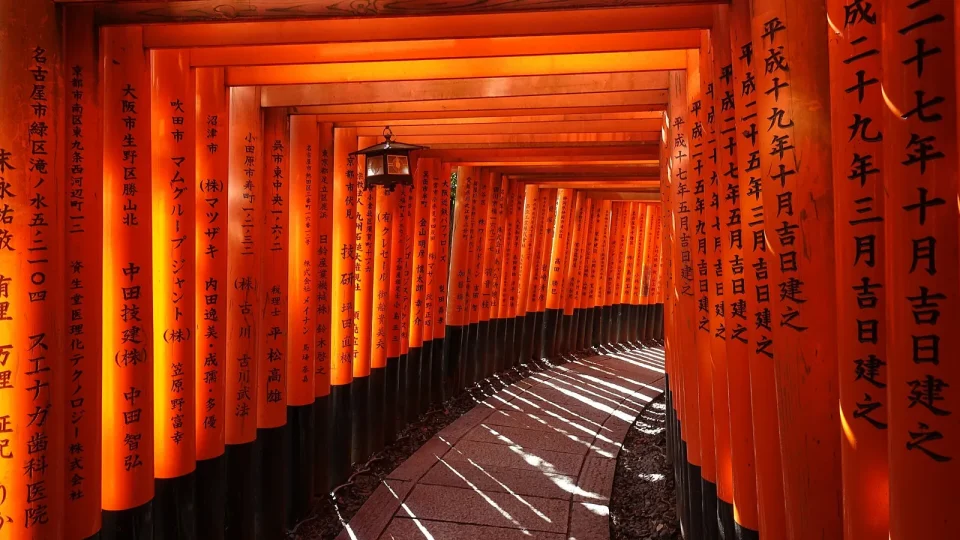
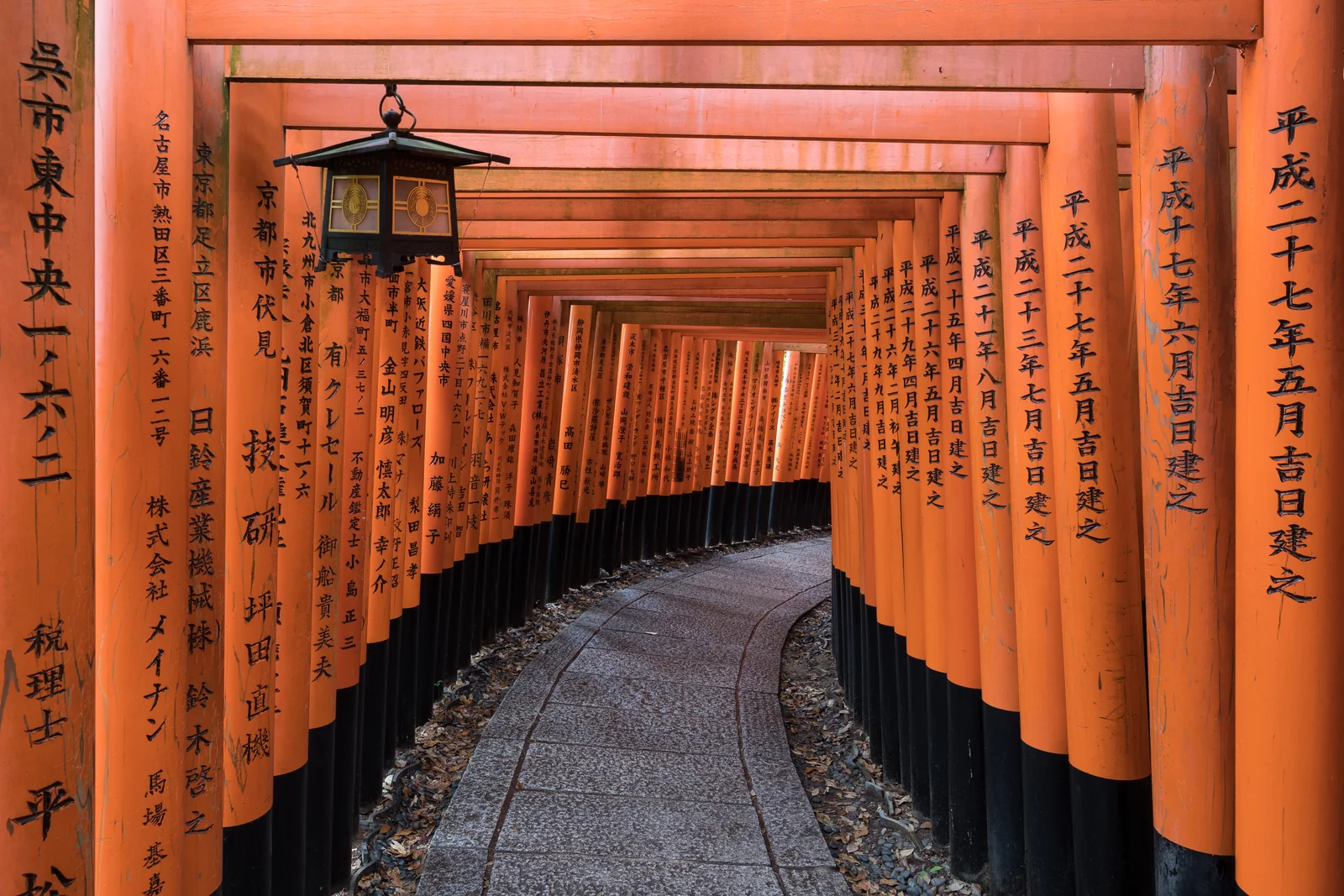
Fushimi Inari Taisha is the shrine behind Kyoto’s most famous photograph. Thousands of vermilion torii gates climb a wooded mountain, and entry is free.
Gates never close here, and the shrine sits directly across from JR Inari Station. This guide covers the route, the real costs, and seven tips that make a first visit far better than a rushed photo stop.
In Short
- Entry is free, and the grounds stay open 24 hours, every day of the year (inari.jp, 2026).
- Ride the JR Nara Line local from Kyoto Station: two stops, five minutes, ¥150 (around Rp16,500) (japan-guide.com, 2026).
- Senbon Torii takes 20–30 minutes, while the full summit loop takes 2–3 hours (japan-guide.com, 2026).
- Arrive before 8:00 to walk the torii tunnels almost alone.
Info Destinasi
| Location | Fushimi-ku, Kyoto — 68 Fukakusa Yabunouchi-cho, Kyoto 612-0882 |
| Opening hours | 24 hours, every day (prayer counter 08:30–16:30) |
| Ticket price | Free — no ticket office, no booking needed |
| Visit duration | 30 minutes (Senbon Torii only) to 2–3 hours (full summit loop) |
| Best time | Before 8:00 or after 17:00; late March–April and November |
Source: inari.jp (2026); fushimiinaritaisha.org (2026).
Cara ke Sana
| From | Mode | Duration | Cost |
|---|---|---|---|
| Kyoto Station | JR Nara Line local to Inari Station (2 stops) | ±5 minutes | ¥150 (around Rp16,500) one way |
| Gion-Shijo | Keihan Main Line to Fushimi-Inari Station, then a 5-minute walk | ±10 minutes | ¥240 (around Rp26,400) one way |
| Osaka Station | JR Special Rapid to Kyoto, then JR Nara Line local to Inari | ±48 minutes | ¥840 (around Rp92,400) one way |
Source: japan-guide.com (2026); fushimiinaritaisha.org (2026); japantripkit.com (2026).
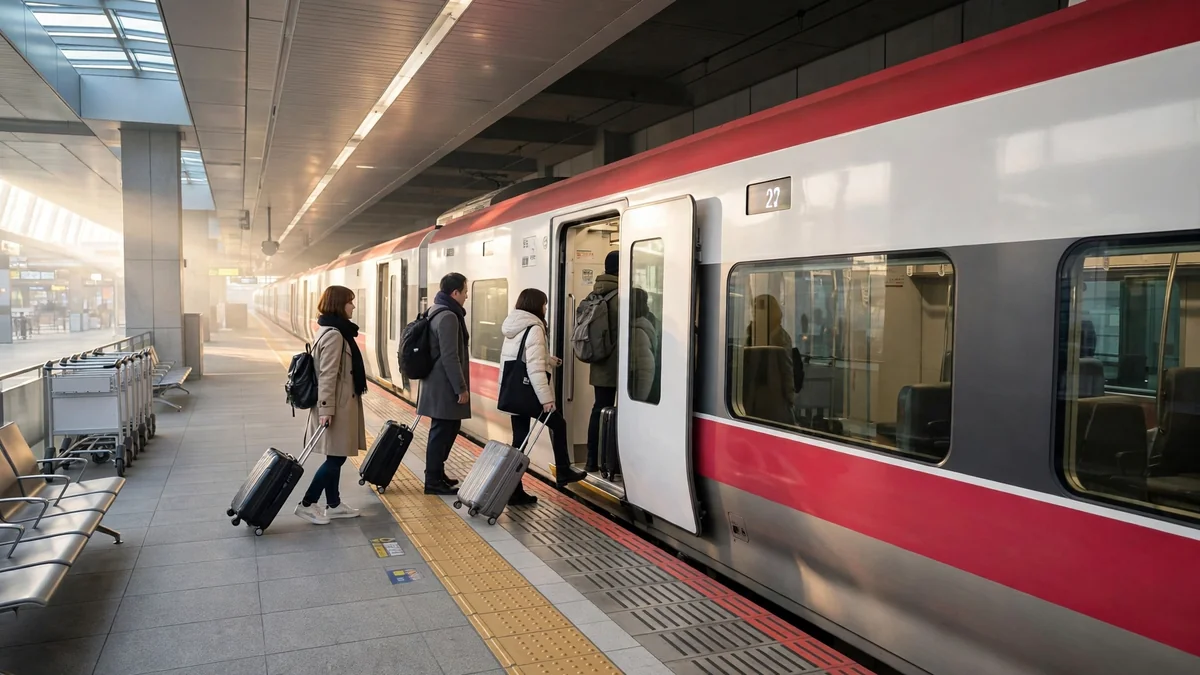
Take a local train on the JR Nara Line. Rapid trains skip Inari Station, and the next stop sits far past the shrine.
How to ride those trains, buy tickets, and use an IC card is covered in Getting Around Japan: Trains, Buses, IC Cards & Shinkansen.
Rincian Biaya
| Item | Yen (¥) | Rupiah (Rp) |
|---|---|---|
| Train return (Kyoto–Inari) | ¥300 | Rp33,000 |
| Admission | ¥0 | Rp0 |
| Lunch (inari-sushi) | ¥500 | Rp55,000 |
| Ema (wish plaque) | ¥800 | Rp88,000 |
| Total | ¥1,600 | Rp176,000 |
Source: japan-guide.com (2026) for fares; sacredjp.com (2026) for lunch; citybreakgeek.com (2026) for ema.
Prices checked 29 November 2026 at ¥1 ≈ Rp110. Lockers at JR Inari Station cost ¥300–¥400 (around Rp33,000–Rp44,000) (fushimiinaritoday.com, 2026) when you need one.
What a full week in Japan costs, beyond this half day, is in Japan Trip Cost 2026: Flights, Hotels, JR Pass & Food.
Peta Lokasi
Zoom out to see Tofuku-ji, one JR stop north.
Itinerary Harian
Half Day — Fushimi Inari
| Time | Activity | Transport | Cost |
|---|---|---|---|
| 07:00 | Arrive at Inari Station, cross to the Romon Gate | JR Nara Line local, 5 minutes | ¥150 (around Rp16,500) |
| 07:10 | Pray at the main hall (honden) | Walk, 5 minutes | ¥0 |
| 07:30 | Walk the Senbon Torii tunnels | Walk | ¥0 |
| 08:00 | Climb to Okusha Hohaisho and lift the Omokaru-ishi stones | Walk, 20 minutes | ¥0 |
| 08:45 | Reach Yotsutsuji viewpoint, rest with tea | Walk, 30 minutes | ¥0 |
| 09:30 | Walk back down and read the gate inscriptions | Walk, 45 minutes | ¥0 |
| 10:15 | Lunch: inari-sushi on the approach street | Walk | ¥500 (around Rp55,000) |
| 11:00 | One stop to Tofuku-ji, or walk to the sake district | JR Nara Line, 1 minute | ¥150 (around Rp16,500) |
Source: sacredjp.com (2026) for trail times; japan-guide.com (2026) for fares.
Times assume a steady pace with photo stops. Add an hour when you climb to the summit.
This half day fits inside a longer first trip in Japan 7-Day Itinerary: Tokyo, Kyoto & Osaka First-Timers.
What Is Fushimi Inari Taisha?
Inari Okami was enshrined on Mount Inari in the second month of 711, on the first Day of the Horse (inari.jp, 2026). Today the shrine heads some 30,000 Inari shrines across Japan (inari.jp, 2026).
Five deities share the main hall as one presence: Ukanomitama, Satahiko, Omiyanome, Tanaka, and Shino Okami. Inari covers rice, harvests, business prosperity, and household safety.
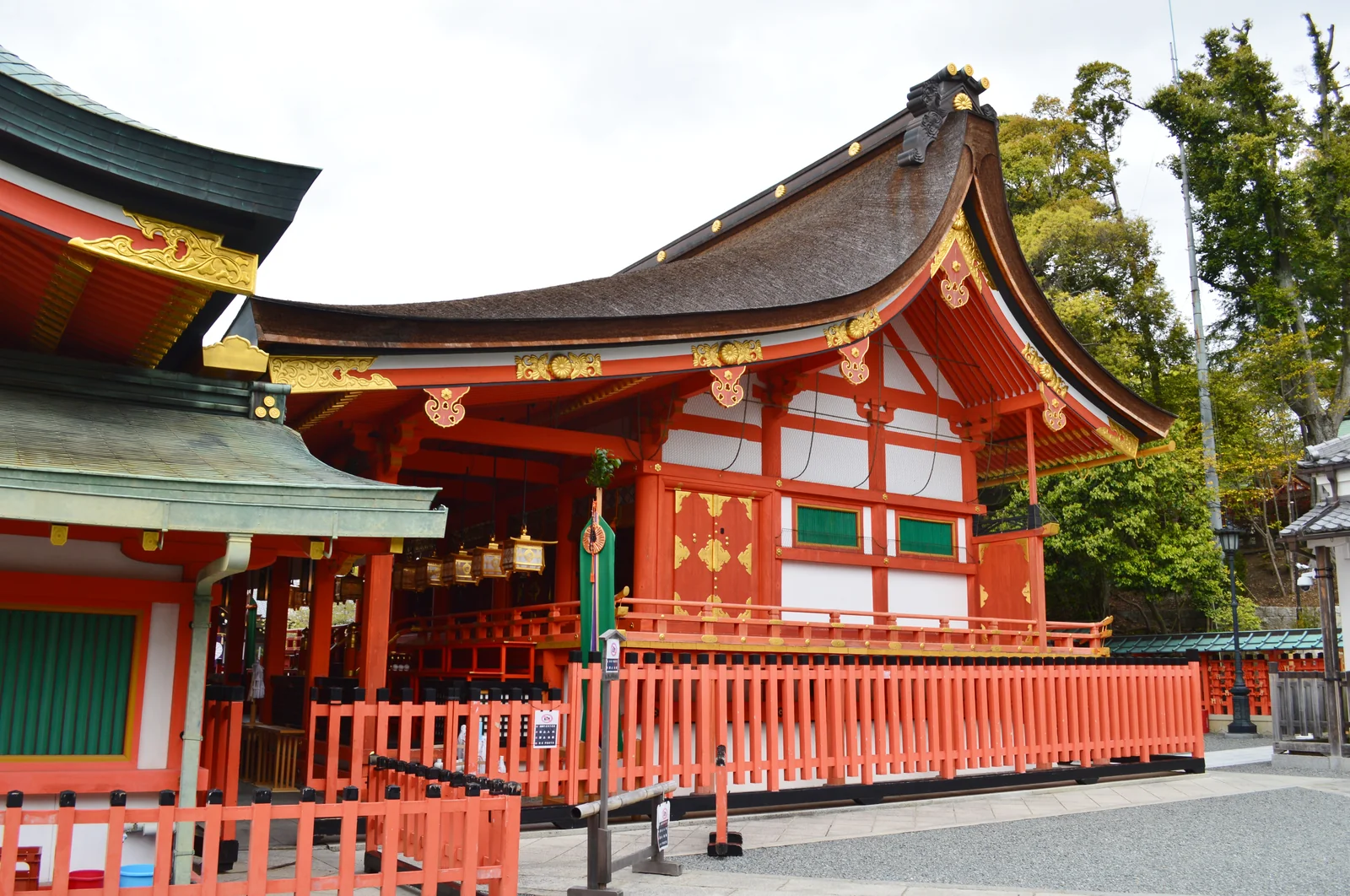
Main hall timbers date from 1499, and the great Romon Gate was rebuilt in 1589 under Toyotomi Hideyoshi (inari.jp, 2026). Both buildings are Important Cultural Properties of Japan (inari.jp, 2026).
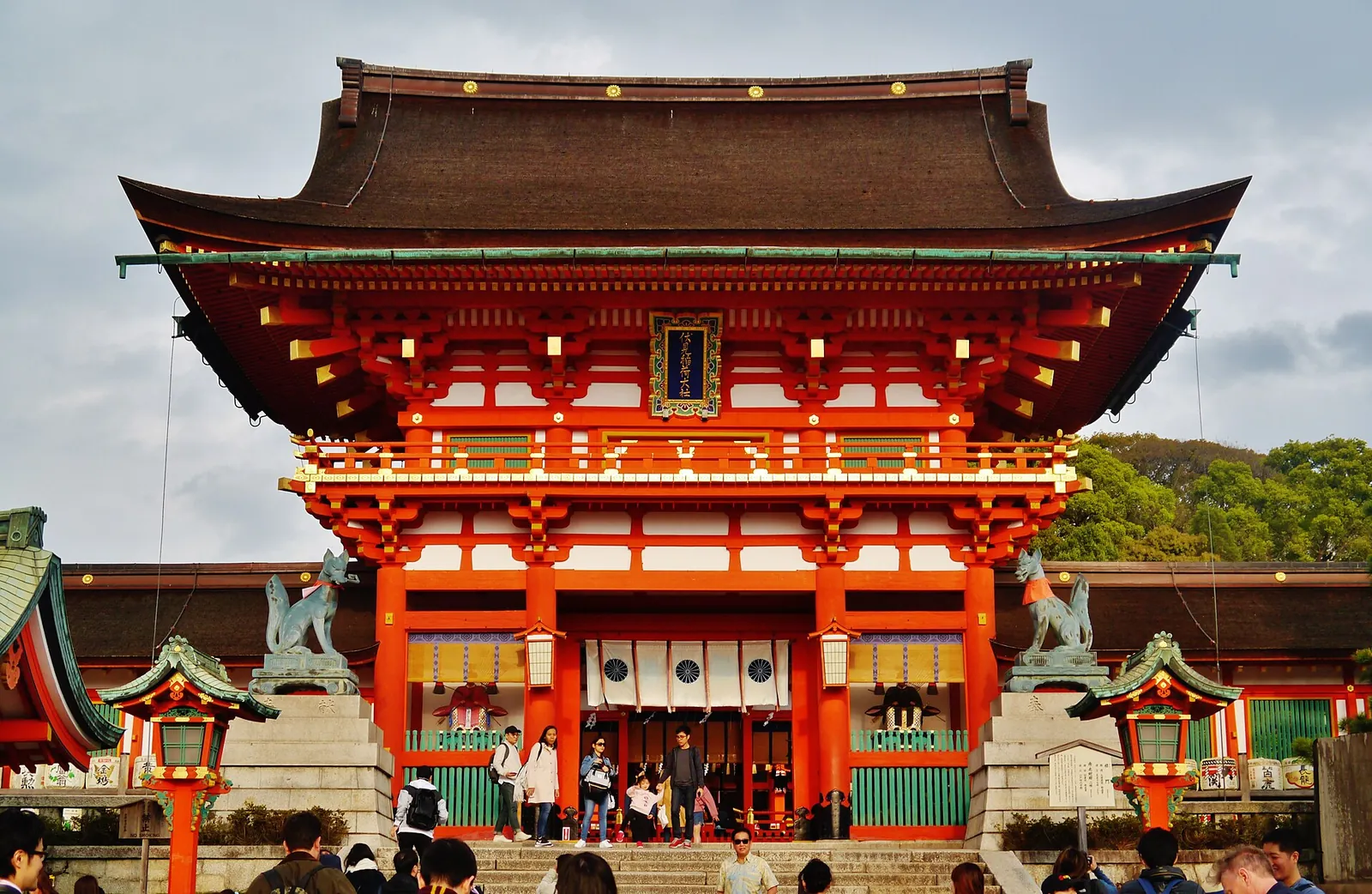
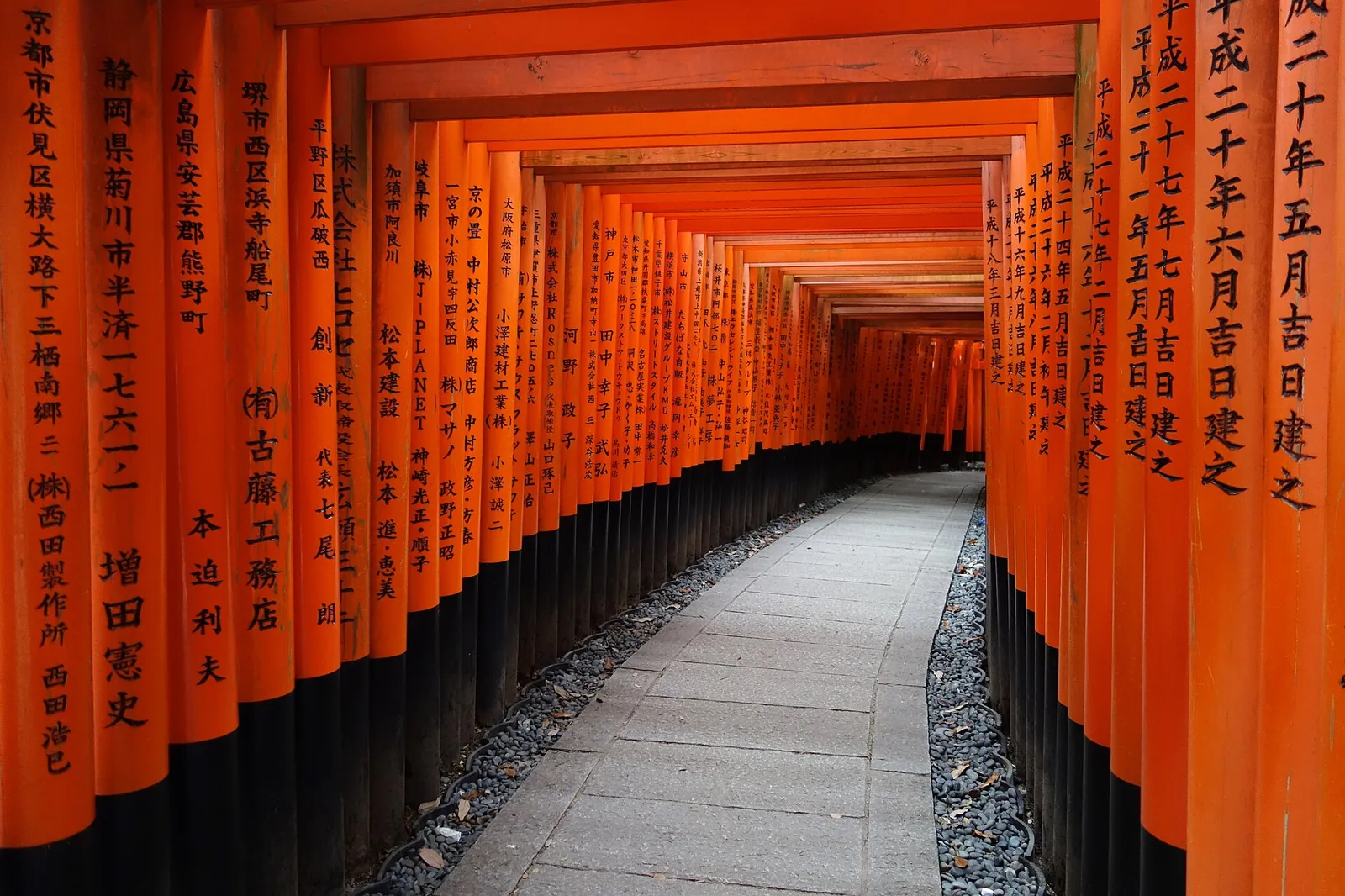
Vermilion gates arrived one donation at a time, starting in the Edo period. Each gate thanks Inari for a wish that came true, with the donor’s name and date carved on its back.
What Will You See on the Way Up?
Romon Gate frames the entrance, and the main hall sits just behind it. Purify your hands at the basin, then offer a coin and pray inside the hall.
Senbon Torii begins behind the main hall as two dense, parallel tunnels of gates. Crowds pack this stretch from late morning to mid-afternoon.
Okusha Hohaisho sits about 15 minutes up (sacredjp.com, 2026), with the Omokaru-ishi wishing stones in front. Lift one stone: light means your wish comes easily, heavy means it takes more effort.
Kumataka-sha follows at about 25 minutes (sacredjp.com, 2026), a small pond shrine where crowds thin sharply. Legend says clapping here points you toward a lost person or thing.
About 45 minutes up (sacredjp.com, 2026), the Yotsutsuji crossroads opens onto Kyoto for the first time, and its tea stalls make a natural rest stop. Most visitors turn back here without missing anything essential.
Ichinomine, the summit, takes about 90 minutes up (sacredjp.com, 2026) and stands 233 metres high (japan-guide.com, 2026). Descend by the trail that passes the Ninomine and Sannomine shrines, then rejoin the main path near the base.
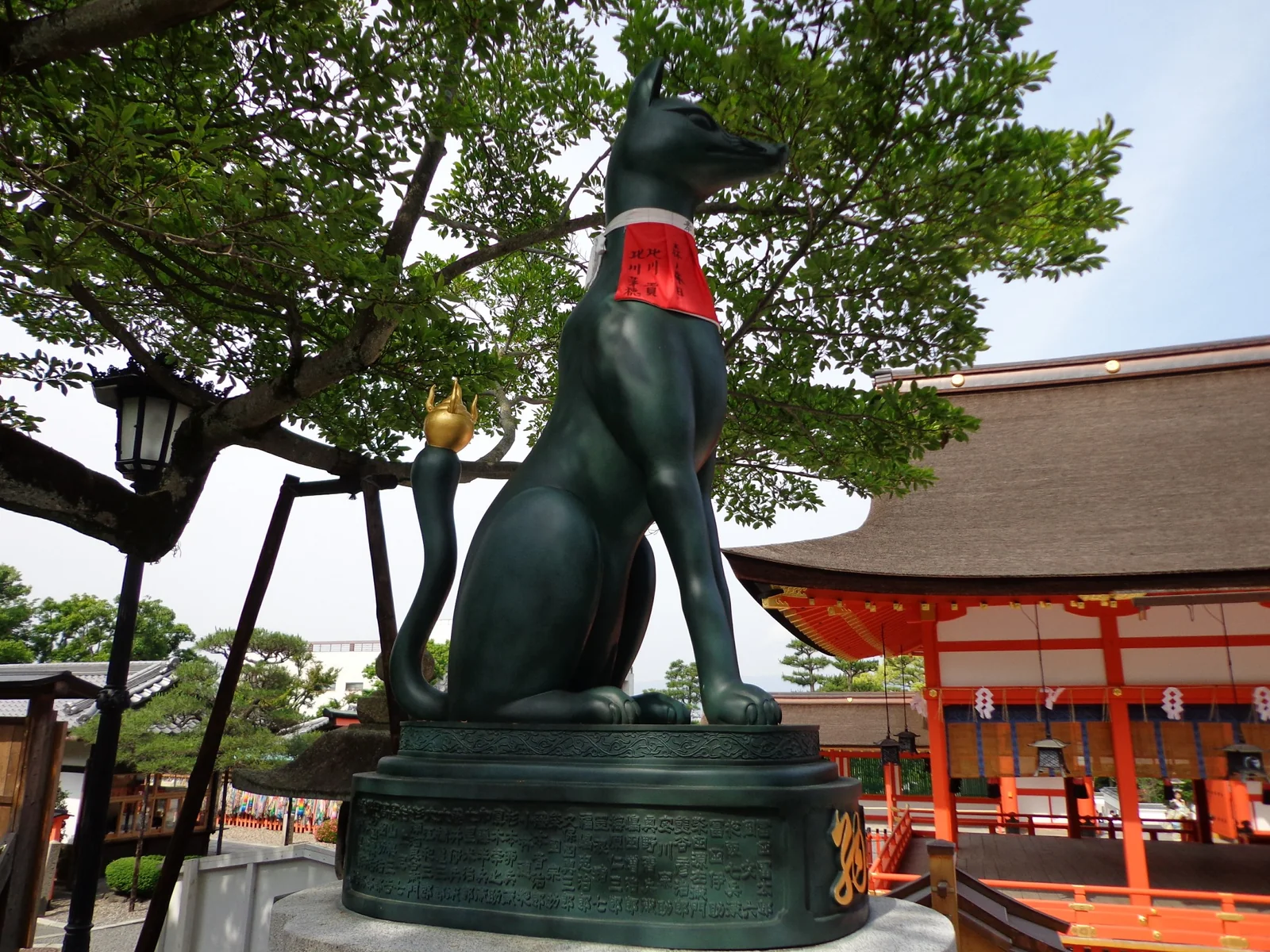
Fox statues guard the paths, each holding a key, a scroll, a jewel, or a sheaf of rice. Messengers of Inari, not the deity itself, they stand for prosperity, knowledge, harvest, and protection.
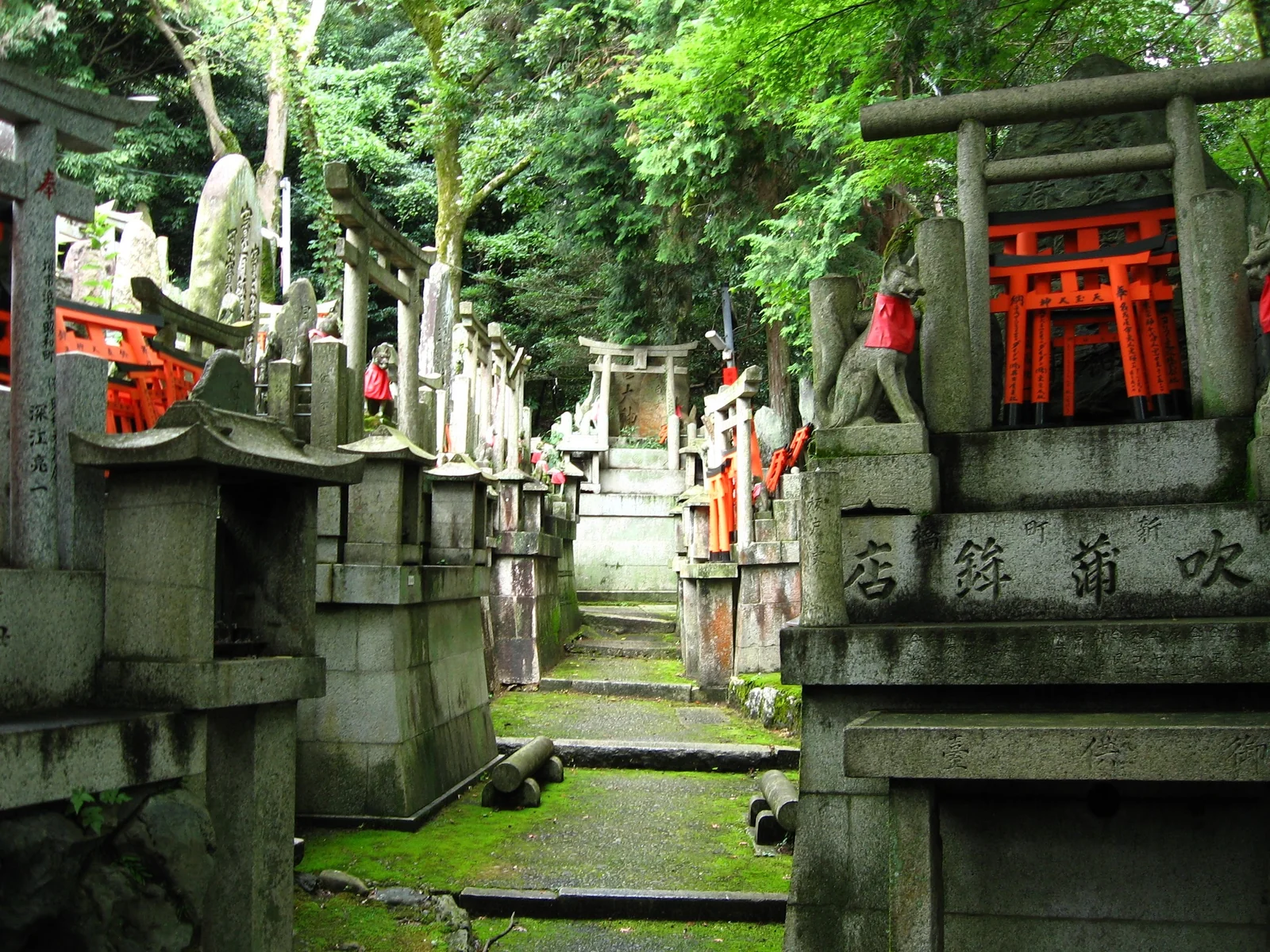
Otsuka clusters fill the forest beyond the main paths — some 10,000 tiny stone altars (sacredjp.com, 2026), each dedicated by a family or business. Speak quietly here, and never touch the offerings left on the altars.
Wild boar roam the upper mountain, so keep your distance and never feed wildlife (fushimiinaritaisha.org, 2025).
When Is the Best Time to Visit Fushimi Inari Taisha?
Beat the crowds by arriving at sunrise: before 7:30 the lower tunnels belong to a handful of early walkers, not tour groups. By 9:00 the mood changes fast, and the tunnels stay busy until about 15:00.
Evenings work too, from about 17:00, when the lower paths glow under lanterns and the crowds thin. Upper paths stay dark and uneven after sunset, so carry light when you climb late.
Spring brings cherry blossom in late March and April, while November brings autumn leaves. Both seasons draw heavy crowds, so the early start matters even more then.
Rain suits the shrine: wet vermilion glows, stone darkens, and casual visitors stay away. Wear shoes with grip, since stone steps turn slick.
Avoid New Year (1–3 January) and Golden Week (late April–early May) for sightseeing. Domestic prayer visits make those days extremely crowded.
7 Proven Tips for a Great First Visit
Seven moves separate a great visit from a rushed photo stop.
Arrive Before 8:00 — the Crowd Decides Everything
Sunrise walkers own the tunnels, while 10:00 arrivals join a slow-moving queue. Set an alarm, not a reminder: the difference between 7:00 and 9:00 is the whole visit.
Take a Local Train — Rapids Skip Inari
Board a local JR Nara Line train at Kyoto Station and get off two stops later. Rapid services pass Inari without stopping, and the next station sits far past the shrine.
Tap an IC card or buy a ¥150 ticket (japan-guide.com, 2026) at the machine. Japan Rail Pass holders ride free, since the Nara Line is a JR service.
Climb in Stages — Pick Your Stopping Point
Twenty minutes buys the Senbon Torii and the main hall, and that satisfies many visitors. Ninety minutes round trip reaches Yotsutsuji (sacredjp.com, 2026), the sweet spot for most first-timers.
Three hours completes the summit loop (japan-guide.com, 2026), with quiet forest and almost no crowds at the top. Choose before you start, then enjoy the walk instead of second-guessing it.
Read the Gates on the Way Down
Inscriptions face the return path, so climbers see plain vermilion on the way up. Turn around now and then: names, dates, and thanks from donors line every gate.
Pray the Shinto Way at the Main Hall
Rinse one hand, then the other, at the temizuya basin before approaching the hall. Drop a coin in the offering box, then follow the shrine’s own rhythm: two bows, two claps, a quiet prayer, and a final bow.
Bring Cash and Travel Light
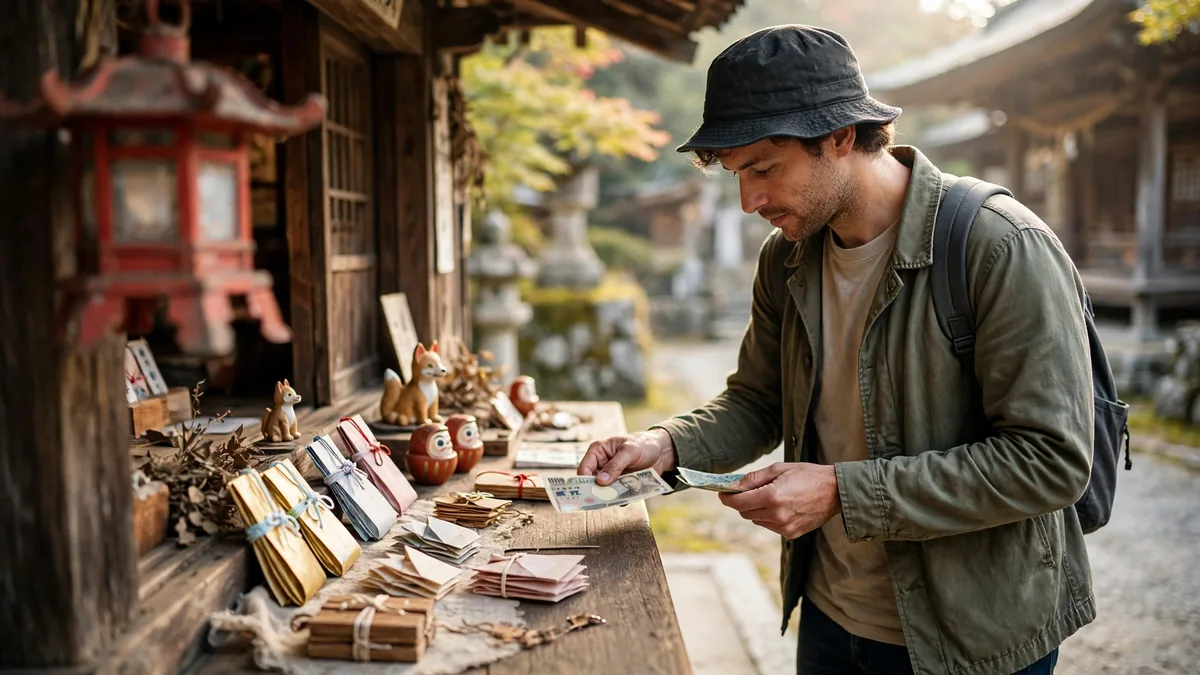
Coins cover offerings, omikuji fortunes, and the food stalls along the approach. Small shops and shrine counters rarely take cards, so carry ¥10,000–¥20,000 for the morning.
Store bags in the coin lockers at Inari Station before you cross the road. No lockers exist at the shrine itself, and the mountain paths punish heavy luggage.
Do Not Rush Back to Central Kyoto
Tofuku-ji temple sits one JR stop north, quiet where Fushimi Inari runs loud. Fifteen minutes west on foot, the Fushimi sake district pours tastings from some 30 breweries (sacredjp.com, 2026).
Inari-sushi, the shrine’s namesake food, sells fresh on the approach for about ¥500 a pack (sacredjp.com, 2026). Foxes favour fried tofu, so the dish began as an offering and became a national snack.
Etiket & Frasa Berguna
Etiket
- Wash your hands at the temizuya before approaching the main hall.
- Bow twice, clap twice, pray briefly, then bow once at the main hall.
- Keep moving where the torii tunnels narrow, and step aside for people praying at small altars.
- Lower your voice around the otsuka clusters — they are active worship spaces.
- Statues are not for climbing, altars are not shelves for bags, and offerings on the small shrines are not to be touched.
- Finish snacks at the stall that sold them instead of eating while you walk between altars.
Frasa Berguna
| Phrase | Pronunciation | Meaning |
|---|---|---|
| Konnichiwa | kon-nee-chee-wah | Hello / good afternoon |
| Sumimasen | soo-mee-mah-sen | Excuse me / sorry |
| Arigatou gozaimasu | ah-ree-gah-toh go-zai-mahs | Thank you very much |
| Ohayou gozaimasu | oh-hah-yoh go-zai-mahs | Good morning |
| Konbanwa | kon-bahn-wah | Good evening |
| Ema wo kudasai | eh-mah woh koo-dah-sai | An ema (wish plaque), please |
FAQ
Is Fushimi Inari Taisha free to enter?
Yes — entry is free, and the grounds stay open 24 hours, every day of the year (inari.jp, 2026). You pay only for what you choose: prayers, amulets, food, and the train there.
How long does the full hike take?
Two to three hours covers the roughly 4 km loop from the base to the summit and back (japan-guide.com, 2026). Visitors short on time can see the main hall and the Senbon Torii in about 20 minutes.
How do I get to Fushimi Inari Taisha from Kyoto Station?
Ride the JR Nara Line local two stops to Inari Station — about five minutes, ¥150 (around Rp16,500) (japan-guide.com, 2026). Station exit faces the shrine entrance directly across the road.
What time is best to visit Fushimi Inari Taisha?
Before 8:00 or after 17:00, when the tunnels empty and the light turns golden. Midday, roughly 10:00–15:00, brings the heaviest crowds.
Do I need a JR Pass for Fushimi Inari Taisha?
No pass is needed for the ¥150 ride (japan-guide.com, 2026), and most Kyoto sights sit beyond JR lines anyway. Pass holders still ride free on the JR Nara Line, so use it when you have one.
Is Fushimi Inari Taisha wheelchair accessible?
Partly: both nearby stations are step-free, ramps reach the main hall, and the Senbon Torii paths take wheels (lonelyplanet.com, 2026). Mountain paths beyond the tunnels use stairs, so the summit loop is not accessible.
Can I visit Fushimi Inari Taisha at night?
Yes — the grounds never close (inari.jp, 2026), and lanterns light the lower paths after dark. Upper trails stay unlit, so bring light and stay on the main path.
How This Guide Was Checked
Facts were checked 29 November 2026 against the shrine’s official site (inari.jp), japan-guide.com, sacredjp.com, fushimiinaritaisha.org, and JR fare listings. Yen figures use ¥1 ≈ Rp110, the rate applied across this article.
Walking times are the guide’s own estimates from the trail layout.
Festival dates shift each year, so confirm them on inari.jp before planning around one.
Referensi
- Fushimi Inari Taisha (official site)
- Fushimi Inari Shrine — japan-guide.com
- Fushimi Inari Taisha Guide: Hours, Routes & Access (Kyoto) — sacredjp.com
- Guide to Fushimi Inari — lonelyplanet.com
- How to Get to Fushimi Inari: JR Inari and Keihan Lines — fushimiinaritaisha.org
- Fushimi Inari Opening Hours — fushimiinaritaisha.org
- Fushimi Inari: How to Get There and How Long the Hike Takes — japantripkit.com
- Fushimi Inari Shrine Guide: Hours, Hike & Tips — citybreakgeek.com
- Fushimi Inari Luggage: Storage and Sending Bags to KIX — fushimiinaritoday.com