
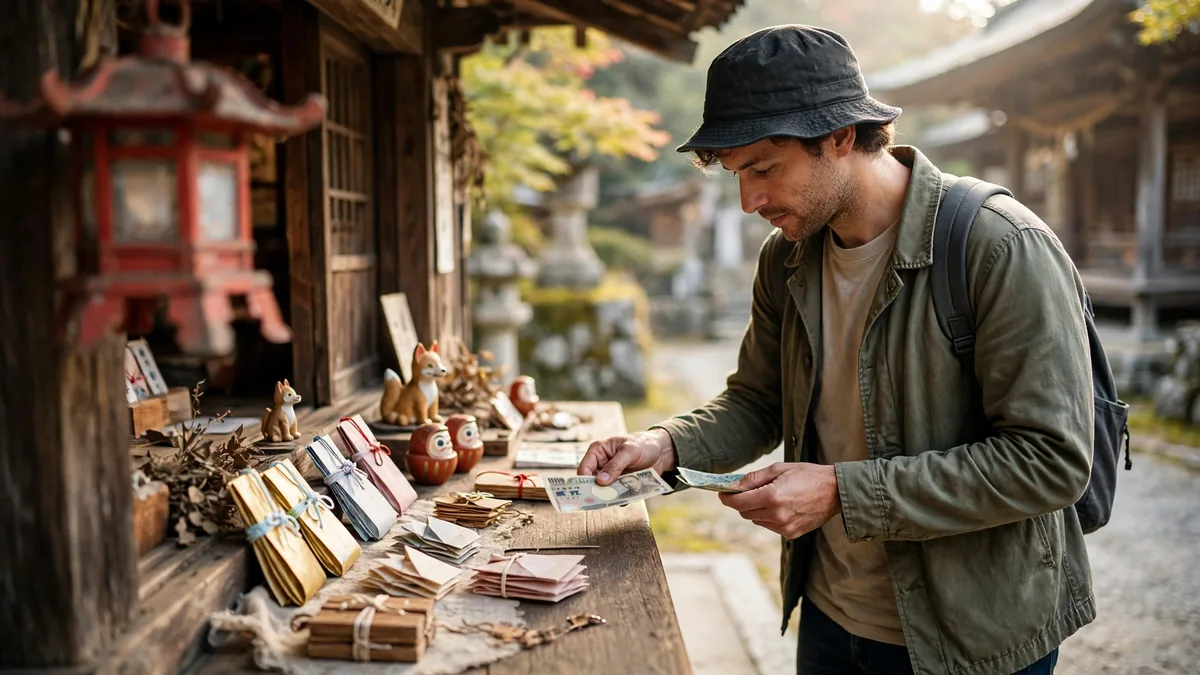
My first week in Japan taught me the money rule fast: cards pay for most of the trip, and cash saves the small moments. A ramen counter with a ticket machine, a shrine selling charms, a rural bus with a fare box — each one wanted yen, not plastic.
This guide answers the question directly: where cards work, where cash still rules, and how much yen to carry for a first trip. Figures come from Seven Bank, Japan Post Bank, and Japan’s Ministry of Economy, Trade and Industry, checked in November 2026.
Cash or Card in Japan in Short
- Cards cover most spending: cashless payments reached 58.0% of consumer spending in 2025 (METI, 2026).
- Cash still rules five spots: small restaurants, shrines and temples, markets, rural buses, and older coin lockers.
- Seven Bank ATMs pay up to ¥100,000 per withdrawal to overseas cards, and Japan Post Bank pays up to ¥50,000 (Seven Bank, 2026; Japan Post Bank, 2026).
- Start with ¥20,000–¥30,000 per person for 5–7 days in cash, refilled at 7-Eleven ATMs (Japan Prep Guide, 2026).
- Always choose yen when a terminal or ATM offers your home currency instead (Seven Bank, 2026).
How Cashless Is Japan in 2026?
Cashless payments reached 58.0% of consumer spending in 2025, with credit cards making up about 83% of that cashless share (METI, 2026). The rest stays cash, mostly at small, independent businesses.
Record crowds make the shift visible: 42,683,600 foreign visitors arrived in 2025, the most ever recorded (JNTO, 2026). Most of them paid by card in cities, then hit a cash-only counter at a temple or a market stall.
Arrivals and spending in full sit in the Japan Tourism Statistics 2026 guide.
Where Cards Work, and Where Cash Still Rules
Acceptance changes shop by shop, so treat any table as a rough map and check the logos at the door. Card logos at the register show what a shop takes (Japan Prep Guide, 2026).
| Place | Credit/debit card | IC card (Suica etc.) | Bring cash? |
|---|---|---|---|
| Convenience stores | Yes | Yes | Not needed |
| Department stores, electronics, big chains | Yes | Usually | Not needed |
| Hotels and chain restaurants | Yes | Often | Rarely |
| Shinkansen and JR ticket machines | Yes | Yes, local trains | Not needed |
| Small family restaurants and izakaya | Sometimes | Sometimes | Yes |
| Temples and shrines | Some major sites | Rarely | Yes |
| Taxis | Most in cities | Often | In rural areas |
| Festival stalls, markets, rural buses, older coin lockers | Rarely | Sometimes | Yes |
Hotels, department stores, and chain restaurants take cards almost everywhere, and convenience stores take cards, IC cards, and cash alike.
5 Places That Still Need Cash
Five kinds of places still run on cash, and they sit at the heart of most first trips. Keep small notes and coins ready for them, not just a ¥10,000 bill.
- Small family restaurants and izakaya, where the owner avoids card fees and the register takes yen only.
- Shrines and temples, for offerings, charms, and goshuin stamps that the office sells for coins and small notes.
- Markets and festival stalls, where the seller has no terminal and change comes from a cash box.
- Rural buses and local lines, where the fare box takes exact change and the driver carries no card reader.
- Older coin lockers, which still want ¥100 coins while newer models take cards or IC cards.
One more cash-only stop sits outside the five: small clinics often take cash only, while major hospitals take cards (Japan Trip Kit, 2026).
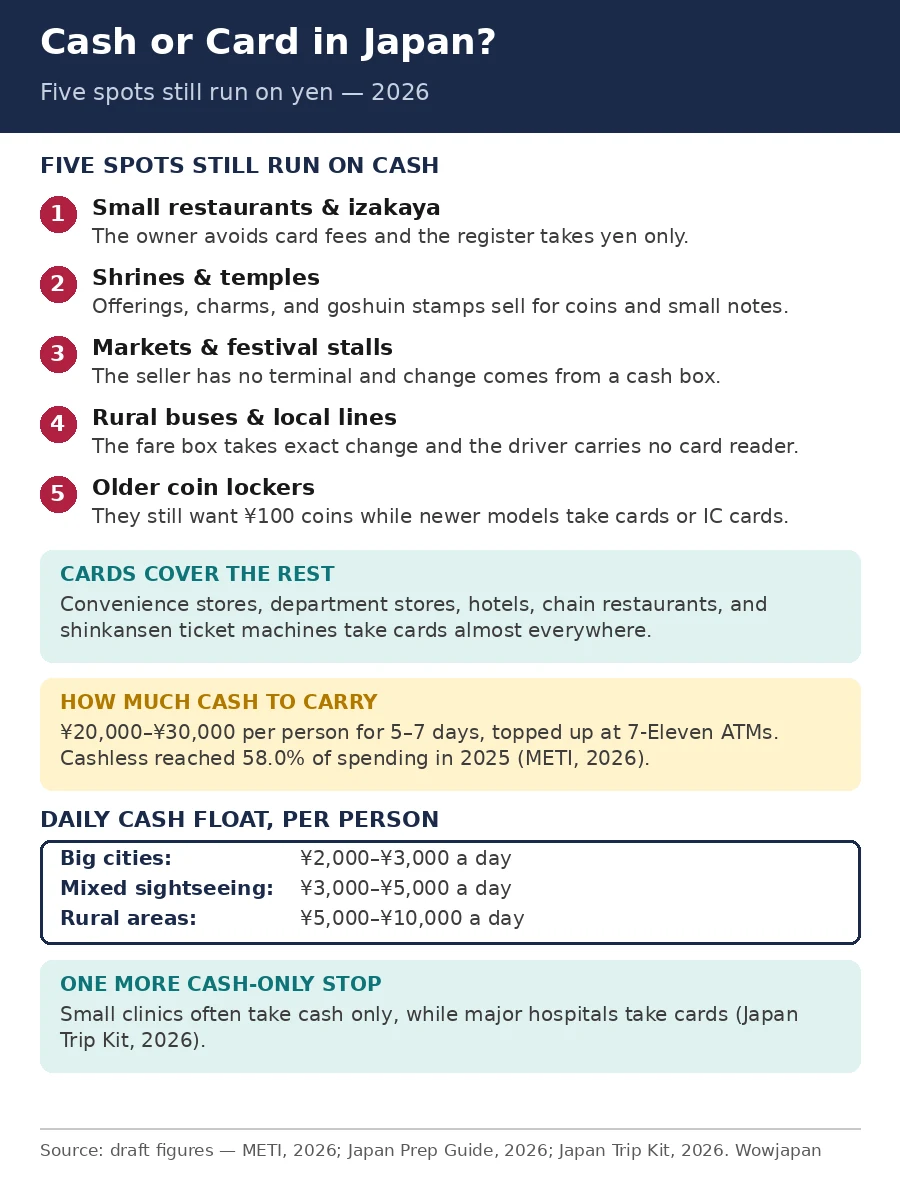
Five spots still ask for yen, from shrine counters to rural buses. Cards cover the rest of the trip.
Which ATMs Take Foreign Cards?
Japanese bank ATMs mostly refuse foreign cards, so visitors plan around two networks instead. Both publish English pages for overseas cards, and both sit where travellers already go.
| ATM network | Where | Max per withdrawal (overseas cards) | Hours and fees |
|---|---|---|---|
| Seven Bank | 7-Eleven stores, airports, some stations and malls | ¥100,000 (¥30,000 magnetic stripe) | Visa and Mastercard 24 hours; other brands about 00:10–23:50; fees vary by card brand |
| Japan Post Bank | Post offices, many FamilyMart stores | ¥50,000 | Post offices about 7:00–23:00, Sundays 7:00–21:00; FamilyMart about 00:05–23:55; ¥220 fee may apply to some cards |
Seven Bank machines stand in every 7-Eleven, at airports, and in some stations and malls. Japan Pocket Guide counts more than 28,000 of them across Japan (Japan Pocket Guide, 2026).
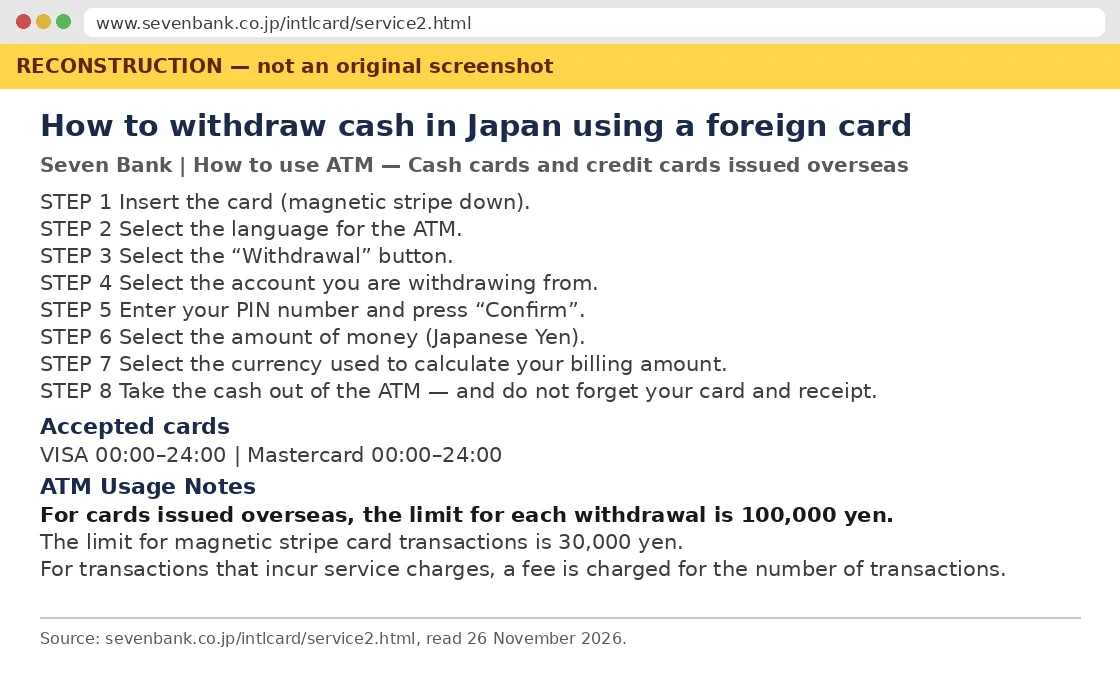
Shown here: the ¥100,000 limit for overseas cards, and ¥30,000 for magnetic stripe. Visa and Mastercard run 24 hours.
Japan Post Bank machines stand in post offices nationwide and as compact ATMs in FamilyMart stores. Hours follow the building: post offices run about 7:00–23:00 on weekdays, while FamilyMart machines run nearly all day (Japan Post Bank, 2026).
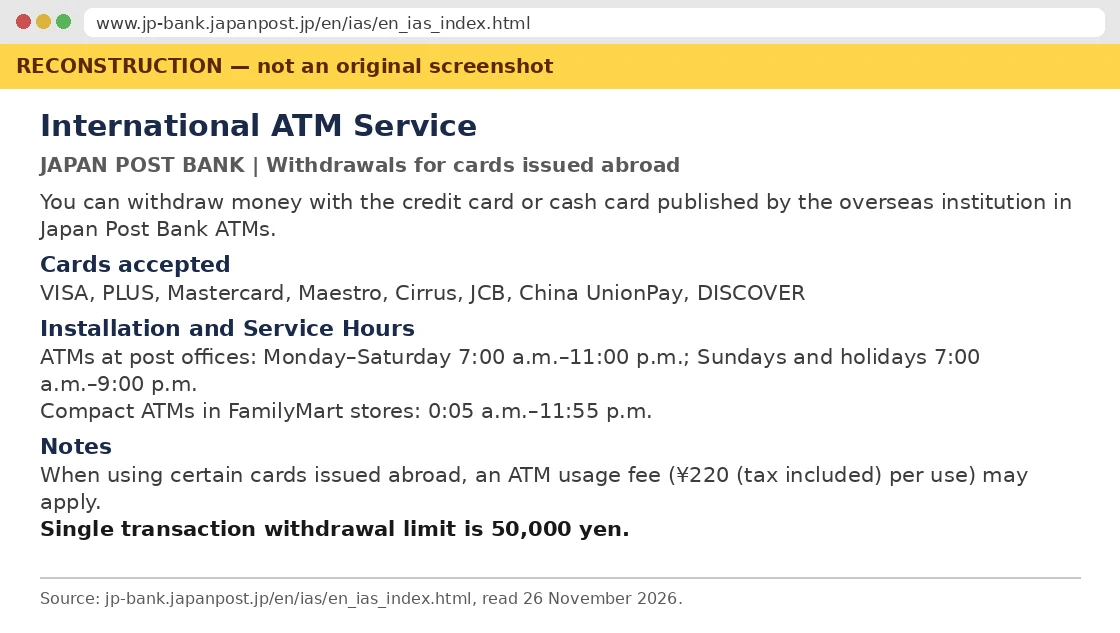
Read here: the ¥50,000 single-withdrawal limit and the ¥220 fee note. Post office machines run about 7:00–23:00; FamilyMart machines nearly all day.
Lawson Bank and E-net add backup machines in Lawson and FamilyMart stores. Treat their limits as approximate and read the fee on screen before confirming (Japan Pocket Guide, 2026).
At that screen, pick yen over your home currency. Conversion at the ATM usually costs more than your card network’s own rate (Seven Bank, 2026).
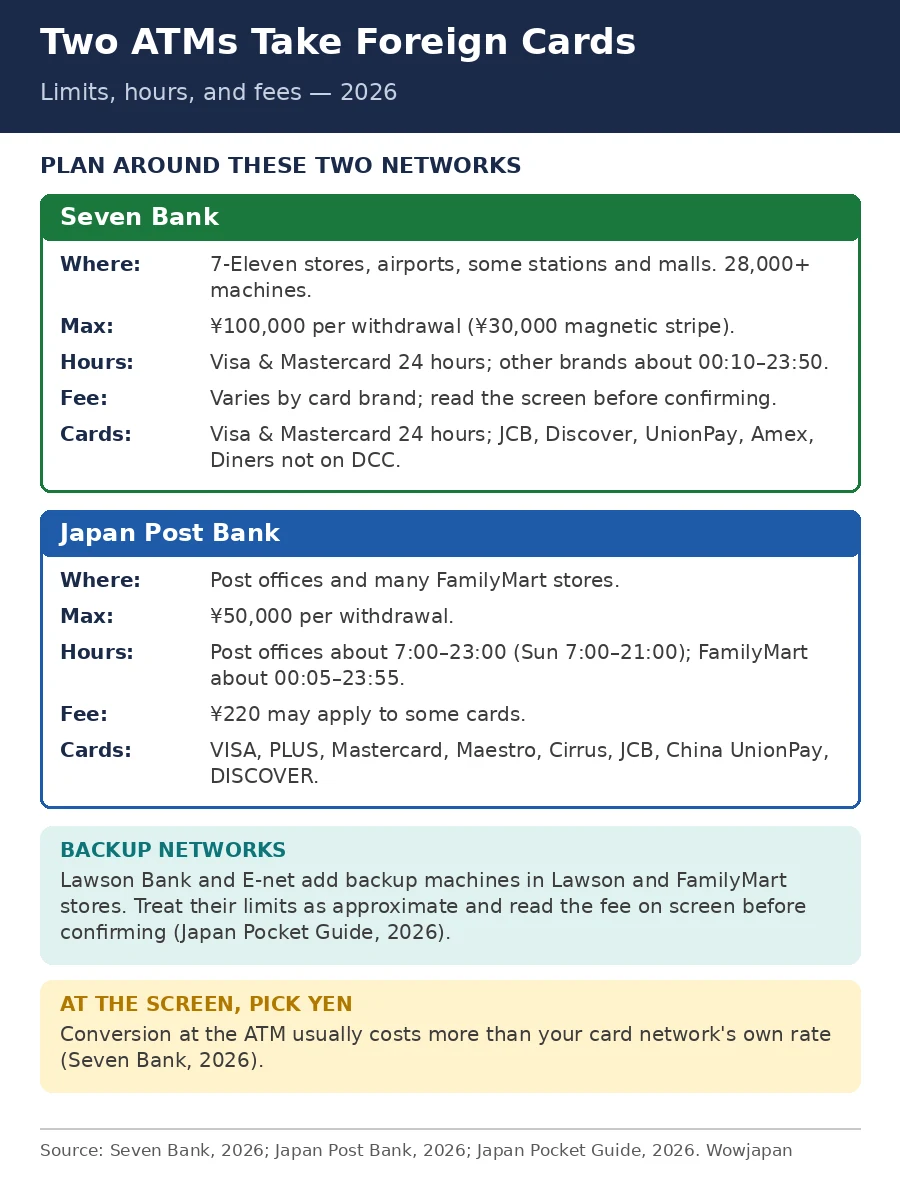
Two networks take foreign cards, with different limits and hours. Check the fee on screen before confirming.
How Much Yen Should You Carry?
Carry the trip float, not the whole trip budget, in cash. Hotels, shinkansen fares, and big dinners go on the card, so the cash only covers small daily spending.
| Trip style | Cash per person per day (approx.) |
|---|---|
| Big cities, chain shops and restaurants, IC card for transport | ¥2,000–3,000 |
| Mixed sightseeing: temples, small eateries, markets | ¥3,000–5,000 |
| Rural areas, traditional inns, festivals, local buses | ¥5,000–10,000 |
Arrive with ¥10,000–¥20,000 in hand for the train in and the first day, then take the rest from ATMs inside Japan (Japan Travel Kit, 2026).
For a 5–7 day trip, the rule of thumb runs ¥20,000–¥30,000 in cash per person, topped up at 7-Eleven ATMs (Japan Prep Guide, 2026).
A second guide puts the budget-trip float lower, at ¥2,000–¥3,000 a day, rising to ¥5,000–¥8,000 when you eat out (Japan Trip Kit, 2026).
Notes alone leave you stuck at lockers and vending machines. ¥100 coins open older lockers and feed vending machines, and small shops dislike breaking a ¥10,000 bill for tea.
IC Cards: The Middle Ground
An IC card works as a small prepaid wallet for trains, buses, konbini, and vending machines. Tap the card at the entry gate and again at the exit, and the system deducts the right fare.
Suica, PASMO, and ICOCA ride every major network in the country. One card per person covers the whole trip, since balances and rides stay personal.
Station machines reload physical cards with cash, and balances stop at ¥20,000 (Japan Prep Guide, 2026). Welcome Suica skips the deposit, lasts 28 days, and never refunds its balance; Welcome Suica Mobile runs 180 days on iPhone (Japan Prep Guide, 2026).
Phones can also tap a contactless credit card at Tokyo Metro, Toei, and many private railway gates. JR lines generally refuse card taps, so the IC card still wins there (Japan Prep Guide, 2026).
Before You Fly: A Money Checklist
Budget, seasons, and the 7-day route all sit in paying for things on a first Japan trip, the beginner guide. The Japan Trip Cost 2026 guide breaks the week down by style, from about ¥60,000 careful to ¥280,000-plus in comfort.
Passports from 74 countries skip the visa queue entirely; the Japan Visa 2026 guide lists them all. Shopping changes the arithmetic once you land: the tax-free shopping guide explains the refund system that started 1 November 2026.
Data is the other arrival job: the eSIM vs pocket WiFi guide compares 7-day prices from $14.
- Pack cards from two networks, and store them apart from each other.
- Pack a card that charges little or nothing for foreign transactions, if you own one.
- Leave the home SIM switched on so bank codes still arrive, and run data through a travel eSIM.
- Save your bank’s lost-card number where you can reach it abroad.
- Check your travel insurance wording: some policies cover stolen cash and cards, others exclude them.
Methodology
Fares, limits, and hours in this guide come from Seven Bank and Japan Post Bank pages, plus METI’s cashless figures, checked in November 2026. Cash floats are planning guides from 2026 travel guides, not official numbers, and they assume hotels and shinkansen fares go on a card.
Fares and limits shift, so confirm the current figure on the operator’s page before paying. ATM screens show the fee before you confirm, and that screen wins over any guide.
FAQ
Do I need cash in Japan?
Yes, but not much. Plan on ¥20,000–¥30,000 per person for a 5–7 day trip, and refill at 7-Eleven ATMs as it runs down (Japan Prep Guide, 2026).
Which ATMs accept foreign cards?
Two networks take them: Seven Bank in 7-Eleven stores and Japan Post Bank in post offices. Limits run ¥100,000 per withdrawal at Seven Bank and ¥50,000 at Japan Post Bank (Seven Bank, 2026; Japan Post Bank, 2026).
Should I pay in yen or my home currency?
Yen. Conversion at the terminal or ATM usually costs more than your card network’s own rate, so decline the home-currency offer.
Can I use Apple Pay or Google Pay in Japan?
Often, yes. Many chains and convenience stores take contactless Visa and Mastercard, and tap-to-pay works on many city subways. Small cash-only shops take neither, so keep yen ready.
Is tipping expected in Japan?
No. Menus show the full price, and the bill matches it. Upscale restaurants and hotels may add a service charge instead (Japan Prep Guide, 2026).
References
- Cash or Card in Japan? How Much Cash to Bring in 2026 — Japan Prep Guide
- How to withdraw cash in Japan using a foreign card — Seven Bank
- International ATM Service — Japan Post Bank
- Cash or Card in Japan (2026): Where Each Works and How Much Yen to Carry — Japan Trip Kit
- ATMs in Japan for foreign cards: which to use, withdrawal limits, fees, hours and the screens step by step — Japan Pocket Guide
- Money in Japan 2026: Cash, Cards, ATMs & Travel Insurance — Japan Travel Kit
- Number of visitor arrivals to Japan — JNTO
- Calculated the 2025 Cashless Payment Ratio — METI
2 thoughts on “Do You Need Cash in Japan? 5 Cash-Only Spots in 2026”