

Main image: AI illustration.
A Japan visa in 2026 costs five times what it cost the year before, and most travelers still do not need one at all.
That split — steep fees for some, no visa for most — is the whole story of the Japan visa 2026 rules. It rewards one habit above all: check your passport against the official list before you book anything.
Japan Visa 2026 in Short
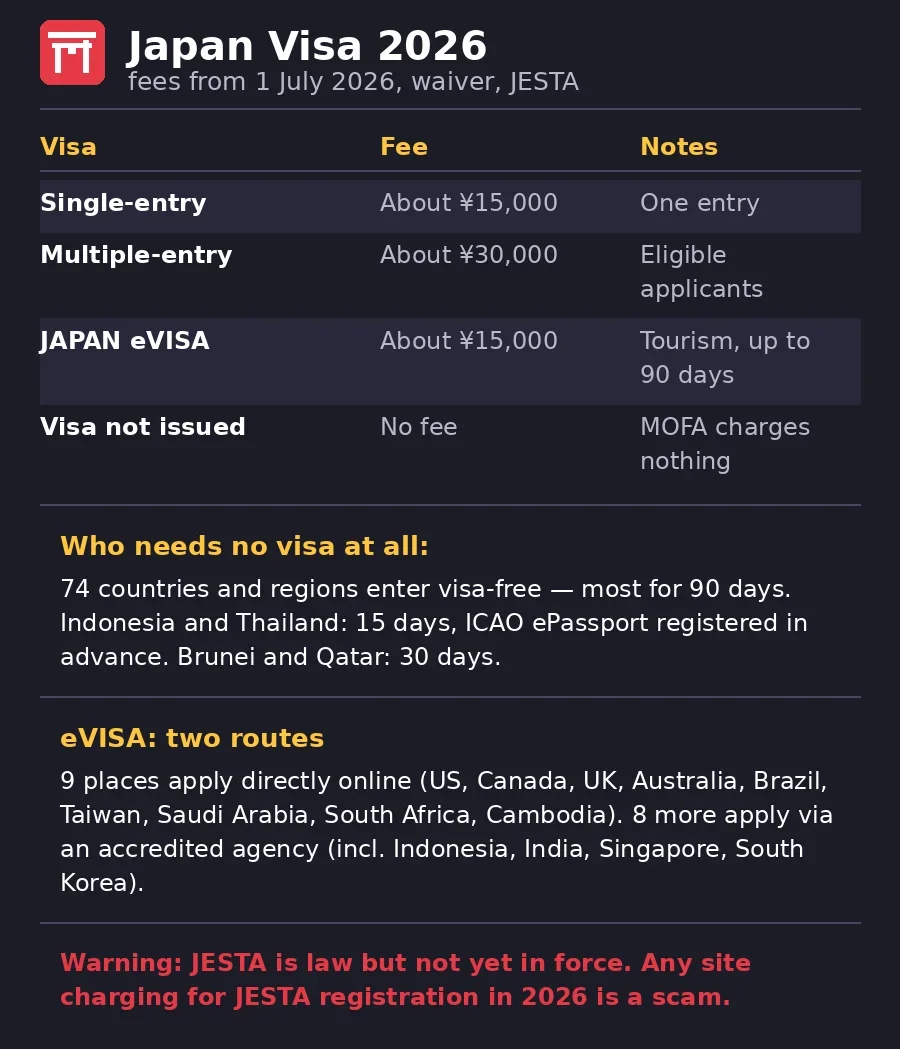
- Single-entry visas cost about ¥15,000 and multiple-entry visas about ¥30,000 for applications accepted from 1 July 2026 (MOFA, 2026).
- Citizens of 74 countries and regions enter visa-free, most for 90 days (MOFA, 2025).
- JAPAN eVISA covers single-entry tourist visas of up to 90 days, applied for online (MOFA, 2026).
- JESTA, the coming travel authorization for visa-free visitors, is law but not yet in force (Immigration Services Agency, 2026).
Visa rules change without much warning. Check the MOFA list and your local Japanese embassy before you apply.
Treat any fee quoted here as current only on the day you read it.
Do You Need a Visa for Japan?
Your passport decides the answer, not your destination. Japan grants visa-free entry to 74 countries and regions, and everyone else applies in advance (MOFA, 2025).
Short stays cover tourism, business meetings, and visits to friends or relatives, up to 90 days for most passports (MOFA, 2025). Work of any kind needs a different visa, and this guide does not cover it.
Three countries joined the visa-free list in 2025. Paraguay joined from 1 June, Peru from 1 July, and Montenegro from 1 September, each for ePassport holders (MOFA, 2025).
If your passport is new to the list, confirm the ePassport condition before you travel.
The 74 Visa-Free Countries
Most travelers from the United States, Canada, the United Kingdom, Australia, and New Zealand land without a visa. Singapore, South Korea, and most of Europe join them, with 90 days on arrival (MOFA, 2025).
Four passports get shorter stays, and the exceptions catch people out.
| Passport | Stay on arrival | Condition |
|---|---|---|
| Most of the 74, including the US, Canada, UK, EU, Australia, New Zealand, Singapore, South Korea | 90 days | Ordinary passport |
| Indonesia, Thailand | 15 days | ICAO ePassport; Indonesia registers it in advance |
| Brunei, Qatar | 30 days | Qatar registers its ePassport in advance |
| Brazil, Malaysia, UAE, Paraguay, Peru, Montenegro, Panama, Serbia | 90 days | ICAO ePassport required |
Indonesia shows how the conditions work. Its citizens need an ICAO ePassport registered in advance at a Japanese mission in Indonesia (MOFA, 2025).
Registration lasts three years or until the passport expires, whichever comes first. Qatar follows the same registered-passport rule for its 30 days.
Germany, the United Kingdom, Ireland, Austria, Switzerland, Liechtenstein, and Mexico hold a quieter perk. Their agreements allow stays up to six months.
Any stay past 90 days needs an extension from the Immigration Services Agency before day 90 ends (MOFA, 2025).
What a Japan Visa Costs Now
Fees changed on 1 July 2026, and the date that matters is the day your application is accepted. Applications accepted from that date cost about ¥15,000 for a single entry and about ¥30,000 for multiple entries (MOFA, 2026).
Each embassy converts the yen amount into local currency, so the figure on your receipt moves with the exchange rate. MOFA charges nothing when a visa is not issued, and some nationalities pay less or nothing under reciprocal deals (MOFA, 2026).
| Visa | Fee from 1 July 2026 | Notes |
|---|---|---|
| Single-entry tourist visa | About ¥15,000 | Paid in local currency; valid for one entry |
| Multiple-entry visa | About ¥30,000 | For eligible applicants |
| JAPAN eVISA, single-entry | About ¥15,000 | Tourism only; up to 90 days |
| Visa not issued | No fee | MOFA charges nothing when no visa is granted |
Fivefold sounds dramatic, and it is: the old fees were ¥3,000 and ¥6,000, unchanged since 1978 (MOFA, 2026). Travelers from visa-exempt countries pay nothing at all, which makes the waiver the cheapest document in travel.
How to Apply: eVISA or Embassy
JAPAN eVISA handles single-entry tourist visas of up to 90 days, entirely online. Residents of nine places apply directly on the official portal (MOFA, 2026).
Australia, Brazil, Cambodia, Canada, Saudi Arabia, South Africa, Taiwan, the United Kingdom, and the United States make the list.
Eight more places of residence go through an accredited agency instead (MOFA, 2026). Hong Kong, India, Indonesia, Macau, Mongolia, South Korea, Singapore, and the United Arab Emirates make that list.
South Korea’s Jeju consular district is the one exception inside that list.
Expect about five working days after a complete application, though MOFA warns that extra checks can stretch the wait past a month (MOFA, 2026). Apply no earlier than three months before travel, and never pay through a lookalike site: the only portal is evisa.mofa.go.jp.
Approval brings one more rule worth knowing. Travelers with an eVISA must display the “Visa issuance notice” online at the airport, and screenshots or printed copies are not accepted (MOFA, 2026).
Paper applications still exist for every visa the eVISA does not cover. Visit the Japanese embassy or consulate for your place of residence, and confirm its document list first — requirements vary by mission (MOFA, 2026).
Start with your passport: it must stay valid for your whole trip, and ePassport holders from several countries need the chip version (MOFA, 2025). Each mission publishes its own document list, so confirm it on the mission’s site before you gather papers (MOFA, 2026).
JESTA: The Travel Authorization That Is Not Here Yet
JESTA will one day ask visa-free travelers to register online before flying, much like the American ESTA. The law creating it passed Japan’s Diet on 29 May 2026, and the government plans to start it in fiscal 2028 (Immigration Services Agency, 2026).
No final start date exists yet, and no traveler needs JESTA today. Treat any site charging for JESTA registration in 2026 as a scam, and check the Immigration Services Agency before your trip for the launch announcement.
Visa-required travelers keep applying as they do now; the authorization is only for visa-free visitors.
Before You Fly: Visit Japan Web
Visit Japan Web, run by Japan’s Digital Agency, lets you complete immigration and customs forms online before landing. Paper forms still work, but the digital queue moves faster at Narita and Haneda (Digital Agency, 2026).
Budget one more line: the departure tax. Japan’s International Tourist Tax rose from ¥1,000 to ¥3,000 on 1 July 2026 (JNTO, 2026).
Airlines fold it into the ticket price, so most travelers never see it as a separate charge.
The Decision: Check First, Book Second
Start with the MOFA list, not with a flight search. A two-minute check of your passport against the 74 names settles the visa question.
No fee bites when your passport is on the list.
With the visa question settled, the money question follows. The Japan trip cost 2026 guide breaks down what seven days actually cost, and the 7-day itinerary turns those numbers into a route.
Methodology
Facts here come from MOFA’s visa pages, the JAPAN eVISA FAQ, JNTO’s tourist tax notice, and the Digital Agency, all read in November 2026.
Fees and lists are quoted as published on those pages, with the check date in References.
Prices in yen are the official figures; local-currency amounts move with the exchange rate.
Nothing here comes from a visa agent, and no fee was paid to any source.
An AI-assisted first draft was checked by hand against every source in References.
Frequently Asked Questions
Do I need a visa for Japan?
It depends on your passport. Citizens of 74 countries and regions enter visa-free (MOFA, 2025), and everyone else applies in advance.
How much does a Japan visa cost in 2026?
About ¥15,000 for a single entry and about ¥30,000 for multiple entries, for applications accepted from 1 July 2026 (MOFA, 2026).
Can I apply for a Japan visa online?
Yes, through JAPAN eVISA, if you live in one of the nine direct-application countries or apply via an accredited agency (MOFA, 2026). Tourism is the only purpose the eVISA covers.
What is JESTA, and do I need it?
JESTA is Japan’s coming electronic travel authorization for visa-free visitors, passed into law in May 2026 but not yet in force (Immigration Services Agency, 2026). Nobody needs it for travel today.
How long does a Japan visa take?
About five working days after a complete application, though extra checks can stretch it past a month (MOFA, 2026). Earliest applications open three months before travel.
References
- Visa Fees — Ministry of Foreign Affairs of Japan
- Exemption of Visa (Short-Term Stay) — Ministry of Foreign Affairs of Japan
- The JAPAN eVISA system — Ministry of Foreign Affairs of Japan
- JAPAN eVISA FAQ — Ministry of Foreign Affairs of Japan
- Japan’s International Tourist Tax is Increasing – Japan National Tourism Organization
- Visit Japan Web — Digital Agency
- The 2026 amendment to the Immigration Control Act — Immigration Services Agency