
Main image: AI illustration.
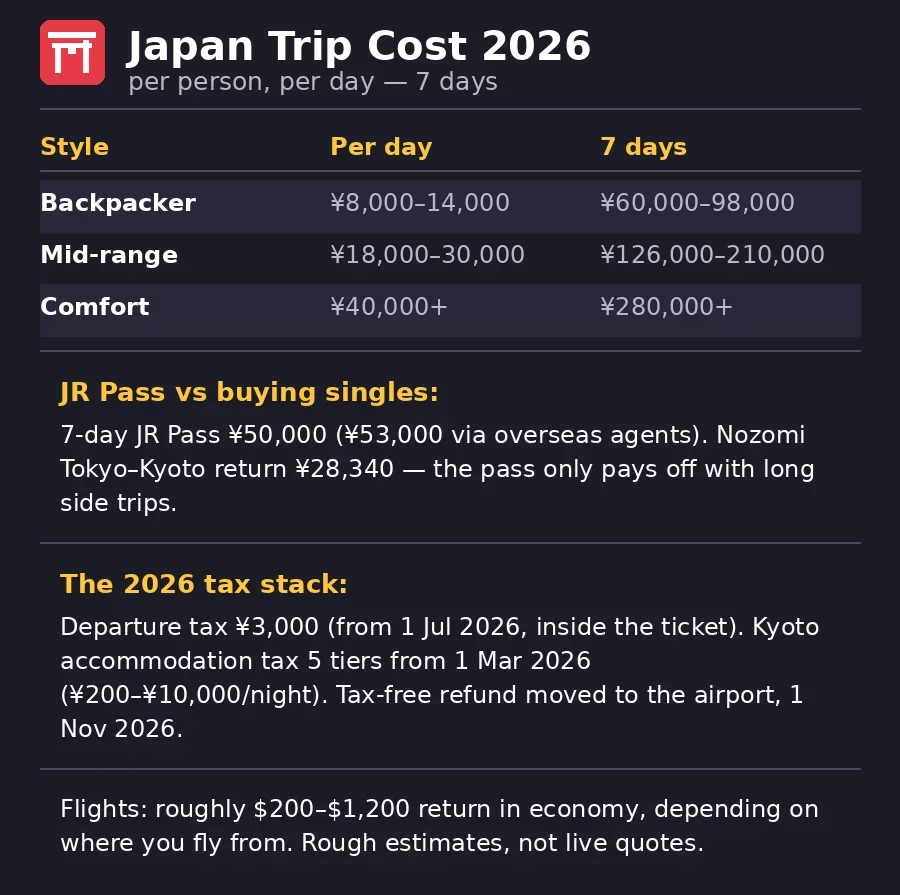
Seven days in Japan costs less than most travelers fear, and more than the cheapest guides admit. One person needs about ¥60,000 on a careful backpacker budget, and ¥280,000 or more in comfort, before flights (Japan Tourism Agency, 2026).
Flights swing the total more than any other line. Route, season, and sleep style decide the rest, so this guide prices each part on its own.
Japan Trip Cost 2026 in Short
The ranges below come from 2026 travel guides and the Japan Tourism Agency (2026).
- Backpacker: about ¥8,000–¥14,000 a day, or ¥60,000–¥98,000 for seven days, before flights.
- Mid-range: about ¥18,000–¥30,000 a day, or ¥126,000–¥210,000 for seven days, before flights.
- Comfort: ¥40,000 a day and up, or ¥280,000 and more for seven days, before flights.
- The JR Pass pays off only on heavy rail weeks; a Tokyo–Kyoto return alone costs less than the pass.
- Flights: roughly $200–$1,200 return in economy, depending on where you fly from.
What Does a 7-Day Japan Trip Cost in Total?
This table turns the summary ranges into per-day and 7-day totals (Japan Tourism Agency, 2026).
| Style | Per day | 7 days | Who it fits |
|---|---|---|---|
| Backpacker | ¥8,000–¥14,000 | ¥60,000–¥98,000 | Hostels, konbini meals, city passes |
| Mid-range | ¥18,000–¥30,000 | ¥126,000–¥210,000 | Business hotels, sit-down meals, some trains |
| Comfort | ¥40,000+ | ¥280,000+ | Central hotels, fine dining, Green Car |
These ranges come from 2026 Japan travel guides that agree with each other, and the Japan Tourism Agency reports a similar scale. Foreign visitors spent about ¥244,457 per stay on average in April to June 2026, over stays averaging 8.7 nights (Japan Tourism Agency, 2026).
That average covers trips of many lengths, so treat it as a sanity check. Your own total depends on how many nights you sleep in Tokyo and Kyoto, where rooms cost the most.
How Much Do Flights to Japan Cost?
Fares swing the total more than any other line, so here are rough 2026 estimates (Tokyo Tourism, 2026). Treat them as planning figures, not quotes, and check live prices before you book.
| From | Rough return fare, economy |
|---|---|
| Southeast Asia | $200–$450 |
| Australia | AUD 900–1,400 |
| United Kingdom | £430–£700 |
| Continental Europe | €500–€800 |
| United States | $650–$1,200 |
These are typical good fares for round trips in economy (Tokyo Tourism, 2026). From Jakarta, low-cost one-stop returns run about Rp6–8 million, while direct full-service flights start near Rp10.5 million (Japan Travel Dreams, 2026).
Three habits keep fares down. Book early, fly midweek, and compare the shoulder seasons — late autumn and late winter — against cherry blossom week and Golden Week.
Arrive through Tokyo or Osaka, the two hubs with the most competition. Smaller airports can look cheaper until the domestic connection is added.
Where Should You Sleep, and What Does It Cost?
Sleep is the second-biggest line after flights, and the gap between choices is wide. Hostel dorm beds run ¥3,500–¥5,000 a night in 2026, while a business hotel room runs ¥9,000–¥15,000 (TravelDojo, 2026).
Tokyo and Kyoto rooms cost more: the same business hotel room runs about ¥12,000–¥22,000 a night. Choose a room near a JR station and the saved taxi fares often cover the premium.
Capsule hotels and hostels suit solo travelers who spend the day outside. Families and couples usually get better value from a business hotel room shared between two.
Kyoto’s rooms carry a tax on top of the rate. Since 1 March 2026, the city charges ¥200 a night for rooms under ¥6,000 (City of Kyoto, 2026).
Top tiers reach ¥10,000 a night for rooms over ¥100,000 (City of Kyoto, 2026).
Is the JR Pass Worth It in 2026?
Most 2026 guides quote one JR Pass price, and most of them are wrong. Two prices now exist: ¥50,000 on the official site, and ¥53,000 through overseas agents (JR Group, 2026).
Agency prices rose on 1 October 2026, while the online price stays frozen for a limited time (JR Group, 2026). JR has not published an end date for the freeze, so check the official site before you buy.
| Pass | Online (official site) | Overseas agent |
|---|---|---|
| 7-day Ordinary | ¥50,000 | ¥53,000 |
| 14-day Ordinary | ¥80,000 | ¥84,000 |
| 21-day Ordinary | ¥100,000 | ¥105,000 |
| 7-day Green | ¥70,000 | ¥74,000 |
Children aged 6 to 11 pay half price (JR Group, 2026). Run the arithmetic below to see when the pass pays for itself — and when it does not.
Take the classic first-timer route: Tokyo to Kyoto and back on the Nozomi. Reserved seats cost ¥14,170 each way in the regular season, so the return runs ¥28,340 (JR Central, 2026).
That is ¥21,660 short of the ¥50,000 pass, before any other ride. Add a Kyoto day trip to Nara (¥720 each way) and the Osaka hop (¥580 each way), and the pass still loses (JR Central, 2026).
Longer routes flip the result. With a Tokyo–Kyoto–Hiroshima week, or daily long rides, the same ¥50,000 turns into a saving instead of a cost.
One more charge hides inside the pass. Riding the fastest Nozomi or Mizuho trains with a pass needs a supplement.
Each way costs ¥4,960 between Tokyo or Shinagawa and Kyoto (JR Central, 2026).
What Does Food Cost in Japan?
Food is where Japan surprises first-timers twice: once with the quality, once with the price. Ramen costs ¥1,000–¥1,300 a bowl, and a beef bowl runs ¥500–¥700 (TravelDojo, 2026).
Convenience stores fill the gaps between meals. An onigiri rice ball costs ¥130–¥200, and a full konbini lunch stays under ¥1,000 for most travelers (TravelDojo, 2026).
Dinner costs the most, and the range is wide. Izakaya evenings run ¥3,000–¥5,000 per person, while a sit-down restaurant meal lands between that and fine dining (TravelDojo, 2026).
Konbini and noodle meals, three a day, add up to about ¥3,000 (TravelDojo, 2026). Relaxed days of sit-down meals land near ¥6,000, and water is free at most restaurants.
What Do Sights and City Transport Cost?
Venue fees below are from the official venue pages and 2026 guides (2026).
Temples and castles are cheap by world standards, and one famous shrine costs nothing at all. Fushimi Inari in Kyoto is free, while Kinkaku-ji and Kiyomizu-dera each charge ¥500 (2026).
Two 2026 fee changes catch repeat visitors out. Ginkaku-ji doubled to ¥1,000 on 1 April 2026, and Nijo Castle charges ¥800, or ¥1,300 with the Ninomaru Palace.
In Nara, Todai-ji charges ¥800 for the Great Buddha Hall, and each of its four halls takes cash only (2026).
In Osaka, the castle tower costs ¥1,200, double the ¥600 older guides still quote (2025).
Its surrounding park is free and open at all hours.
City transport is a small line, and day passes shrink it further. City buses cost a flat ¥230 a ride, and the Kyoto Subway and Bus 1-day pass costs ¥1,100 (2026).
Day trips between cities stay cheap on local trains. Osaka runs ¥580 from Kyoto on the JR Special Rapid in about 28 minutes, and Nara runs ¥720 in about 45 minutes (JR West, 2026).
What Hidden Taxes and Fees Should You Budget?
Three 2026 changes sit outside the daily budget, and all three are easy to miss. All three take a little more than last year: the departure tax, the Kyoto room tax, and the new tax-free shopping system.
Japan’s International Tourist Tax rose from ¥1,000 to ¥3,000 on 1 July 2026 (JNTO, 2026). Airlines fold it into the ticket, so you will not see it as a separate charge.
Kyoto’s accommodation tax started on 1 March 2026 and scales with the room price (City of Kyoto, 2026). Budget ¥200 a night at the cheapest rooms, and up to ¥1,000 a night in the middle tiers (City of Kyoto, 2026).
Tax-free shopping changed on 1 November 2026 (JNTO, 2026). Visitors now claim the refund at the airport instead of at the shop, so keep your receipts until departure.
How Can You Cut the Cost Without Cutting the Trip?
Sleep in two cities, not three. Kyoto and Osaka sit 28 minutes apart by train, so one Kyoto base covers both and saves a hotel move.
Eat where office workers eat. Station noodle shops and department-store basements serve the same quality as tourist streets at half the price.
Walk the free sights early and pay for one big ticket a day. Fushimi Inari, the Nara deer park, and riverside walks cost nothing, and they fill a morning well.
Buy the JR Pass only after doing the arithmetic above. The wrong pass is the most expensive souvenir of the trip.
A Note on Prices
Prices in this guide come from official sources and 2026 travel guides, and they move with the season and the exchange rate. Check the official JR and venue sites before you book, and treat every figure here as a planning estimate.
Seven days in Japan rewards the traveler who prices the trip before booking it. Pick your tier, do the rail arithmetic, and spend the savings on one meal you will remember.
Your next step is the route itself. Next, the 7-day itinerary turns these numbers into a day-by-day plan, and the Japan visa 2026 guide checks whether you need a visa first.
Methodology
Every price in this guide was checked against an official source or against at least two independent 2026 travel guides. Flight figures are rough 2026 estimates by origin region, not live quotes, so check live fares before you book.
An AI-assisted first draft was checked by hand against every source in References.
Frequently Asked Questions
How much does a 7-day Japan trip cost in 2026?
About ¥60,000–¥98,000 for a backpacker, ¥126,000–¥210,000 mid-range, and ¥280,000 or more in comfort (Japan Tourism Agency, 2026). Airfares sit on top of those figures, roughly $200–$1,200 return in economy by origin (Tokyo Tourism, 2026), and Tokyo and Kyoto rooms cost the most.
Is the JR Pass worth it for a first trip?
Only when your route includes several long rides. Tokyo–Kyoto returns cost ¥28,340 (JR Central, 2026), well under the ¥50,000 pass, so a Hiroshima leg or daily long rides must fill the gap.
How much should I budget for food per day?
About ¥3,000 a day for konbini and noodle meals (TravelDojo, 2026), and near ¥6,000 for relaxed sit-down eating. Ramen bowls run ¥1,000–¥1,300, and an izakaya dinner runs ¥3,000–¥5,000 per person (TravelDojo, 2026).
What is the cheapest way to travel between Tokyo, Kyoto, and Osaka?
Book the shinkansen early through SmartEX for the Tokyo–Kyoto leg, and use local JR trains between Kyoto and Osaka. Kyoto–Osaka takes 28 minutes on the JR Special Rapid, for ¥580 (JR West, 2026).
Are there any hidden costs I should know about?
Yes, three. Departure tax now runs ¥3,000 (JNTO, 2026), and Kyoto charges an accommodation tax from ¥200 a night (City of Kyoto, 2026).
Refunds moved to the airport in November 2026 (JNTO, 2026).
References
- Japan Rail Pass — Official Site
- Price Changes for the Japan Rail Pass — JR East
- Kyoto’s Accommodation Tax to Change Starting March — Kyoto City Official Travel Guide
- Japan’s International Tourist Tax Is Increasing — JNTO
- Inbound Consumption Survey Explained: Q2 2026 — HotelBank
- Cheap Flights to Tokyo: Airlines, Routes & Tips (2026)
- How Much Does a Japan Trip Cost from Indonesia? 7-Day Budget (2027)
- TravelDojo — Japan Travel Costs
- smartEX Service Prices (Reserved Seat in Ordinary Cars) — JR Central