
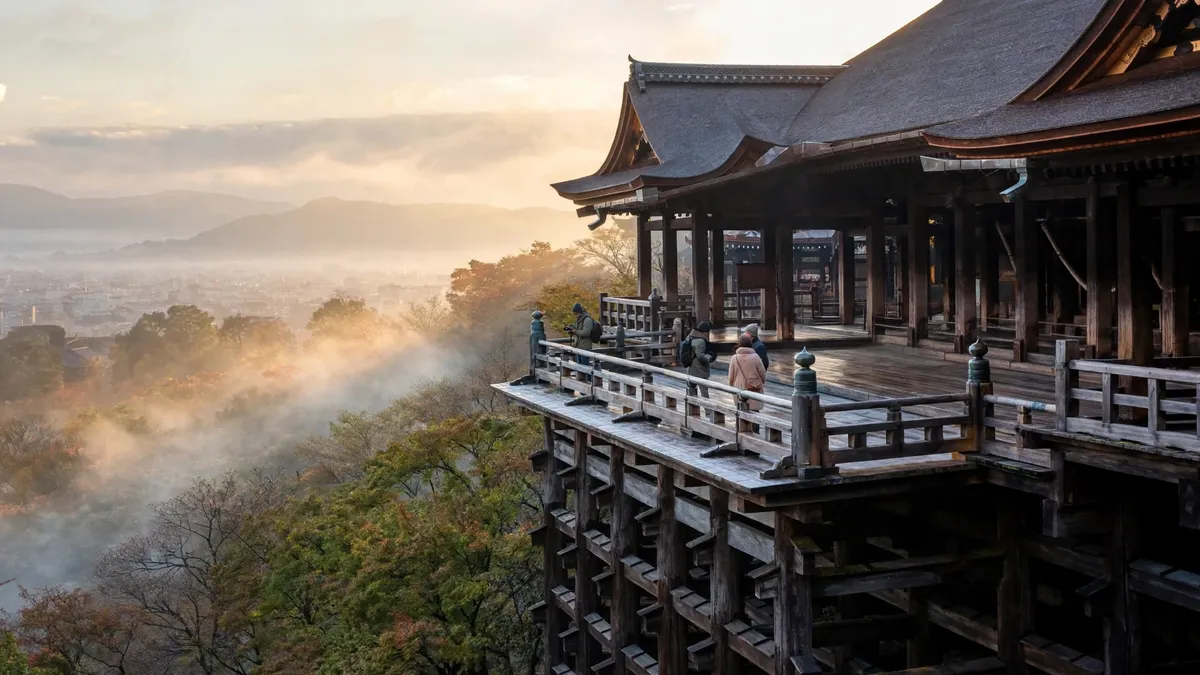
Main image: AI illustration.
Kyoto at 6:00 (Kiyomizu-dera, 2026) belongs to the temple sweepers and a handful of early risers. That quiet hour is where this itinerary earns its keep.
Seven days, three cities, two hotel bases, and one rule: mornings belong to the sights, evenings belong to the streets.
Everything below runs on trains and feet, with prices checked against the venues themselves in 2026. Start in Tokyo, move once to Kyoto, and let Osaka come to you as a day trip.
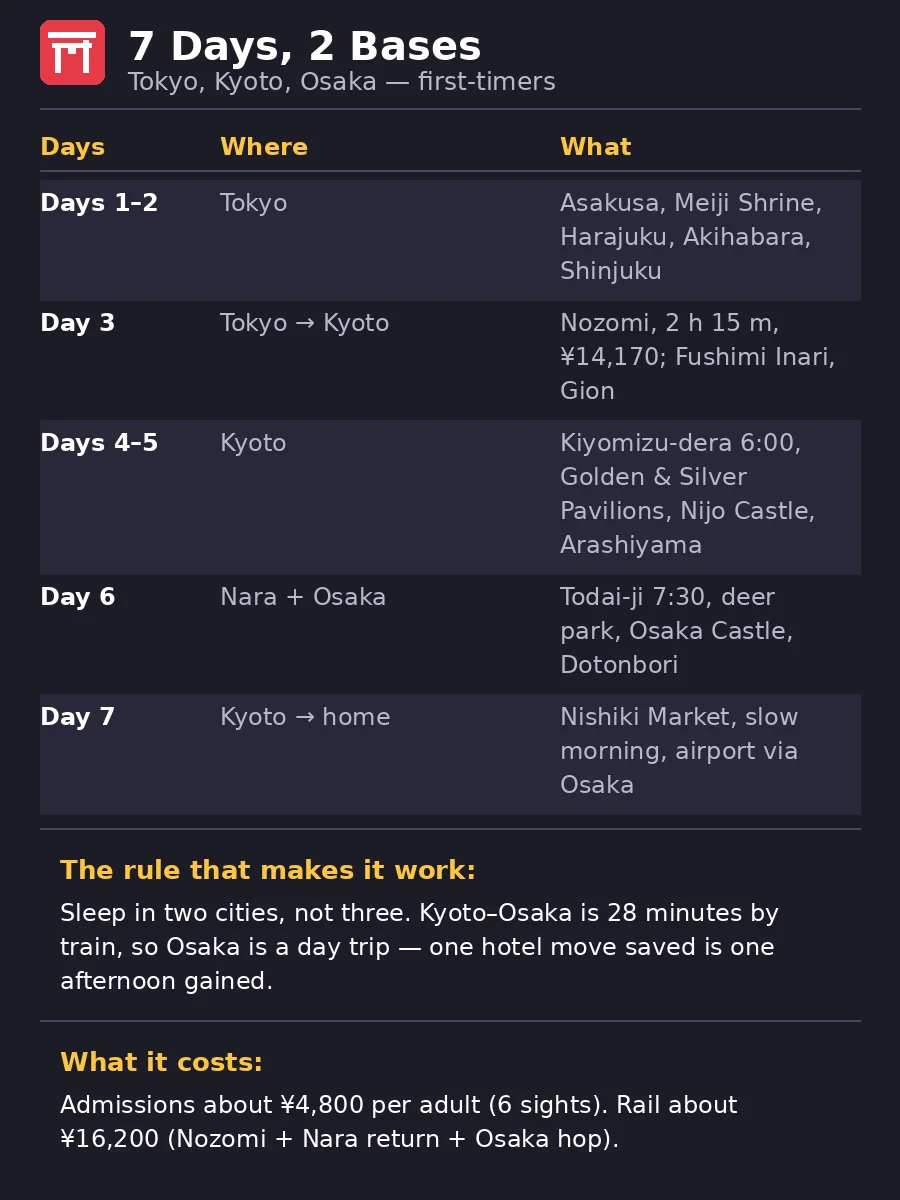
Japan 7-Day Itinerary for First-Timers in Short
- Days 1–2: Tokyo — Asakusa and Senso-ji, Meiji Shrine in Shibuya, Harajuku, Akihabara, and Shinjuku at night.
- Day 3: Nozomi to Kyoto, about 2 hours 15 minutes (JR Central, 2026), Fushimi Inari in the afternoon, Gion after dark.
- Days 4–5: Kyoto — Kiyomizu-dera at 6:00 (2026), the Golden and Silver Pavilions, Nijo Castle, and Arashiyama.
- Days 6–7: Nara and Osaka as day trips from Kyoto, then a slow last morning before the airport.
How Is This Itinerary Built?
Two bases carry the whole week. Tokyo holds nights one and two, Kyoto holds nights three to six, and Osaka never gets a suitcase.
Kyoto and Osaka sit about 28 minutes apart by train (JR West, 2026), so a Kyoto base covers both. Moving hotels for one Osaka night would cost an afternoon of packing for nothing.
Mornings start at opening time, because the crowds arrive an hour later. Afternoons stay loose, so a missed train or a long lunch never breaks the day.
Day 1: Tokyo — Arrive and Find Your Feet
Land, drop your bags, and head for Asakusa in eastern Tokyo. Senso-ji, the city’s oldest temple, costs nothing to enter, and the Nakamise shopping street leads straight to its gate.
Give the afternoon to the river and the old streets around the temple. Evening belongs to Shibuya, where the crossing outside the station moves more people than most towns hold.
Day 2: Tokyo — Shrines, Streets, and Neon
Morning starts at Meiji Shrine in Shibuya, Tokyo, under a forest canopy in the middle of the city. Its grounds open early and cost nothing, and the walk from Harajuku station sets the pace for the day.
Harajuku follows, one stop of color after the shrine’s calm. Akihabara comes next for electronics and arcades, and Shinjuku closes the day with neon, ramen, and the city’s biggest station crowds.
Ride the Yamanote line loop between the day’s stops and the city does the navigating for you. Stations sit beside every stop in this plan, and one IC card covers the trains, the subway, and the buses.
Day 3: Tokyo to Kyoto — The Shinkansen Morning
Check out after breakfast and walk to Tokyo Station for the shinkansen. A reserved Nozomi seat to Kyoto costs ¥14,170 in the regular season and takes about 2 hours 15 minutes (JR Central, 2026).
Slower trains cost less and still arrive before lunch. The Hikari runs the same route for ¥13,850 in about 2 hours 40 minutes, and the Kodama takes about four hours (JR Central, 2026).
Drop your bags in Kyoto and head straight for Fushimi Inari in the south of the city. Its vermilion gates run up the mountain for free, and the climb thins the crowds with every flight of steps.
Evening belongs to Gion, the old entertainment district in eastern Kyoto. Walk its lanes after dark, keep your voice down on the residential streets, and leave the geiko spotting to luck.
Day 4: Kyoto — The 6:00 Start
Set an alarm for 5:30 and reach Kiyomizu-dera in eastern Kyoto as its gates open at 6:00. Admission is ¥500 for adults, and the wooden stage over the city is nearly empty at that hour (2026).
Walk downhill through the old lanes of Sannenzaka and Ninenzaka toward the center. Kinkaku-ji, the Golden Pavilion in northwest Kyoto, opens at 9:00 and charges ¥500 for adults (2026).
Cross the city to Ginkaku-ji, the Silver Pavilion at the north end of the Philosopher’s Path. Admission doubled to ¥1,000 on 1 April 2026, the first rise in 32 years, and the temple opens at 8:30 from March to November.
Day 5: Kyoto — Castle Morning, Bamboo Afternoon
Nijo Castle in central Kyoto opens the day, with its painted corridors and the Ninomaru Palace inside. Entry costs ¥800, or ¥1,300 with the palace, and the last admission is 16:00 (2026).
Afternoon belongs to Arashiyama in western Kyoto and its bamboo grove. The grove itself is free, and the river walk below it makes the best slow hour of the week.
End the day back in central Kyoto with dinner on Pontocho Alley, the narrow lane along the river. Restaurants there book out early, so arrive before the evening crowd or reserve ahead.
Day 6: Nara in the Morning, Osaka in the Afternoon
Catch the JR Miyakoji Rapid from Kyoto Station to Nara, about 45 minutes for ¥720 (JR West, 2026). Todai-ji opens at 7:30 from April to October, and its Great Buddha Hall charges ¥800 for adults (2026).
Bring cash: each of Todai-ji’s four halls takes ¥800 (Todai-ji, 2026) and none takes cards. Nara Park outside is free, and its deer numbered 1,687 in the July 2026 census (Nara Deer Preservation Foundation, 2026), a record since 1953.
Feed the deer only the official shika senbei crackers, about ¥200 a bundle (Time to Japan, 2026). Ride on to Osaka for the castle, then Dotonbori after dark, and catch the 28-minute train back to Kyoto to sleep (JR West, 2026).
Osaka Castle’s Main Tower costs ¥1,200 for adults, double the ¥600 older guides still quote. Around it, the park is free and open at all hours, and the tower closes at 18:00 with last entry at 17:30 (2026).
Day 7: Kyoto Morning, Then Home
Keep the last morning slow. Nishiki Market in central Kyoto fills a relaxed hour of tasting, and Fushimi Inari waits for anyone who skipped it on day three.
Leave Kyoto by early afternoon and ride to the airport through Osaka. One last look back at the mountains from the train window is the right way to end the week.
What Does This Itinerary Cost?
Add up the paid sights and the number stays small. Kiyomizu-dera, Kinkaku-ji, Ginkaku-ji, Nijo Castle, Todai-ji, and Osaka Castle together cost about ¥4,800 in admission fees for one adult.
Rail legs add about ¥16,200: the Nozomi to Kyoto, the Nara return, and the Osaka hop. Full budgets for each style of travel sit in the Japan trip cost 2026 guide.
Children pay less at every sight in this plan, and the youngest enter free at several of them.
Seven days is short, and this plan spends them where they count. Early mornings go to the temples, slow afternoons to the old streets, and one bright night to each city.
Pack light, start early, and let the trains do the rest. Before you book, check the Japan visa 2026 guide for entry rules and the Japan trip cost 2026 guide for budgets.
Methodology
Every time, fee, and fare in this plan was checked against the venue or operator page, or against two independent 2026 guides. Opening hours and fees change with the season, so confirm each one on the official page before you go.
An AI-assisted first draft was checked by hand against every source in References.
Frequently Asked Questions
Is 7 days enough for Tokyo, Kyoto, and Osaka?
Yes, with two bases and early mornings. Tokyo takes two days, Kyoto takes three with Nara and Osaka as day trips, and the seventh day is a slow departure.
Should I stay in Osaka too?
No, unless your flight leaves very early. One Kyoto base covers both cities, and the 28-minute train saves a hotel move.
Do I need the JR Pass for this itinerary?
Probably not. Nozomi one-way fares run ¥14,170, and the local day trips are cheap, so add up your rides against the ¥50,000 pass (JR, 2026) before buying.
What time should I start each day?
At opening time for the big temples: 6:00 at Kiyomizu-dera, 7:30 at Todai-ji from April to October (2026). Afternoons can stay loose, because the crowds thin after 16:00.
How much cash should I carry?
More than you think. Todai-ji takes cash only, many temples take cash at the gate, and small restaurants and shrines often do too.
References
- Kiyomizu-dera — Official Site
- Todai-ji — Official Site
- Osaka Castle — Official Site
- Japan Rail Pass — Official Site
- Visa Fees — Ministry of Foreign Affairs of Japan
- smartEX Service Prices (Reserved Seat in Ordinary Cars) — JR Central
- Nara Deer Population Hits Record High — Discover Nara
- Nara Park — Time to Japan